



Over 56% of U.S. consumers begin their product search on Amazon — yet most sellers are quietly bleeding ad spend on campaigns that were never built to win.
If you've ever stared at a climbing ACoS and wondered where your margins went, you already know the problem. Running an Amazon advertising campaign without a disciplined, data-driven strategy is like filling a leaking bucket — no matter how much budget you pour in, the ROI never holds.
The good news? The brands that are scaling profitably in 2025 aren't working harder — they're working smarter, using structured campaign frameworks, buyer-intent intelligence, and AI-powered automation to do what manual management simply can't.
This guide breaks down 10 proven strategies to transform your Amazon advertising campaigns from a cost center into a compounding growth engine — and shows you exactly how purpose-built AI tools make every step effortless.
🚀 Stop guessing. Start winning with 24/7 AI-powered bid optimization.
Launch Your Free AdAstraa Trial →
1. Build a Bulletproof Campaign Architecture First
The single most overlooked reason Amazon sellers struggle with profitability is poor campaign structure. Before you touch a bid, you need a logical, scalable foundation.
The most effective framework used by 7- and 8-figure brands relies on Single Product Ad Groups (SPAGs) — isolating each ASIN in its own ad group so you get granular control over budget, bids, and negative keyword targeting. This eliminates the cannibalization that kills performance in bloated, catch-all campaigns.
Segment by Match Type from Day One
Separate your Broad, Phrase, and Exact match campaigns. Broad campaigns are discovery engines — they find new converting search terms. Phrase and Exact campaigns are profit engines — they harvest and scale what already converts.
Mixing match types in a single campaign is one of the most essential mistakes to avoid. It makes attribution murky and optimization nearly impossible. Structure first, scale second.
Learn how AdAstraa's Amazon PPC guide walks you through campaign architecture that's built to scale from day one.
2. Master Negative Keywords to Eliminate Wasted Spend
If there's one game-changing lever in Amazon PPC that most sellers under-use, it's aggressive negative keyword management. Non-converting clicks are the silent killer of your ACoS.
The rule is deceptively simple: any keyword with 10 or more clicks and zero sales should be added as a negative exact immediately. Don't wait. Every additional click is wasted budget that could fund a winning keyword.
Apply a Tiered Negative Keyword System
- Negative Exact: Block specific irrelevant terms that have consumed spend with zero conversion.
- Negative Phrase: Block entire topic clusters that are structurally misaligned with your product.
- Campaign-level vs. Ad Group-level: Prevent cross-contamination between your discovery and harvesting campaigns.
Done manually, this is a weekly three-hour chore. With AI-powered advertising automation, AdAstraa's Autopilot continuously scans for non-converting search terms and applies negative targeting in real time — 24 hours a day, 7 days a week.
3. Use a Data-Driven Bid Strategy, Not Amazon's Default
Amazon's suggested bids are designed to maximize Amazon's revenue — not yours. Relying on them is one of the most costly default decisions a seller can make.
Your starting bid should be anchored to your Target ACoS. The formula is straightforward: Max CPC = (Conversion Rate × Average Order Value) × Target ACoS. This grounds every bid decision in actual profitability math, not platform suggestions.
Leverage Dynamic Bidding with Purpose
Dynamic Bids – Down Only is the safest default for most campaigns: Amazon lowers your bid when a conversion is less likely. As you build confidence in your data, Dynamic Bids – Up and Down can dramatically increase impression share on high-intent placements.
The real breakthrough comes when AI handles bid adjustments at a keyword level, every hour, based on real-time conversion probability — not a weekly manual review. That's precisely what AdAstraa's Autopilot delivers.
4. Build a Systematic Keyword Harvesting Pipeline
Auto campaigns are not a set-it-and-forget-it tactic — they're your most powerful keyword discovery machine when used correctly. The essential discipline is to harvest and promote converting search terms on a consistent cycle.
Any search term generating 2 or more orders in your Auto or Broad campaign should be promoted to a Manual Exact campaign with a competitive bid. Then, add that term as a Negative Exact in the source campaign to prevent bidding on both simultaneously.
Layer Your Keyword Architecture for Long-Term Growth
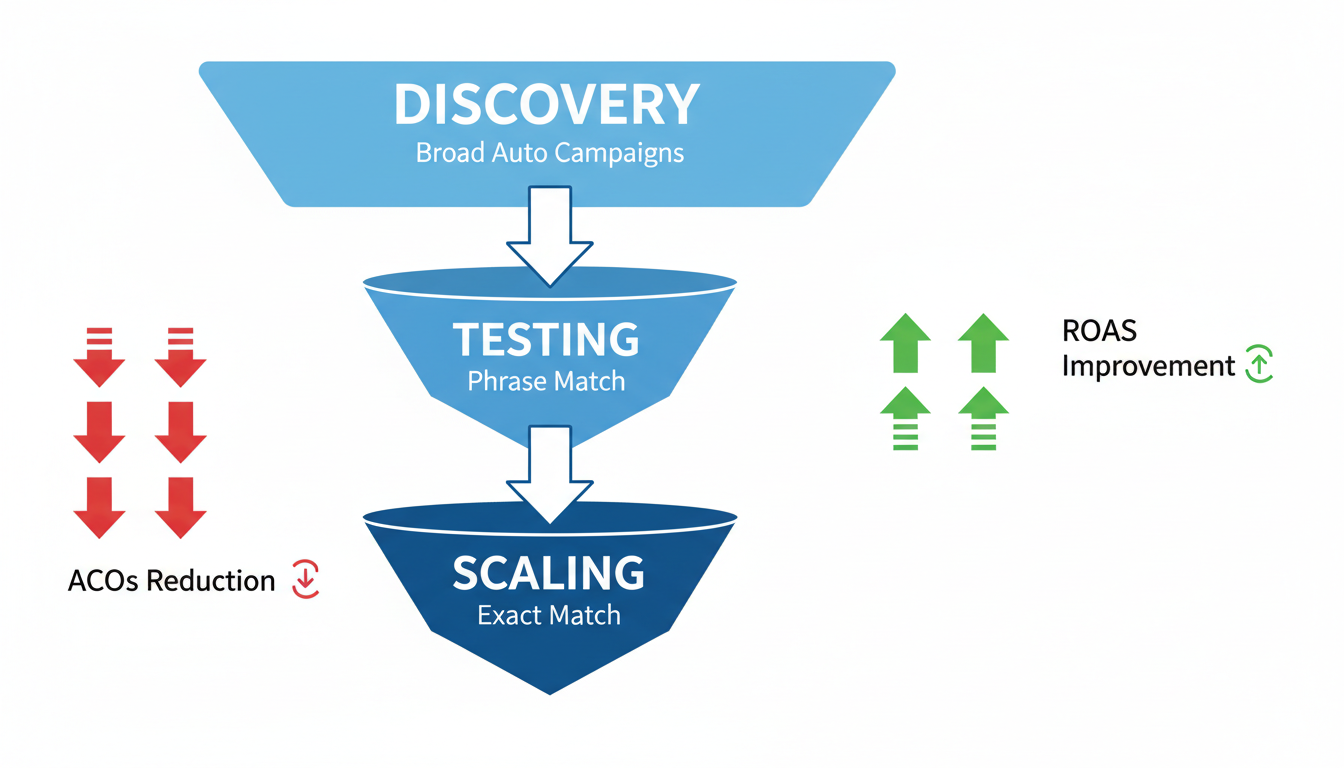
Think of your keyword ecosystem in three tiers: Discovery (Auto + Broad), Testing (Phrase), and Scaling (Exact). Terms flow upstream as they prove themselves. This disciplined funnel ensures every dollar you spend on discovery has a clear path to becoming a profitable, protected keyword.
AI-driven keyword harvesting — as built into AdAstraa's platform — eliminates the latency of weekly manual reviews. New converting terms are captured and escalated in hours, not days, giving your campaigns a compounding edge that manual management simply cannot match.
5. Target Buyer Intent, Not Just Search Volume
High search volume is seductive but dangerous. A keyword searched 50,000 times per month means nothing if those searchers are browsers, not buyers. The most powerful Amazon advertising strategy is to build campaigns around high-intent buyer language — terms that signal purchase readiness, not just curiosity.
"The sellers who are winning right now are not spending more. They're spending on terms that match how buyers actually phrase their searches — increasingly conversational and intent-driven."
AdAstraa's Shopper OS provides real-time buyer intent intelligence, surfacing the exact language patterns that precede purchases in your category. This means your campaigns target converting intent — not vanity impressions. Explore how Shopper OS maps buyer intent across your entire Amazon catalog.
6. Set Campaign-Specific ACoS Targets Based on Product Lifecycle
One of the most sophisticated — yet must-know — shifts serious Amazon advertisers make is abandoning the idea of a single, account-wide ACoS target. Different products in different lifecycle stages demand fundamentally different ACoS tolerances.
| Product Stage | Campaign Goal | Acceptable ACoS Range |
|---|---|---|
| New Launch | Rank & Visibility | 40–80% (invest in rank) |
| Growth Phase | Market Share & Reviews | 25–40% |
| Maturity / Profit Phase | Margin Optimization | 10–25% |
| Clearance | Velocity & Inventory Flush | Variable — ROAS-focused |
When you know your true margin per ASIN — including FBA fees, COGS, and returns — you can set ACoS targets that are actually meaningful. AdAstraa's True Profit per ASIN dashboard makes this visible in real time, so you're always optimizing toward actual profitability, not just ad metrics.
7. Diversify Across Sponsored Products, Brands, and Display
Sellers who rely exclusively on Sponsored Products are leaving a significant share of the customer journey unaddressed. An essential component of a mature Amazon advertising strategy is leveraging all three ad types in concert.
- Sponsored Products: Your workhorse for direct conversion. High-intent, bottom-of-funnel. Prioritize here first.
- Sponsored Brands: Powerful for brand awareness and intercepting competitor searches. Headline Search ads with video dramatically outperform static formats.
- Sponsored Display: Remarketing gold. Re-engage shoppers who viewed your product or competitor ASINs but didn't convert. Often the highest ROAS in a well-structured account.
The most powerful campaigns use all three ad types to build a full-funnel presence — from the first search impression to the final remarketing nudge that closes the sale.
8. Invest in High-Converting Ad Creatives That Outperform Competitors
Even a perfectly optimized bid strategy fails if the creative doesn't convert. Your main image, headline, and A+ content are doing the heavy lifting before a single click is paid for — and yet most brands treat creative as an afterthought.
The step-by-step creative optimization approach: start with your main product image (it drives click-through rate more than any other element), then refine your title for keyword-plus-benefit structure, then test your A+ content modules for conversion lift.
How AI Makes Creative Testing Effortless
AdAstraa's AdCreative+ generates conversion-optimized ad creatives, A+ content modules, and banner variations using AI — allowing you to test multiple creative angles simultaneously without hiring a design team. Brands using AdCreative+ report measurable CTR improvements within the first campaign cycle.
Explore how AdCreative+ generates AI-powered ad visuals tailored specifically for Amazon's most competitive ad placements.
⚡ Let AI generate your next high-converting Amazon ad creative in minutes.
Try AdCreative+ Free Today →9. Optimize Dayparting and Budget Allocation for Peak Hours
Not all hours of the day convert equally. Sophisticated Amazon advertisers use dayparting — adjusting bids or pausing campaigns during low-conversion windows — to concentrate spend where it delivers the strongest ROAS.
The reality is that most categories see peak conversion rates in the evening hours (7 PM–11 PM) and weekend afternoons. Meanwhile, early-morning impressions in competitive categories often drive up CPCs without proportionate conversion volume. Budget burned at 3 AM is budget that could have won a 9 PM sale.
Smart Budget Pacing Protects Peak Performance Windows
Campaigns that exhaust their daily budget by early afternoon go dark during peak evening hours — one of the most preventable causes of lost sales. The guaranteed fix is intelligent budget pacing that holds budget in reserve for high-conversion windows.
AdAstraa's Autopilot incorporates dayparting intelligence into its 24/7 bid optimization engine, automatically conserving budget during low-intent periods and aggressively capturing high-intent traffic when conversion probability is highest.
10. Implement Full-Stack AI Campaign Management to Scale Without Limits
Here's the honest truth: executing all nine strategies above manually — across 50, 100, or 500 ASINs — is operationally impossible without sacrificing quality or burning out your team. The brands that are compounding their Amazon advertising performance in 2025 have made a fundamental shift: they've replaced manual campaign management with AI-powered advertising software.
According to industry data, the right Amazon PPC automation tool reduces campaign management time from 15+ hours per week to under 2 hours, while simultaneously improving ROAS by 25–40% through continuous, data-driven optimization that human managers simply cannot replicate at scale.
The AdAstraa Advantage: A Real-World Example
Consider a mid-size FMCG brand managing 120 ASINs across four Amazon marketplaces. Before AI automation, their team spent 18+ hours weekly on manual bid adjustments, keyword reviews, and reporting — and ACoS still hovered at 38%. After deploying AdAstraa's Autopilot combined with Shopper OS buyer intent intelligence, their management overhead dropped to under 3 hours weekly. ACoS fell to 22% within 60 days as non-converting keywords were systematically eliminated and bids were dynamically calibrated to actual purchase probability — not guesswork.
AdAstraa's four purpose-built AI tools work in concert to deliver this outcome at scale:
- Autopilot: 24/7 bid optimization that responds to real-time market signals — no rules to set, no manual adjustments required.
- Shopper OS: Buyer intent intelligence that ensures your campaigns target purchase-ready customers, not browsers.
- EcomGPT: Automated customer operations that reduce support overhead and protect seller ratings — freeing your team to focus on growth strategy.
- AdCreative+: AI-generated ad creatives and A+ content that test, iterate, and optimize without requiring a design agency.
Explore the full suite on the AI advertising strategies page to see how each tool integrates into a single, unified campaign management platform.
What Happens When You Combine All 10 Strategies
These strategies don't operate in isolation — they compound. A brand with strong campaign architecture benefits exponentially more from negative keyword automation. A brand with buyer-intent targeting converts its ad creative investment at a dramatically higher rate. The whole is far greater than the sum of its parts.
The common thread connecting top-performing Amazon advertising campaigns in 2025 is this: systematic discipline powered by AI velocity. Humans set the strategy; AI executes it at a scale and speed that makes manual management structurally obsolete.
For D2C brands, FMCG sellers, and ad agencies managing multiple Amazon accounts, this isn't just an efficiency upgrade — it's the difference between scaling profitably and plateauing with rising ad costs and declining margins.
See how brands have used AdAstraa's AI advertising platform to achieve breakthrough results across categories.
Additional Resources
Deepen your understanding of Amazon advertising campaign management and AI-driven marketing with these authoritative references:
- Amazon Ads: Understanding ACoS (Advertising Cost of Sales) — Official Amazon Ads guide explaining how to calculate, interpret, and optimize your ACoS across campaign types.
- FTC Endorsement Guides for Digital Advertising — Federal Trade Commission — Essential compliance reference for brands running Amazon sponsored ads and influencer-based campaigns.
- How to Design an AI Marketing Strategy — Harvard Business Review — Strategic framework for integrating AI tools into your broader marketing and advertising operations.
- Amazon Ads Explained — About Amazon (Official) — A plain-language overview of the Amazon advertising ecosystem for brands of all sizes.
- Amazon Advertising Research & Insights — eMarketer — Up-to-date market data, ad spend projections, and competitive intelligence for Amazon advertisers.
The Bottom Line: Strategy + AI Is the Only Scalable Path Forward
The Amazon advertising landscape in 2025 rewards precision, speed, and intelligence. CPC rates have surged across most major categories, competition has intensified, and Amazon's own AI-driven search engine (Rufus) now directly influences which ads surface and convert.
Manual management isn't just inefficient anymore — it's a structural disadvantage. The brands winning at scale have stopped trying to out-manage their competitors manually. They've chosen to out-optimize them systematically, using proven campaign frameworks powered by AI tools that never sleep.
The 10 strategies in this guide give you the foundation. AdAstraa gives you the ultimate infrastructure to execute them at scale — lowering ACoS, boosting ROAS, and reclaiming the management hours your team deserves to spend on growing your brand, not babysitting bids.
Ready to slash your ACoS and scale your Amazon advertising?
Join Amazon-first brands using AdAstraa's AI-powered campaign management to win more — and spend less doing it.
Start Your Free Trial — No Credit Card Required →