
Right now, the average Amazon seller is flushing 30–40% of their entire ad budget down the drain — on keywords that will never convert, on campaigns that have never been truly optimized, on bids placed by gut feeling rather than data. With Amazon's ad revenue surging past $56.2 billion in 2024, the battlefield has never been more crowded or more expensive.
The brands that win aren't spending more. They're spending smarter — with precision targeting, AI-powered campaign structures, and real-time optimization that never sleeps. If you want to stop bleeding ad budget and start building a campaign architecture that actually scales, you're in the right place.
This guide breaks down 10 essential, battle-tested Amazon advertising campaign management strategies — from campaign architecture to AI-driven bid logic to creative performance — that are delivering measurable results for D2C brands, FMCG sellers, and ad agencies in 2025.
⚡ Stop guessing. Start optimizing. AdAstraa's AI engine works 24/7 to eliminate wasted spend and maximize every rupee of ad budget.
Launch Your Free Campaign Audit →
Why Most Amazon Advertising Campaigns Silently Fail
The brutal reality is that most Amazon sellers structure their campaigns the same way they did three years ago — and the platform has fundamentally changed. With CPC costs rising 15% year-over-year and thousands of new competitors launching campaigns daily, yesterday's strategy is today's budget drain.
Three critical failure points destroy Amazon advertising campaign performance before it ever gets a chance to succeed:
- Flat-bid campaigns — setting one bid and walking away, regardless of hour, device, or search intent.
- Keyword bloat — hundreds of irrelevant, non-converting terms silently consuming budget.
- Zero segmentation — mixing brand, category, and competitor keywords in a single ad group, making optimization impossible.
Understanding these failure modes isn't just academic — it's the foundation of every proven strategy in this guide. Let's start building the right way.
Strategy 1: Build a Tiered Campaign Architecture That Actually Scales
The single most powerful structural decision you can make is separating your campaigns by intent tier — not just match type. Most sellers create campaigns by product, then layer in all keyword types together. This approach is a guaranteed path to inflated ACoS.
The Three-Tier Campaign Structure
Structure your campaigns around three distinct buyer intent signals: brand terms (highest conversion, lowest CPC), category keywords (mid-funnel discovery), and competitor conquesting (high-CPC, strategic spend). Each tier gets its own campaign, its own budget, and its own optimization targets.
This segmentation unlocks a critical benefit — you can set aggressive bids on proven brand converters while keeping exploratory category spend tightly capped. Brands using this structure with AdAstraa's Amazon PPC guide framework routinely see ACoS drop by 18–25% within the first 60 days, simply from reorganization alone.
Within each tier, never mix Sponsored Products with Sponsored Brands. They serve different funnel positions and dilute each other's data when bundled together.
Strategy 2: Leverage AI-Powered Bid Optimization for 24/7 Campaign Control
Human bid management has a hard ceiling. You check campaigns once or twice a day. Amazon's auction happens millions of times per second. The gap between your last optimization and the next buyer's search is where money disappears.
AI-powered bid optimization eliminates that gap entirely. Platforms like AdAstraa's Autopilot feature for AI advertising continuously adjust bids based on real-time signals: time of day, day of week, conversion velocity, inventory levels, and competitive pressure — all simultaneously.
The Bid Signals That Matter Most
Not all bid signal inputs carry equal weight. Research consistently shows that hour-of-day conversion variance can shift purchase probability by up to 40% within the same keyword. AI systems that incorporate this signal alone outperform static rule-based systems by significant margins.
AI-powered tools have been shown to outperform traditional rule-based systems by 26% in annual efficiency, with most implementations achieving positive ROI within just 30–45 days. That's not a future promise — that's today's documented baseline.
"With AI tools now optimizing 61% of all active Amazon campaigns, brands still relying on manual bid management aren't just falling behind — they're actively funding their competitors' growth."
Strategy 3: Eliminate Wasted Spend with Aggressive Negative Keyword Harvesting
If you only implement one strategy from this entire guide, make it this one. Negative keyword harvesting is the single fastest way to immediately reduce ACoS without touching a single bid or launching a new campaign. It's unglamorous. It's mechanical. And it is devastatingly effective.
A well-managed negative keyword list acts as a permanent filter — continuously preventing budget from flowing to search terms that have statistically demonstrated they will not convert for your specific product. This isn't a one-time task; it's a weekly discipline that compounds in value over time.
The Auto-to-Manual Pipeline
Run automatic targeting campaigns as permanent data-mining tools. Every week, pull the Search Term Report, identify terms that generated clicks but zero conversions over a meaningful sample size (typically 15+ clicks), and add them as exact-match negatives to your manual campaigns. Simultaneously, promote high-converting search terms into dedicated exact-match campaigns where you control the bid precisely.
This pipeline — automatic campaigns feeding data into manual campaigns — is the backbone of every high-performance AI advertising strategy that consistently delivers sub-20% ACoS.
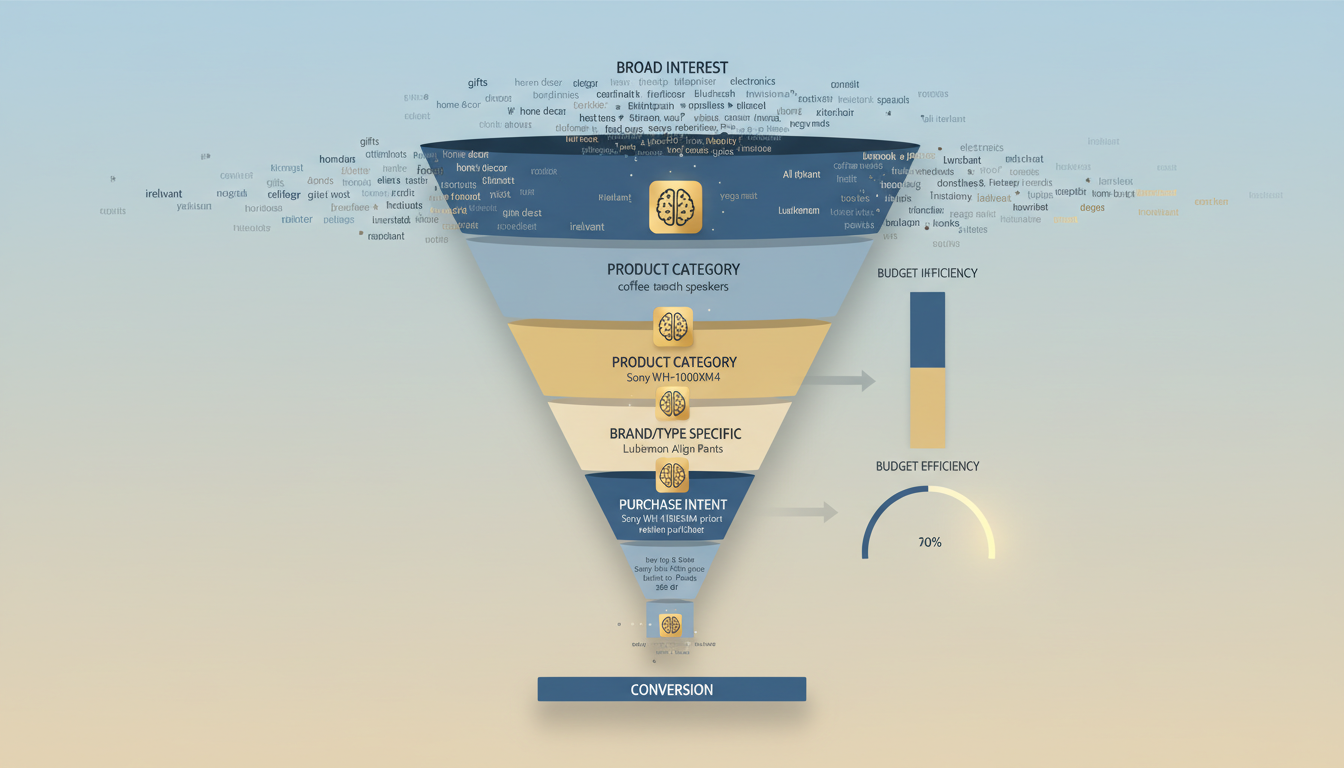
Strategy 4: Use Buyer Intent Intelligence to Target the Right Shoppers
Standard keyword targeting answers one question: what did a shopper type? Buyer intent intelligence answers a deeper, more powerful question: what does this shopper intend to do? These are fundamentally different inputs — and the brands that can read intent rather than just text have a game-changing edge.
AdAstraa's Shopper OS platform processes behavioral signals beyond the keyword itself — browsing patterns, category navigation sequences, comparison behaviors — to identify which shoppers are in high-purchase-probability states. When your bids prioritize these signals, your ad spend naturally concentrates where conversion is most likely to occur.
Segmenting by Purchase-Ready Intent Signals
The most overlooked intent signal on Amazon is product page visit recency. A shopper who visited your product page two days ago and then searched again is statistically 3–5x more likely to convert than a cold-impression shopper. Remarketing sequences via Sponsored Display that prioritize these high-recency audiences can dramatically lower your effective CPA without increasing total spend.
Combine this with seasonal intent modeling — identifying when your category's purchase intent peaks during the year — and you have a sophisticated, data-driven targeting layer that most competitors cannot replicate manually.
Strategy 5: Structure Ad Groups Around Single-Keyword Themes for Precise Control
Multi-keyword ad groups feel efficient to build and are catastrophic to optimize. When ten keywords share one bid, you're using the average performance of all ten to set the bid for each individual one — a structurally broken approach that guarantees you're overbidding on weak terms and underbidding on strong ones simultaneously.
The breakthrough shift is moving toward Single Keyword Ad Groups (SKAGs) for your top-performing terms. Each proven converting keyword gets its own ad group, its own bid, and its own performance history. This gives you surgical control — the ability to scale what works without subsidizing what doesn't.
Yes, this creates more campaigns to manage. That's exactly why AI-powered campaign management tools exist — to handle the operational complexity at scale while you focus on strategy.
Strategy 6: Optimize Ad Creative with AI-Generated, Data-Backed Assets
Amazon's advertising landscape is increasingly visual. Sponsored Brand ads, video creatives, and A+ Content modules now play a direct role in conversion rate — and therefore in the true cost-per-acquisition of every campaign you run. Weak creative is a silent ACoS killer that bid optimization alone cannot fix.
AI ad creative generation has reached a point where it consistently outperforms static, human-only designs — not because AI is more creative, but because AI tests more permutations faster. AdAstraa's AdCreative+ tool generates performance-optimized ad visuals by analyzing what's historically driven conversions in your specific category, then producing assets aligned to those proven patterns.
A Systematic Creative Testing Framework
Test one variable at a time: headline copy, primary image, lifestyle versus white-background product shot, or CTA phrasing. Give each variant a statistically significant impression count (minimum 2,000–3,000 impressions) before drawing conclusions. The winning variant becomes the new control — and the testing cycle repeats.
Brands that maintain an always-on creative testing culture consistently outperform category averages on CTR by 20–35%. Higher CTR means more traffic at the same CPC — which is the most efficient way to grow revenue without growing budget.
Strategy 7: Track True Profit Per ASIN — Not Just ACoS — for Smarter Budget Decisions
ACoS is not your profitability metric. It never was. ACoS measures the ratio of ad spend to ad-attributed revenue — it tells you nothing about margin, fulfillment cost, return rates, or the organic sales halo that advertising creates. Brands that optimize for ACoS alone routinely make decisions that improve their scorecard while quietly destroying their bottom line.
The metric that actually matters is True Profit per ASIN — what you actually keep after product cost, FBA fees, return processing, ad spend, and platform fees are all accounted for. This number tells you which products in your catalog deserve more ad investment and which are being subsidized by your winners.
TACoS as the True Health Indicator
Total Advertising Cost of Sales (TACoS) — ad spend as a percentage of total revenue, not just ad-attributed revenue — gives you a far more honest picture of advertising efficiency. Healthy Amazon advertising benchmarks in 2025 sit at TACoS between 10–15% for mature product lines. Products with TACoS climbing above 20% are signaling either weak organic rank or unsustainable ad dependency.
Use TACoS trajectory over 90-day rolling windows to make scaling decisions. A product with declining TACoS while growing total revenue is generating organic lift from advertising — a powerful signal to increase investment. A product with rising TACoS and flat revenue is a drain to deprioritize.
Strategy 8: Automate Customer Operations to Convert Ad Traffic More Efficiently
Most Amazon advertising guides stop at the click. But the conversion funnel doesn't end when a shopper reaches your product page — it extends through every post-purchase touchpoint. Review velocity, question response time, and seller feedback scores all directly influence your product's organic rank and conversion rate, which in turn determines how hard your ad spend has to work.
Slow response to buyer questions kills conversion. A shopper who asks a question and waits 48 hours for an answer has almost certainly already purchased from a competitor. AI-powered customer operations tools like AdAstraa's EcomGPT platform automate personalized, accurate responses within seconds — not hours — dramatically improving the conversion environment that your ad spend is driving traffic into.
Think of it this way: better post-click conversion means lower effective CPA from the same ad budget. A 10% improvement in conversion rate is mathematically equivalent to a 10% reduction in CPC — with zero additional ad spend required.
Strategy 9: Build a Real-World Budget Allocation Model Based on Proven Performance Data
Budget allocation on Amazon is where strategy meets math. Most sellers allocate budgets based on intuition, historical inertia, or simply copying last month's numbers. The step-by-step approach that genuinely works is performance-based portfolio budgeting — treating your campaign portfolio like an investment portfolio.
The Portfolio Budgeting Framework
Classify every campaign in your account into one of four categories: Scale (high ROAS, growing revenue — invest aggressively), Maintain (steady ROAS, stable revenue — hold spend level), Test (new campaigns with insufficient data — allocate limited discovery budgets), and Pause (consistently below breakeven ACoS with no improvement trend — stop spending immediately).
Reassign budgets quarterly based on this classification. The effect is a natural capital flow toward your most efficient campaigns and away from your underperformers — without requiring individual campaign-level intuition to drive every decision.
📊 Real-World Example: FMCG Brand Restructure
An FMCG brand managing 47 active campaigns audited their portfolio using this framework and discovered that just 9 campaigns (19% of total) were generating 74% of profitable revenue. By reallocating the budget from the bottom 25 underperforming campaigns to the top 9 performers, they reduced total ad spend by 18% while growing ad-attributed revenue by 31% — a 59% improvement in overall ROAS in a single quarter.
Strategy 10: Consolidate Campaign Management on an All-in-One AI Advertising Platform
Fragmented tools are one of the most underappreciated sources of campaign performance loss. When your keyword research lives in one tool, your bid management in another, your creative production in a third, and your analytics in a spreadsheet — you lose the compound intelligence that emerges when all these data streams talk to each other.
An all-in-one AI advertising platform integrates every layer of campaign management into a single operating environment. Bid decisions are informed by creative performance data. Keyword expansion is guided by conversion analytics. Budget reallocation happens automatically in response to real-time performance signals — not after a weekly review meeting.
This is the operating model that separates category leaders from average performers. Explore AdAstraa's full suite of AI-powered advertising tools to see how each capability reinforces the others in a unified campaign management system.
🚀 Ready to unify your entire Amazon ad stack? AdAstraa's platform connects Autopilot, Shopper OS, EcomGPT, and AdCreative+ into one powerful campaign management engine.
Explore the Full AdAstraa Platform →Amazon Advertising Benchmarks You Should Actually Be Hitting
Before you can optimize, you need a clear, honest picture of where you stand relative to platform-wide performance norms. The following benchmarks reflect aggregated 2025 data across categories and represent healthy, achievable targets for brands with optimized campaign structures:
| Metric | Healthy Benchmark | Warning Zone |
|---|---|---|
| ACoS | 20–32% | Above 40% |
| ROAS | 3.0x – 5.0x | Below 2.5x |
| TACoS | 10–15% | Above 20% |
| CTR (Sponsored Products) | 0.40% – 0.70% | Below 0.35% |
| Conversion Rate | 10–12% | Below 7% |
| CPC | $1.18 – $1.22 (avg) | Category-dependent |
These benchmarks are starting points, not ceilings. The brands consistently operating above these benchmarks share one common trait: they are running AI-assisted campaign management with continuous optimization cycles, not weekly or monthly manual reviews.
Additional Resources
Deepen your Amazon advertising knowledge with these authoritative external references:
- Amazon Ads: Official Sponsored Products Best Practices Guide — Amazon's own framework for campaign structure, bidding strategy, and targeting optimization for Sponsored Products.
- Amazon Ads: AI Marketing Trends 2025 — Expert Perspectives — An official interview with Amazon Ads' VP of Creative Experiences on the future of AI-powered advertising tools.
- Adweek: Amazon's 2024 Ad Revenue Hits $56 Billion — Adweek's analysis of Amazon's advertising business growth and what it means for sellers and brands competing on the platform.
- Triple Whale: Amazon Ads Benchmarks by Industry (Updated Data) — Industry-level CPA, ROAS, CVR, and CPM benchmarks across Amazon ad categories with current performance data.
- Sequence Commerce: Amazon Advertising Benchmarks 2026 — A detailed breakdown of ACoS, CPC, CTR, and conversion rate benchmarks by product category for current Amazon advertising performance.
The Bottom Line: Smarter Amazon Advertising Campaign Management Starts Now
The 10 strategies in this guide are not theoretical aspirations. They are the operational reality of how category-leading Amazon brands build and manage advertising campaigns in a marketplace that grew to $56.2 billion in ad revenue in 2024 — and is projected to reach $88.6 billion by 2026. The stakes have never been higher. The tools have never been more powerful.
The gap between brands winning on Amazon and those slowly bleeding budget comes down to one essential difference: systematic, AI-assisted campaign management versus ad hoc, manual optimization. The former compounds over time. The latter creates an exhausting treadmill of incremental fixes that never reach true efficiency.
You now have the complete framework. Tiered campaign architecture. AI bid optimization. Negative keyword discipline. Intent-based targeting. Creative testing. True profit measurement. Automated operations. Portfolio budgeting. And an integrated platform that makes all of it work together.
The only question is: when do you start? Visit our AdAstraa case studies page to see exactly how brands like yours have implemented these strategies for measurable, documented results.
Your Most Profitable Amazon Campaign Is One Decision Away
Join 1,500+ brands already running on AdAstraa Autopilot — with 24/7 AI optimization, buyer intent intelligence, and proven creative generation working for them around the clock.
Get Started with AdAstraa — Free →