



Amazon generated $56.2 billion in advertising revenue in 2024 — and most brands are leaving a shocking share of that on the table.
If you're an Amazon seller, D2C brand, or FMCG advertiser, here's the uncomfortable truth: running ads on Amazon without a structured strategy is like paying a premium fee at a casino. You might win occasionally, but the house — or more precisely, your competitors — almost always wins.
The good news? The brands that consistently dominate Amazon search results, Best Seller rankings, and DSP placements aren't necessarily spending more. They're spending smarter. This guide breaks down 10 proven, essential Amazon advertising strategies that cover everything from Amazon DSP and mobile advertising to product listing optimization, Amazon Vine, and affiliate programs — giving you a complete, battle-tested blueprint.
Stop burning ad spend on guesswork. AdAstraa's AI-powered Autopilot runs 24/7 bid optimization so you never overpay for a click again.
Start Your Free Trial Today →
1. Master Amazon DSP to Reach Buyers Beyond the Search Bar
Amazon DSP (Demand Side Platform) is one of the most powerful yet underutilized tools in a brand's advertising arsenal. Unlike Sponsored Products that only target in-search shoppers, Amazon DSP lets you reach programmatic audiences — people who have browsed your category, viewed competitor listings, or abandoned carts — across Amazon properties, third-party websites, and streaming platforms.
Amazon's next-generation DSP, updated in late 2024, introduced AI-driven campaign optimization and improved modeled attribution for off-Amazon conversions — a genuine game-changing leap for brands running multi-channel strategies.
Key DSP Audience Targeting Options
- Remarketing audiences: Re-engage shoppers who viewed your ASINs but didn't convert.
- Lifestyle segments: Target consumers based on purchase behavior patterns, not just browsing.
- Competitor conquesting: Serve display ads to shoppers actively browsing rival product pages.
- Streaming TV (STV) ads: Build brand recall via Prime Video and Twitch placements.
Pro tip: Start Amazon DSP campaigns with a frequency cap of 7x per day at the Order level, then adjust based on CTR and conversion data. Set monthly budget caps to ensure consistent pacing throughout your campaign flight.
Explore how AdAstraa's AI advertising suite integrates DSP-level audience intelligence into your daily campaign management.
2. Optimize Product Listings for Both Search Rank and Conversion
Your product listing is the single most essential asset in your Amazon ecosystem. It's where advertising traffic lands — and where it either converts or bounces. Nearly 80% of Amazon sellers now prioritize listing optimization as their top growth lever (Jungle Scout, 2024).
A winning listing isn't just about stuffing keywords into your title. It requires a disciplined, step-by-step approach to every element — title, bullet points, A+ content, backend search terms, and images.
The 5 Must-Optimize Listing Elements
| Element | Best Practice | Impact |
|---|---|---|
| Title | Lead with primary keyword, include brand + key feature | High — A9 ranking signal |
| Bullet Points | Lead with benefit, support with feature | High — conversion driver |
| Images | White BG hero + lifestyle + infographic (min. 3) | Very High — trust + CVR |
| A+ Content | Brand story + comparison modules | Medium — reduces returns |
| Backend Terms | Include misspellings, synonyms, Spanish terms (US) | Medium — invisible SEO lift |
With AdAstraa's AdCreative+, AI-generated listing copy and image recommendations are produced at scale — eliminating the manual bottleneck that slows most brands down during a launch or relaunch.
3. Build a Mobile-First Amazon Advertising Experience
Over 60% of Amazon purchases now originate from mobile devices. Yet most sellers still design their listings, A+ content, and ad creatives with a desktop mindset — a costly and increasingly irreversible mistake.
Mobile advertising on Amazon demands a different visual and copy hierarchy. Your first three bullet points must stand alone as a compelling mini-pitch. Your hero image needs to communicate the product's core value proposition within a 300×300 pixel thumbnail.
Mobile Advertising Optimization Checklist
- ✅ Thumbnail is legible and compelling at 150px wide
- ✅ Title front-loads the most important keyword within first 70 characters
- ✅ Sponsored display ads use lifestyle imagery that renders crisply on OLED screens
- ✅ Video ad hooks land within the first 3 seconds (no logo-first intros)
- ✅ CTA copy on display ads uses action verbs: "Shop Now", "See Why", "Grab Yours"
4. Engineer Your Path to Best Seller on Amazon
Earning a Best Seller badge — whether you're targeting a top selling product in Amazon India or a hyper-competitive US category — isn't luck. It's the result of aligning sales velocity, advertising, pricing, and reviews into a single, compounding growth engine.
Amazon's Best Sellers Rank (BSR) is updated hourly and is relative to competing products in the same subcategory. The proven secret most agencies don't tell you? Subcategory selection is your most powerful BSR lever. A product ranked #5,000 in "Electronics" might rank #12 in "Portable Bluetooth Speakers Under $50."
3 Breakthrough Tactics to Climb BSR Fast
- Launch with a velocity burst: Use Sponsored Products on exact-match, high-intent keywords during the first 14 days. Early sales signals permanently anchor your ranking trajectory.
- Price competitively at launch: A 10–15% introductory discount compresses BSR rapidly. Use coupons rather than list price reductions to protect your perceived value.
- Dominate subcategory placement: Request placement in at least two tightly relevant subcategories. Tighter categories = lower competition = faster badge acquisition.
"One of our FMCG clients in the personal care space moved from BSR #4,200 to #87 in their subcategory in just 21 days — by combining aggressive Sponsored Products bids on launch day with AdAstraa's Autopilot to prevent overbidding post-velocity window." — AdAstraa Growth Team
See real results in our AdAstraa case studies and discover how other brands have engineered their way to top-page placement.
5. Use Amazon Vine to Build Unshakeable Social Proof
Amazon Vine is Amazon's invitation-only review program, where trusted "Vine Voices" receive your products for free in exchange for honest, unbiased reviews. For new launches or relaunches, it's one of the only legitimate ways to rapidly build a credible review base — and it has a powerful, compounding effect on both conversion rate and organic rank.
Products with 15–30 detailed Vine reviews — complete with photos and verified usage notes — have been shown to significantly outperform zero-review competitors in both ad CTR and organic click-share. Customers trust Vine Voices because the badge is visible on the review.
When to Use Amazon Vine
- New product launches with fewer than 15 reviews
- Product reformulations where old negative reviews need to be diluted
- Category expansion where you're entering a review-dense competitive landscape
- High-AOV products where the cost of providing free units is justified by the conversion lift
Note: Amazon Vine costs $200 per ASIN enrollment as of 2024. Budget this into your total launch media and fee structure, alongside your Amazon advertising fees and FBA costs.
6. Get Ruthless About Amazon Fee Management to Protect Margins
Amazon advertising fees are only one component of your true cost structure. The full picture — including FBA storage fees, referral fees, return processing charges, and long-term storage penalties — can quietly erode margins to the point where your ads are profitable on paper but devastating to your business.
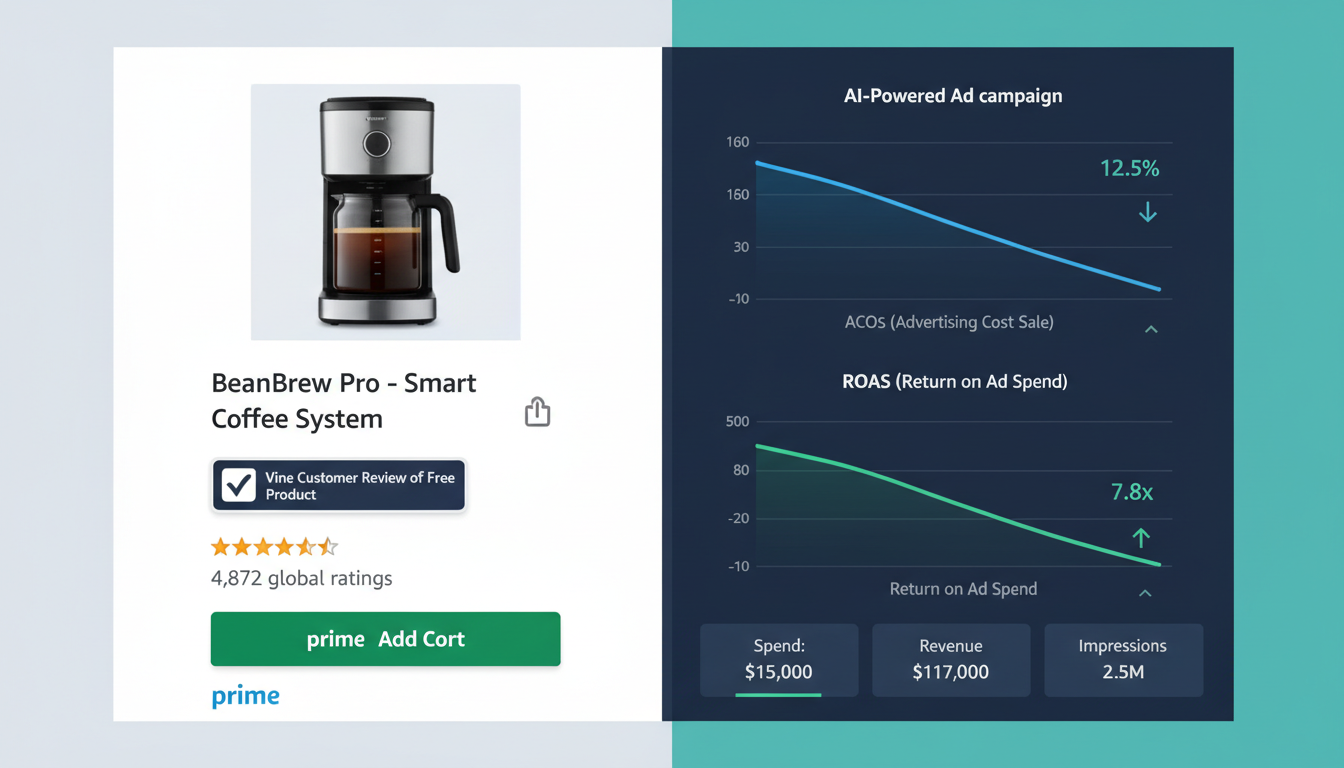
The industry benchmark ACoS for Sponsored Products sits at 29.8% (Statista, 2024). Established brands should target 15–25% ACoS. But here's the essential distinction most sellers miss: ACoS alone does not tell you whether your ads are profitable. You must factor in referral fees (typically 8–15% depending on category), FBA pick-and-pack fees, and per-unit CoGS to calculate True Profit per ASIN.
True Profit Per ASIN Formula
True Profit = Sale Price − CoGS − FBA Fees − Referral Fee − Ad Spend per Unit − Returns Cost
AdAstraa's Shopper OS surfaces real-time True Profit visibility per ASIN — so you stop optimizing campaigns based on vanity metrics and start making decisions based on actual dollars in your pocket.
7. Amplify Reach with Amazon Affiliate Marketing Programs
Amazon's Associates program is one of the world's largest affiliate marketing ecosystems — and it's a massively underutilized external traffic channel for sellers. Every sale driven by an affiliate earns that creator a commission (typically 1–10% depending on category), but from your perspective as a seller, it's paid performance marketing with no upfront cost and a direct BSR boost to boot.
Amazon rewards external traffic to product listings with organic ranking boosts. When an affiliate blog post, YouTube review, or influencer TikTok drives a purchase, Amazon's algorithm treats it as a high-quality, intent-rich signal — which can meaningfully accelerate your path toward a Best Seller badge.
How to Activate Affiliate Channels for Your ASINs
- Build an Amazon Brand Referral Bonus-eligible storefront to earn back a percentage of affiliate-driven sales.
- Reach out to niche review bloggers and YouTube creators with high domain authority in your product category.
- Create a dedicated Amazon Storefront page to serve as a high-converting landing hub for all affiliate traffic.
- Use UTM-tagged Amazon Attribution links to measure which affiliate channels are actually converting.
Ready to unify your Amazon ads, affiliate traffic, and organic strategy under one intelligent operating system?
Explore AdAstraa's Full Platform →8. Build a Layered Media and Advertising Mix Across the Funnel
Amazon is no longer purely a bottom-of-funnel platform. The rise of Streaming TV ads, audio ads, and DSP display placements means that serious brands must build a full-funnel media and advertising strategy — one that creates demand at the top, nurtures in the middle, and closes at the bottom.
The most competitive FMCG brands and D2C sellers on Amazon in 2024 are running at least three campaign types simultaneously: Sponsored Products for conversion, Sponsored Brands video for consideration, and DSP display/STV for awareness. Each layer feeds the next.
Full-Funnel Campaign Architecture
- Awareness (Top): Amazon DSP STV, OLV (Online Video), audio ads via Amazon Music
- Consideration (Mid): Sponsored Brands, Sponsored Display with lifestyle imagery, category retargeting
- Conversion (Bottom): Sponsored Products — exact match, ASIN targeting, competitor conquesting
- Retention (Post-purchase): DSP remarketing, Subscribe & Save, loyalty promotions
Discover how AdAstraa's AI advertising strategies help brands build and automate this full-funnel architecture without a team of 10 analysts.
9. Eliminate Non-Converting Keywords to Instantly Cut Wasted Spend
One of the most impactful and consistently overlooked Amazon advertising strategies is negative keyword harvesting. Most brands focus obsessively on finding new keywords to add — while ignoring the keywords that are quietly draining their budget every single day.
Industry data shows that the average Amazon advertiser wastes 20–30% of their total ad budget on keywords that generate clicks but zero conversions. For a brand spending $20,000/month on ads, that's up to $6,000 per month in pure waste — money that could be reinvested in high-ROAS campaigns.
The Step-by-Step Negative Keyword Process
- Pull your Search Term Report weekly and sort by spend descending.
- Flag any search term with 10+ clicks and zero orders over a rolling 14-day window.
- Add flagged terms as Exact or Phrase negatives at the campaign and/or ad group level.
- Review and repeat — keyword waste is not a one-time problem, it's a weekly discipline.
AdAstraa's Autopilot engine automates this entire process in real time — eliminating non-converting keywords and reallocating budget to your top performers without requiring a single manual pull or pivot table.
10. Scale Effortlessly Using AI-Powered Ad Automation
Every strategy in this article — DSP targeting, listing optimization, negative keyword hygiene, fee management, affiliate tracking — shares one fatal limitation when executed manually: it doesn't scale. The moment you go from 5 ASINs to 50, or from $5,000/month in ad spend to $50,000, manual management collapses under its own weight.
This is exactly why AI-powered Amazon ad automation has become not a luxury, but a competitive necessity. Amazon advertising revenue grew 24% to $47.4 billion in 2024. The brands winning market share aren't doing it with larger teams — they're doing it with smarter systems.
How AdAstraa Automates Your Entire Amazon Ad OS
- Autopilot: 24/7 AI bid optimization — reacts to market shifts, dayparting windows, and competitor activity in real time.
- Shopper OS: Buyer intent intelligence that surfaces which keywords and ASINs are trending before your competitors act on them.
- EcomGPT: Automates customer operations — from Q&A responses to review management — so your team focuses on growth, not inbox management.
- AdCreative+: AI-generated ad creatives, listing copy, and A+ content that are performance-tested and brand-consistent from day one.
Together, these tools form a complete Amazon Advertising Operating System — one built specifically for the brands that refuse to lose ground to better-funded competitors.
Additional Resources
For deeper research and authoritative reference material on Amazon advertising, ecommerce strategy, and digital media, explore these trusted sources:
- Amazon Ads Official Resource Center — Best practices, case studies, and campaign guides directly from Amazon's advertising team.
- FTC Endorsement & Affiliate Marketing Guidelines — Essential reading for brands running affiliate and influencer programs on or off Amazon.
- eMarketer: Amazon Advertising Trends & Data — Independent market research and forecasts on Amazon's share of global digital ad spend.
- Forbes: Amazon Seller Statistics — A comprehensive overview of seller economics, revenue benchmarks, and marketplace growth data.
- Jungle Scout State of the Amazon Seller Report — Annual survey of 1,000+ Amazon sellers covering profitability, advertising trends, and growth strategies.
The Bottom Line: Strategy Without Automation Is Just Theory
Amazon advertising in 2025 rewards the brands that move from reactive to predictive. The 10 strategies outlined above — from Amazon DSP and mobile advertising to Vine, affiliate programs, fee management, and AI automation — aren't standalone tactics. They're interconnected levers of a single, unified growth engine.
The sellers becoming best sellers on Amazon India, dominating US Sponsored Product placements, and achieving sub-20% ACoS aren't just buying more traffic. They've built a system. A smarter, more effortless operating model where AI handles the optimization work, and their team focuses on strategy, brand, and product.
AdAstraa was built to be that system — purpose-built for Amazon-first brands that are done settling for average ROAS and manual management overhead.
Your competitors are already running smarter campaigns.
Join hundreds of Amazon brands using AdAstraa to lower ACoS, boost ROAS, and reclaim hours of manual management — starting today.
Get Started with AdAstraa for Free →