


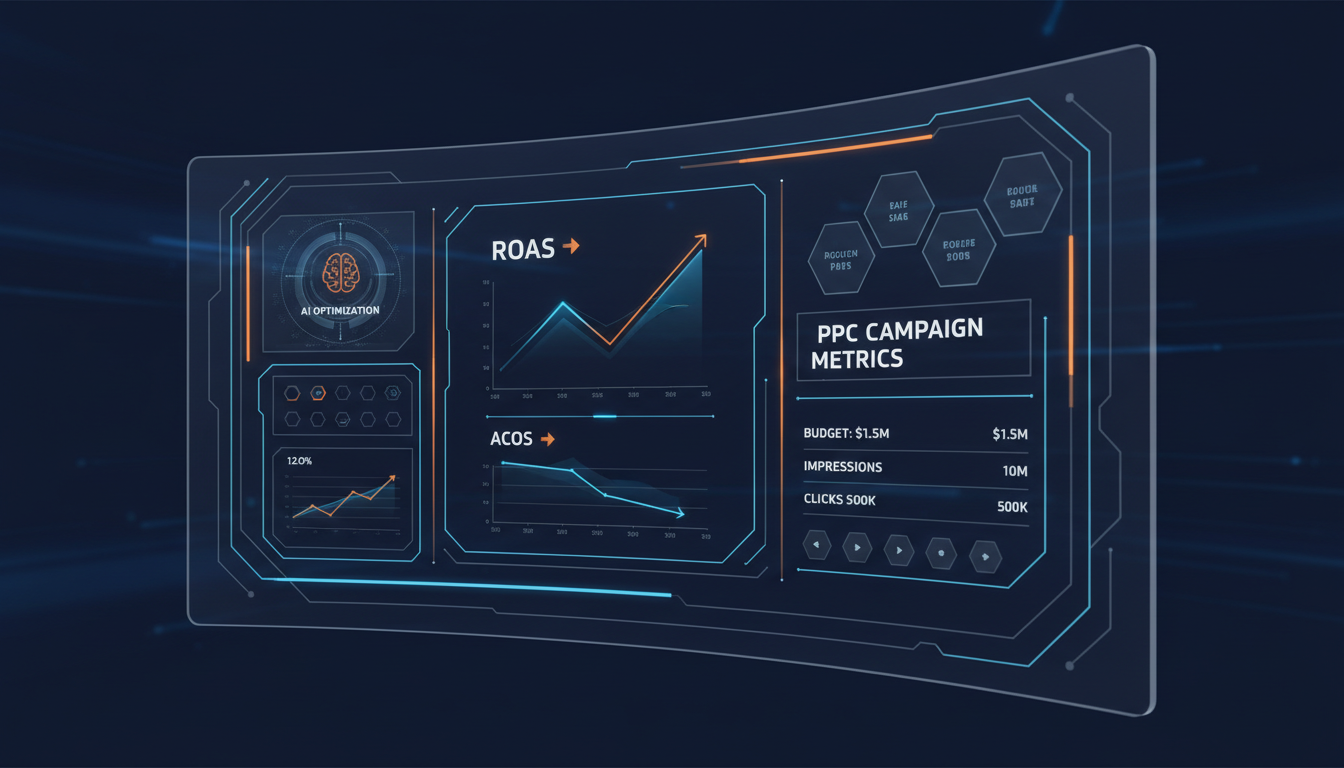
The average Amazon seller wastes 20–40% of their ad budget on campaigns that never convert. That is not a rounding error — that is real revenue silently bleeding out every single day while competitors sharpen their edge.
If your ACoS is stubbornly high, your ROAS refuses to climb, or you are spending hours each week manually adjusting bids with little to show for it, you are not alone. Amazon's advertising ecosystem has grown ferociously complex — and the brands that win are the ones using smarter, more systematic Amazon PPC optimization strategies.
In this guide, we break down the 10 essential, battle-tested strategies that help D2C sellers, FMCG brands, and Amazon-first agencies reclaim ad budget, lower ACoS, and build campaigns that compound over time. Each strategy is actionable, measurable, and designed to work whether you manage five ASINs or five hundred.
Ready to stop guessing and start winning?
See how AdAstraa's AI-powered platform cuts wasted spend and boosts ROAS automatically — 24/7, across every ASIN.
Start Your Free Trial Today →
Why Amazon PPC Optimization Is Non-Negotiable in 2025
Amazon's ad revenue crossed $47 billion in 2023 and continues to surge. More sellers are bidding on the same keywords, CPCs are rising, and the margin for sloppy campaign management has essentially evaporated. What worked in 2020 — set bids, forget, collect sales — is a guaranteed path to profitability destruction today.
True Amazon advertising campaign optimization means more than toggling bids once a week. It means building an intelligent, self-reinforcing system where every signal — from search term data to dayparting patterns to conversion rates by placement — feeds back into your bidding logic in real time.
Brands that invest in robust AI advertising tools alongside disciplined campaign hygiene are consistently reporting ACoS reductions of 20–35% and ROAS improvements well above industry benchmarks. The gap between optimized and unoptimized campaigns is no longer a small delta — it is a competitive chasm.
Strategy 1: Build a Bulletproof Amazon Ad Campaign Structure
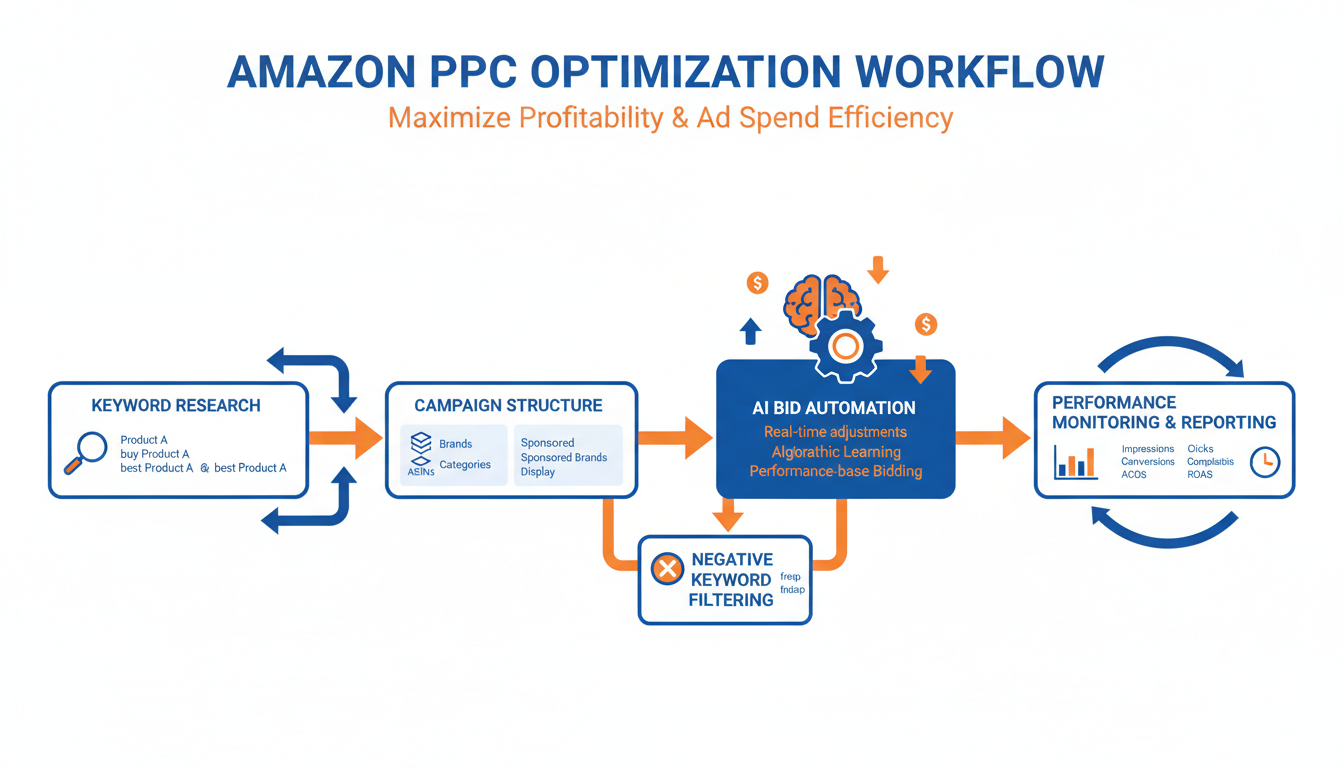
The single most common root cause of wasted spend is a faulty campaign architecture. When Sponsored Products, Sponsored Brands, and Sponsored Display campaigns share budgets, targeting pools, and broad match keywords without deliberate separation, optimization becomes nearly impossible.
The Proven Tiered Campaign Framework
- Discovery campaigns (Broad/Auto): Designed purely to harvest new, converting search terms. Set conservative bids and low budgets.
- Performance campaigns (Exact/Phrase): Feed your proven winners from discovery. These carry the majority of your budget and conversion intent.
- Defence campaigns: Target your own brand keywords to prevent competitors from poaching your traffic and cannibalising hard-won organic rank.
- Conquest campaigns: Target competitor ASINs and brand terms strategically when your product offers a superior value proposition.
Applying a one product per ad group rule wherever possible provides the granularity needed to measure True Profit per ASIN — a metric that radically changes your allocation decisions. Learn how our complete Amazon PPC guide breaks down campaign architecture for brands at every scale.
Strategy 2: Aggressively Harvest and Apply Negative Keywords
If your Search Term Report is not open every week, you are almost certainly paying for clicks that will never convert. Negative keywords are the most underused, highest-ROI lever in Amazon PPC management, and neglecting them is the fastest way to inflate ACoS without any corresponding sales benefit.
A Step-by-Step Negative Keyword Workflow
- Pull your Search Term Report weekly — filter for clicks with zero orders over a rolling 30-day window.
- Identify irrelevant intent signals (wrong colour, size, use case, or product category) and add them as exact match negatives.
- Look for search terms triggering spend on low-margin ASINs and move budget toward high-margin products.
- Create a shared Negative Keyword List at the account level for universally irrelevant terms so you never pay for them again.
- Review monthly for false positives — occasionally a blocked term becomes relevant after a product refresh or new variant launch.
"Advertisers who consistently manage negative keywords report a 15–25% reduction in wasted ad spend within the first 60 days — without sacrificing impression share on converting terms."
Strategy 3: Use AI-Powered Bid Optimization for 24/7 Precision
Manual bid adjustments made once or twice a week are a relic of a simpler era. Today, Amazon's auction prices fluctuate hour-by-hour based on competitor activity, seasonality, device type, placement, and dozens of other variables that no human team can monitor simultaneously at scale.
True AI PPC management means deploying machine learning models that continuously ingest performance signals — conversion rate by keyword, daypart, placement, and audience segment — to calculate and apply the optimal bid in real time. The results are not marginal; brands leveraging AI bid automation report campaign management time reductions of up to 70% and ROAS improvements of 3x or more.
AdAstraa's Autopilot module applies exactly this logic — running 24/7 bid optimization across every keyword and every ASIN, ensuring you win auctions when conversion probability is high and preserve budget when it is not. Explore our platform overview to understand the full intelligence stack powering these decisions.
Strategy 4: Set Product-Level ACoS Targets, Not Account-Wide Averages
One of the most breakthrough shifts a brand can make is abandoning the account-level ACoS target. Treating every product identically — a $9 consumable and a $140 premium appliance — with the same ACoS ceiling is a guaranteed way to over-invest in low-margin items while starving your highest-profit ASINs of budget they deserve.
The ACoS Formula Every Seller Must Know
Your break-even ACoS is simply your product profit margin expressed as a percentage. If your margin is 35%, your break-even ACoS is 35%. Any campaign running above that is costing you money; any campaign running below it is generating profit on every sale.
Set your target ACoS at 60–80% of break-even for established products, and allow a higher ACoS for new product launches where ranking velocity and review acquisition justify a short-term investment. Track True Profit per ASIN — factoring in COGS, FBA fees, returns, and ad spend — rather than relying on ACoS alone as a health signal.
Strategy 5: Mine Search Term Reports for Untapped Revenue
Your Search Term Report is arguably the most valuable dataset Amazon gives you for free — and most sellers barely glance at it. It reveals the actual queries shoppers typed before clicking your ad, which is fundamentally more accurate buyer intent data than any third-party keyword tool can provide.
Beyond removing non-converting terms as negatives, use this report to discover high-intent converting queries you have not yet added as exact match keywords. If a broad-match campaign surfaces a search term that has generated five or more orders at a strong conversion rate, promote it immediately to a dedicated exact match campaign with a competitive, purposeful bid.
This keyword promotion pipeline — discovery to performance — is the engine that powers compounding organic rank improvements alongside paid conversion efficiency. It is also one of the workflows that AdAstraa's Shopper OS automates through real-time buyer intent intelligence, surfacing your highest-value search terms before competitors can capitalize on them.
Strategy 6: Optimize Bid Adjustments for Placement and Daypart
Amazon allows you to apply placement bid multipliers for Top of Search, Rest of Search, and Product Pages. This is a game-changing lever that most sellers set and forget at default. The reality is that conversion rates vary dramatically by placement — and the optimal multiplier is different for every product category and time of day.
Analyze your Placement Report monthly. If Top of Search is converting at twice the rate of Product Pages, apply a 30–50% bid multiplier to ensure you win those premium placements on your best-performing keywords. Conversely, reduce multipliers for placements with poor conversion efficiency to stop overpaying for impressions that do not convert.
Dayparting — reducing bids or pausing campaigns during low-conversion hours — is equally powerful for categories where purchase intent has strong hourly patterns. Automated PPC optimization software handles this at the granularity and frequency that manual management simply cannot match.
Strategy 7: Master Portfolio-Level Budget Allocation
Budget starvation is an invisible killer. When your best-converting campaigns run out of daily budget at 2 PM and stop serving ads for the highest-intent afternoon shopping window, you lose sales silently — with no alarm, no alert, and no obvious data trail.
Use Amazon's Portfolio Budgets to group campaigns by ASIN, category, or funnel stage and set shared budget caps that allow high performers to spend more when demand is strong. Audit your budget utilization weekly — any campaign hitting its daily budget cap before the end of the day is leaving profitable sales on the table.
For brands managing complex catalogs across multiple categories, this multi-variable budget allocation problem is precisely where AI-powered ad management platforms deliver their most essential value — optimizing budget flow across campaigns at a pace and precision no manual process can replicate.
Let AI handle the complexity for you
AdAstraa's Autopilot optimizes bids, budgets, and placements 24/7 — so your campaigns never miss a high-intent window again.
See AdAstraa in Action →Strategy 8: Invest in AI-Powered Ad Creative That Converts
Bid optimization and campaign structure can only take you so far. When your creative — your hero image, Sponsored Brands video, or custom product imagery — fails to connect with the shopper's intent in under two seconds, no amount of bid precision will fix a broken conversion rate.
Modern AI ad creative tools have made high-quality, on-brand creative iteration dramatically faster and more affordable. Instead of waiting weeks for an agency revision cycle, brands can now generate and A/B test multiple creative variations in hours — systematically identifying which images, headlines, and lifestyle contexts resonate most strongly with their specific buyer personas.
AdAstraa's AdCreative+ module generates on-brand ad creatives at scale — purpose-built for Amazon's Sponsored Brands and Sponsored Display formats — ensuring your visual presence matches the precision of your bidding strategy.
Strategy 9: Learn from Real Campaigns — A Mini Case Study
Consider a mid-sized UK home-goods brand selling on Amazon UK and DE. They had 12 product lines running across 40 campaigns with a blended ACoS of 38% — well above their 24% break-even threshold. Their team was spending 18+ hours per week on manual bid adjustments, yet results were deteriorating.
The core problems were familiar: no tiered campaign structure, over 600 irrelevant search terms receiving clicks, flat account-level ACoS targets applied to every ASIN regardless of margin, and creative assets that had not been refreshed in 14 months.
After restructuring campaigns into a tiered discovery-performance-defence architecture, deploying AI bid automation, implementing product-level ACoS targets, and refreshing creatives through an AI ad generator, the brand achieved a 31% ACoS reduction in 90 days, a 2.6x improvement in ROAS on their top five ASINs, and reclaimed over 14 hours per week of management time. The budget was not increased — it was optimised.
This is the proven, repeatable outcome that systematic Amazon PPC optimization delivers. Explore more outcomes like this in our brand case studies.
Strategy 10: Build a True Profit Analytics Framework, Not Vanity Metrics
ACoS and ROAS are useful compass points, but they are not the full picture. A campaign can boast a 15% ACoS and still lose money if the ASIN's COGS, FBA fees, return rate, and storage costs are not factored into the equation. Optimizing for vanity metrics is one of the most expensive mistakes a growing brand can make.
Build a reporting stack that surfaces True Profit per ASIN — a fully-loaded profitability metric that accounts for every cost driver from first click to fulfillment. This is the metric that drives genuinely intelligent budget allocation, because it tells you not just which campaigns are efficient, but which products deserve more investment and which should be sunset.
Layer in marketing analytics AI to identify anomalies — sudden CPC spikes, drop-offs in conversion rate, creative fatigue signals — before they erode profitability. Brands using real-time analytics platforms consistently catch budget leaks days faster than those relying on weekly manual reporting cycles. Review the full range of AI advertising strategies that empower data-driven decisions across your entire catalog.
| Metric | What It Tells You | Limitation |
|---|---|---|
| ACoS | Ad cost as % of attributed revenue | Ignores COGS and FBA fees |
| ROAS | Revenue generated per $1 of ad spend | Does not reflect true margin |
| TACoS | Ad spend as % of total (paid + organic) revenue | Hides product-level profitability |
| True Profit / ASIN | Fully-loaded profit after all cost drivers | Requires integrated data infrastructure |
Additional Resources
Deepen your knowledge of Amazon advertising and AI-powered marketing with these authoritative external sources:
- Amazon Advertising — Official Sponsored Products Guide — Amazon's own best-practice documentation for Sponsored Products campaign setup and optimization.
- FTC Guide on Endorsements and Advertising Disclosures — Essential compliance reading for brands running AI-generated ad creative and influencer partnerships.
- Harvard Business Review — How to Design an AI Marketing Strategy — A rigorous, research-backed framework for integrating AI into your broader marketing operations.
- McKinsey — The Data-Driven Enterprise of 2025 — Insights on how data and AI are reshaping enterprise-level marketing performance and investment decisions.
- American Marketing Association — How AI Is Changing Advertising — An accessible overview of AI's transformative role across the modern advertising landscape.
The Bottom Line: Optimization Is a System, Not a One-Time Fix
The brands extracting the most value from Amazon advertising in 2025 are not those with the biggest budgets. They are the ones with the most disciplined, systematic, and intelligence-driven approach to campaign management. Every strategy in this guide compounds on the others — campaign structure enables precise bid automation; negative keyword hygiene sharpens conversion efficiency; true profit analytics ensures every optimization decision is grounded in reality.
The ultimate competitive advantage is not spending more — it is spending smarter, faster, and with greater precision than the competition. That is exactly what a purpose-built Amazon advertising management platform powered by AI enables: the effortless elimination of waste, the instant reallocation of budget toward what converts, and the guaranteed visibility into where every dollar of your ad spend is actually going.
You now have the roadmap. The next step is execution — and you do not have to do it alone.
Your most profitable campaigns start here
Stop wasting ad spend. Start scaling with confidence.
AdAstraa combines AI bid automation, buyer intent intelligence, and real-time profit analytics in one powerful platform — built exclusively for Amazon-first brands.
Claim Your Free Trial Today →