




Amazon sellers collectively waste over 26% of their PPC ad spend on clicks that never convert. That silent bleed quietly kills margins — and most sellers don't even know it's happening.
If you've ever stared at a ballooning ACoS, wondered why your campaigns burn budget overnight, or felt like Amazon advertising is a black box you can never fully control — you are not alone. The good news? The problem isn't your product. It's your strategy.
Amazon PPC optimization is no longer optional. It is the essential engine behind every profitable Amazon-first brand in 2025. Whether you're managing five SKUs or five hundred, the sellers dominating search results today share one thing: they've stopped guessing and started using intelligent, data-driven campaign management.
In this guide, you'll find 10 proven, step-by-step Amazon PPC optimization strategies — built for D2C brands, FMCG sellers, and agency managers who are ready to reclaim wasted spend, lower ACoS, and scale ROAS with confidence.
Stop burning ad budget on guesswork.
AdAstraa's AI Autopilot optimizes your Amazon PPC campaigns 24/7 — no manual babysitting required.
Why Amazon PPC Optimization Is a Game-Changing Priority in 2025
The Amazon advertising landscape has fundamentally shifted. Competition has intensified, CPCs have climbed, and the margin for error has narrowed dramatically. The global marketing automation market hit $6.65 billion in 2024 and is projected to reach $15.58 billion by 2030 — because brands that automate and optimize simply outperform those that don't.
For every $1 invested in intelligent marketing automation, companies see an average return of $5.44 over three years. On Amazon specifically, the stakes are even higher: your ad rank, organic rank, and buy box eligibility are all intertwined. Poor PPC management doesn't just waste money — it actively suppresses your organic visibility.
The brands winning on Amazon right now are not necessarily those with the biggest budgets. They are the ones with the sharpest campaign structure, the most disciplined keyword management, and the most intelligent bid automation. Let's break down exactly how they do it.
Strategy 1: Build a Bulletproof Amazon Advertising Campaign Structure
A disorganized campaign structure is the root cause of most Amazon PPC inefficiency. Without deliberate architecture, you end up cannibalizing your own keywords, inflating CPCs, and losing control of budget allocation.
Use Single-Product Ad Groups as Your Baseline
Industry data from accounts managing millions in Amazon ad spend consistently shows that single-product ad groups offer the most control for 80–90% of accounts. They allow you to isolate performance by ASIN, make precise bid adjustments, and diagnose issues without ambiguity.
Separate Match Types Across Campaigns
Running Exact, Broad, and Phrase match types within the same ad group is a guaranteed way to lose budget transparency. Segment them across dedicated campaigns so you can see precisely where your spend is producing returns — and where it isn't.
Create an Auto-to-Manual Harvest Funnel
Launch Automatic campaigns to discover converting search terms, then harvest those winners into Manual campaigns for tighter control and scaled bidding. This is the proven foundation of every efficient Amazon advertising strategy.
Want to go deeper on campaign architecture? Explore AdAstraa's complete Amazon PPC guide for a step-by-step breakdown.
Strategy 2: Eliminate Wasted Spend with Negative Keyword Mastery
Negative keywords are the most underutilized tool in the Amazon seller's arsenal — and the most powerful for instantly recovering lost margin. Sellers who actively manage negative keyword lists report saving 10–30% of total ad spend almost immediately.
The essential rule: if a search term has consumed significant clicks with zero sales, it is a drain on your budget and a signal to Amazon that your product is irrelevant for that query. Both outcomes hurt you.
- Negative Exact: Blocks the precise search term — use for clearly irrelevant queries.
- Negative Phrase: Blocks any search containing that phrase — more powerful, use with precision.
- Campaign-level vs. Ad Group-level: Campaign-level negatives protect your entire structure; ad group-level gives surgical control.
- N-gram analysis: Identify recurring wasted-spend patterns across hundreds of search terms at once — a breakthrough tactic most sellers overlook.
Pro tip: Build a data-driven threshold for negation based on your product's actual clicks-to-conversion ratio — not arbitrary rules like "negate after 25 clicks." Every ASIN has a unique benchmark.
Strategy 3: Deploy Intelligent AI Bid Optimization for 24/7 Performance
Manual bid management is a full-time job — and even then, you're always reacting to yesterday's data. AI-powered bid optimization fundamentally changes the equation by processing hundreds of signals simultaneously to forecast the optimal bid for every keyword, every hour.
Unlike rule-based automation (which simply triggers pre-set actions), AI bid optimization analyzes:
- Historical conversion patterns at keyword level
- Real-time competitor bidding behavior
- Time-of-day and day-of-week conversion windows
- Seasonality and inventory status
- ASIN-level profitability thresholds
The result? Bids that are never too high (wasting margin) and never too low (ceding visibility). Research from Helium10 confirms that AI-powered Amazon PPC software saves sellers 10+ hours per week while delivering measurably superior ROAS through bid accuracy that manual management simply cannot match.
AdAstraa's Autopilot feature delivers exactly this — continuous, intelligent bid management working around the clock so your campaigns never sleep and never overspend.
Strategy 4: Target Buyer Intent Keywords, Not Just High-Volume Terms
High search volume is not the same as high purchase intent. Targeting broad, informational keywords inflates impressions, burns budget, and produces the kind of high-ACoS, low-conversion performance that discourages sellers from scaling.
The essential shift: prioritize transactional and buyer-intent keywords — terms that signal a shopper is ready to purchase, not just browse. These typically include modifiers like:
- Brand comparisons ("vs," "alternative to")
- Specificity signals (size, color, quantity, use case)
- Problem-solution phrases ("for sensitive skin," "bulk pack")
- High-intent modifiers ("best," "buy," "shop")
AdAstraa's Shopper OS intelligence layer maps real buyer intent signals from live Amazon shopper behavior — giving you a proven edge in identifying keywords that convert before your competitors even notice them.
Strategy 5: Set Profitable ACoS Targets Per ASIN — Not Account-Wide
One of the most common and costly mistakes in Amazon advertising campaign management is applying a single ACoS target across an entire account. Every ASIN has a different margin, a different conversion rate, and a different strategic role. A one-size-fits-all ACoS target virtually guarantees that some products are over-spending and others are leaving revenue on the table.
Calculate Break-Even ACoS for Every SKU
Break-even ACoS = (Gross Margin %) × 100. If a product has a 40% margin, your break-even ACoS is 40%. Anything above that, and you're advertising at a loss. Target ACoS should typically sit 10–15 percentage points below break-even to preserve profitability.
Distinguish Launch ACoS from Maintenance ACoS
New ASINs require aggressive investment to build sales history and organic rank — a higher ACoS at launch is a strategic investment, not a failure. Once rank is established, pull ACoS targets down systematically. This launch-to-harvest transition is a must-know lifecycle management tactic.
"Your ACoS target is wrong. Here's what to focus on instead: True Profit per ASIN — accounting for COGS, fees, and ad spend together."
— A principle shared consistently by top Amazon PPC strategists in 2025
AdAstraa surfaces True Profit per ASIN in real time across your entire catalog — removing the guesswork and giving every optimization decision a solid financial foundation.
Strategy 6: Use AI-Powered Ad Creatives to Boost Click-Through Rate
Even a perfectly optimized campaign will underperform if your ad creative fails to stop the scroll. In an increasingly visual Amazon search environment — with Sponsored Brands video ads, lifestyle imagery, and custom storefronts — creative quality is a direct lever on your conversion rate and, therefore, your effective ACoS.
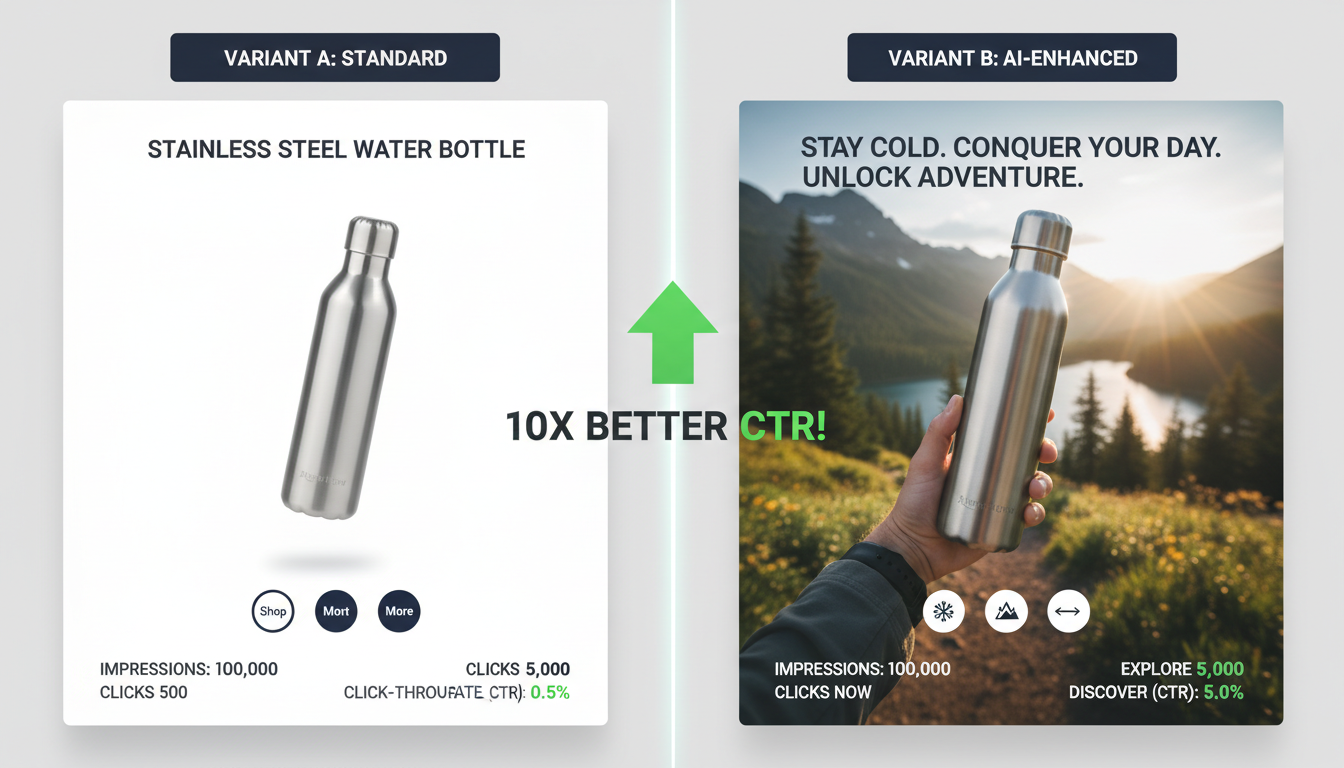
AI-generated creatives now make it effortless to produce high-converting, on-brand ad visuals at scale — without a design team or a lengthy production cycle. The brands that iterate creatives fastest have an insurmountable competitive advantage: they test more, learn faster, and continuously compound their performance gains.
Key principles for Amazon ad creative optimization:
- Lead with the product benefit, not just the product itself
- Use lifestyle imagery for Sponsored Brands — shoppers respond to context
- A/B test headline copy relentlessly — small wording changes drive significant CTR swings
- Align creative messaging tightly with the keyword intent of each campaign
AdAstraa's AdCreative+ tool generates AI-powered, conversion-optimized ad creatives purpose-built for Amazon — so your visuals work as hard as your bids.
Strategy 7: Learn from a Real Brand Transformation — A Mini Case Study
Consider a mid-size FMCG brand selling premium personal care products across 60+ ASINs on Amazon. Before intelligent campaign management, their account had all the classic symptoms of unoptimized PPC: an ACoS hovering at 38%, campaigns bleeding spend on non-converting generic keywords, and a team spending 20+ hours per week manually pulling reports and adjusting bids.
After implementing a structured optimization program — including ASIN-level ACoS targets, a systematic negative keyword build-out, AI-driven 24/7 bid adjustments, and buyer-intent keyword segmentation — the results over 90 days were transformative:
| Metric | Before | After 90 Days | Change |
|---|---|---|---|
| ACoS | 38% | 21% | ▼ 45% reduction |
| ROAS | 2.6x | 4.7x | ▲ 81% increase |
| Wasted Spend | 29% of budget | 6% of budget | ▼ 79% reduction |
| Weekly Management Hours | 22 hours | 4 hours | ▼ 82% reduction |
The core insight: optimization is not a one-time event. It is an ongoing, compounding process. The brands that win are those who build systems — not just execute tactics.
Ready to see results like these for your brand?
Explore how AdAstraa's AI advertising suite transforms Amazon PPC performance from day one.
Strategy 8: Optimize Campaign Budget Allocation for Maximum Impact
Budget misallocation is a silent performance killer. Many sellers spread budgets too thinly across too many campaigns, preventing any single campaign from gathering enough data to optimize — or they over-invest in high-visibility campaigns that aren't actually driving profitable sales.
Tier Campaigns by Performance, Not by Instinct
Segment your campaigns into three tiers: Scale (low ACoS, strong ROAS — invest aggressively), Optimize (moderate performance — test and refine), and Pause or Cut (consistently unprofitable — eliminate). Review tier assignments weekly, not monthly.
Apply Dayparting to Concentrate Spend in High-Converting Windows
Amazon shopper behavior is deeply time-dependent. Analyze your conversion data by hour and day of week. Concentrate budget during proven high-conversion windows and pull back during historically wasteful periods. This single tactic can improve effective ROAS by 15–25% without changing a single bid.
Leverage Portfolio Budgets for Flexible Cap Management
Amazon's Portfolio Budget feature allows you to set shared budgets across campaign groups — preventing any single campaign from exhausting funds and leaving others dark. An essential tool for multi-ASIN accounts with complex budget structures.
Strategy 9: Mine the Search Term Report — Your Most Powerful Free Data Source
Amazon's Search Term Report is arguably the most valuable — and most ignored — asset available to every Amazon seller. It reveals exactly which shopper queries are triggering your ads, how much each is costing, and what each is generating in revenue. Analyzed correctly, it is a goldmine for both opportunity and waste identification.
A rigorous Search Term Report workflow should include:
- Weekly export and segmentation — sort by spend descending to find the highest-cost queries first.
- Zero-sale high-spend terms — immediate candidates for negative keywords.
- High-conversion terms not yet in manual campaigns — instant keyword harvest opportunities.
- Brand vs. non-brand segmentation — brand traffic converts at a fundamentally different rate and should never compete for budget with non-brand discovery terms.
- ASIN-level attribution — identify which specific products are winning (or losing) on each query.
Automating this workflow with AI-driven ad management software eliminates the hours of manual spreadsheet work and surfaces insights the moment they become actionable — not a week later when the damage is already done.
Discover how AdAstraa's AI advertising intelligence layer automates search term analysis and delivers real-time optimization signals across your entire account.
Strategy 10: Build a Full-Funnel Amazon Advertising Strategy for Sustained Growth
Most sellers focus exclusively on Sponsored Products — the bottom of the funnel. While Sponsored Products drive immediate conversions, a full-funnel Amazon advertising strategy compounds performance over time by building brand awareness, retargeting consideration-stage shoppers, and dominating category visibility.
Sponsored Brands: Own the Top of the Funnel
Sponsored Brands ads appear at the top of search results with your logo, headline, and a curated product selection. They are uniquely powerful for new customer acquisition and brand recall — especially in competitive categories where Sponsored Products alone cannot guarantee top-of-page presence.
Sponsored Display: Re-Engage and Convert
Sponsored Display retargeting allows you to reach shoppers who viewed your product but didn't purchase — both on and off Amazon. These audiences are warm, high-intent, and convert at substantially higher rates than cold traffic. Yet they are dramatically underutilized by most sellers.
Integrate Brand Analytics for Strategic Keyword Intelligence
Amazon Brand Analytics provides market basket data, demographic insights, and search frequency rankings that are unavailable anywhere else. Cross-referencing Brand Analytics with your campaign data reveals strategic opportunities invisible to sellers relying solely on the Advertising Console.
For a comprehensive breakdown of advanced Amazon advertising strategies, visit AdAstraa's AI advertising strategies hub — built specifically for brands scaling past six figures on Amazon.
How to Put All 10 Strategies Together: Your Amazon PPC Optimization Roadmap
Implementing all ten strategies simultaneously can feel overwhelming — especially if you're managing a large catalog or running a lean team. The most effective approach is a phased rollout prioritized by impact:
| Phase | Strategies | Timeline | Expected Impact |
|---|---|---|---|
| 1 — Stop the Bleed | Negative keywords, Search Term audit, ASIN-level ACoS targets | Week 1–2 | Immediate wasted spend recovery |
| 2 — Build Foundation | Campaign structure, match type segmentation, budget tiering | Week 2–4 | ACoS stabilization and control |
| 3 — Accelerate Growth | AI bid automation, intent-based targeting, creative optimization | Month 2 | ROAS improvement and scaling |
| 4 — Dominate | Full-funnel strategy, Sponsored Display retargeting, Brand Analytics | Month 3+ | Category authority and compounding returns |
The difference between brands that plateau and brands that scale is not luck — it is the systematic, relentless application of intelligent optimization. Every week you delay is a week your competitors are compounding their advantage.
Additional Resources
Expand your Amazon advertising knowledge with these authoritative external resources:
- Amazon Ads Support Center: Optimize Your Campaign — Official Amazon documentation on campaign optimization best practices and metric guidance.
- Complete Guide to Amazon PPC Optimization (2025) — Adspert — An in-depth technical guide to PPC campaign structure, keyword management, and bid optimization tactics.
- Marketing Automation ROI Statistics 2025–2026 — RevenueMemo — Comprehensive data analysis on financial returns, lead generation impact, and AI-driven marketing automation performance.
- PPC Campaigns That Work: Strategies to Reduce ACoS — SellerEngine — Practical strategies and keyword research techniques for improving Amazon ad profitability in 2025.
- How AI-Powered Amazon PPC Saves 10+ Hours Weekly — Helium10 — Detailed breakdown of the performance and time-saving advantages of AI-driven PPC automation versus rule-based approaches.
Final Thoughts: Amazon PPC Optimization Is the Ultimate Competitive Moat
Amazon advertising has never been more competitive — or more rewarding for those who master it. The 10 strategies in this guide are not theoretical. They are the proven, battle-tested pillars that separate profitable Amazon brands from those perpetually chasing a break-even ACoS.
To recap: build a bulletproof campaign structure, master negative keywords, deploy AI bid optimization, target genuine buyer intent, set ASIN-level profitability thresholds, invest in creative quality, learn from data relentlessly, allocate budgets strategically, mine your search term reports weekly, and expand to a full-funnel approach.
Each strategy amplifies the others. Together, they create a compounding performance engine that grows stronger every week — and widens the gap between you and competitors still managing campaigns manually.
The brands achieving 4x, 5x, and 6x ROAS on Amazon aren't working harder. They're working with smarter tools, sharper strategies, and an AI-powered operating system purpose-built for Amazon-first growth.
AdAstraa is your all-in-one Amazon advertising operating system.
Autopilot bid optimization. Shopper intent intelligence. AI-generated creatives. Real-time True Profit visibility. Everything your brand needs to win — in one powerful platform.
Start Optimizing with AdAstraa — Free →