

Here is a number that should make you pause: Amazon's advertising revenue hit $68 billion in 2025 — a 22% year-over-year increase. Your competitors are capturing a growing share of that pie while many sellers are still manually adjusting bids in spreadsheets, burning budget on keywords that will never convert, and flying blind without real-time profit visibility.
The uncomfortable truth? The average Amazon brand wastes 30–40% of its entire ad budget on irrelevant clicks, bloated keyword lists, and poorly timed bids. That is not a small leak — that is a flood. And plugging it manually, one campaign at a time, is no longer a viable strategy at scale.
The brands that are winning in today's hyper-competitive Amazon marketplace are not working harder — they are working with AI-powered advertising tools that make smarter decisions, faster than any human team ever could. They are leveraging machine learning to read buyer intent, automate bids 24/7, generate high-converting creatives, and surface real profit per ASIN in real time.
This guide breaks down the 5 essential AI advertising strategies that top Amazon brands are using right now to transform their campaign management — and how you can apply each one starting today.
Tired of watching ad spend disappear without results?
AdAstraa's AI advertising platform puts your campaigns on Autopilot — 24/7 bid optimization, zero wasted spend, real profit visibility.
Start Optimizing for Free →Why AI Advertising Is No Longer Optional for Amazon Brands
The Amazon advertising landscape has fundamentally changed. With over 2 million active sellers competing for a finite number of premium placements, the days of setting a manual bid and walking away are long gone. Cost-per-click rates have climbed aggressively across most categories, and Amazon's own algorithm now rewards sellers who optimize in real time — not those who review performance once a week.
AI advertising tools process thousands of data signals simultaneously — time of day, device type, search query semantics, shopper purchase history, competitor bids, inventory levels — and translate them into instant, profitable bid adjustments that no human team can replicate at speed or scale.
According to recent industry data, brands that implement AI-driven marketing automation report an average ROI increase of 76% alongside a 30% reduction in wasted ad costs. That is not a marginal improvement — that is a structural competitive advantage.
Understanding how to deploy these tools strategically — rather than just switching on automation and hoping for the best — is what separates the brands that scale from the brands that stagnate. The five strategies below give you the proven framework to do exactly that. To understand the full ecosystem behind AI-driven ad management, explore what modern AI advertising actually looks like in practice.
Strategy 1: Deploy 24/7 AI Bid Optimization Across Every Campaign
The single most powerful — and most immediate — transformation you can make to your Amazon advertising management is removing humans from the bid adjustment loop and replacing them with a purpose-built AI engine that never sleeps.
Manual bid management suffers from two fatal flaws: speed and scale. A human manager can check campaign performance once or twice a day at best. But Amazon's auction environment shifts by the hour — competitor bids change, search volumes surge during flash purchase windows, and conversion rates fluctuate across devices and dayparts. By the time you review last week's data and make adjustments, the market has already moved on.
How Real-Time Bid Automation Delivers Instant Results
AI-powered bid optimization tools like AdAstraa's Autopilot engine work by continuously analyzing rolling conversion data across every keyword, ad group, and campaign. They apply dynamic bid adjustments — scaling up on high-converting opportunities, pulling back on underperformers — every hour, not every week.
The key mechanics that make this breakthrough approach work include:
- Dayparting intelligence: Automatically increases bids during peak buying hours and reduces them during low-conversion windows, protecting your daily budget.
- Device-level bid modifiers: Adjusts bids differently for mobile, desktop, and tablet shoppers based on historical conversion rate data per ASIN.
- Velocity-based scaling: Detects when a keyword is on a conversion streak and confidently raises bids to capture additional market share before the window closes.
- ACoS guardrails: Sets hard profitability floors per campaign so the AI never optimizes for volume at the expense of margin.
The result? Brands running Autopilot consistently report ACoS reductions of 15–25% within the first 60 days, without touching a single bid manually. That is the effortless compounding effect of letting AI do what AI does best.
Strategy 2: Unlock Buyer Intent Intelligence to Target Smarter
Not all clicks are created equal. A shopper searching for "vitamin C serum" is in a very different purchase mindset than someone searching for "best vitamin C serum for oily skin under $20." The second query carries explicit purchase intent signals — specificity, a defined constraint, and a clear product fit — and yet many Amazon campaigns treat both keywords with the same bid and priority.
This is where AI-driven buyer intent intelligence becomes a game-changing advantage. Instead of guessing which keywords are worth investing in, a sophisticated AI platform maps the entire shopper decision journey — identifying which search terms at which funnel stage reliably convert at profitable margins for your specific ASINs.
Reading Purchase Signals in Real Time
AdAstraa's Shopper OS analyzes aggregated buyer behavior patterns across the marketplace to identify high-intent search clusters specific to your product category. It surfaces the keywords that signal a shopper is minutes away from hitting "Add to Cart" — and the equally important negative signals that indicate a browsing-only mindset.
The step-by-step implementation of intent-based targeting follows this logic:
- Map your keyword universe into three tiers: high intent (ready to buy), mid intent (comparing options), and low intent (researching).
- Allocate budget by intent tier — highest spend on Tier 1, limited spend on Tier 2, aggressive negative matching for Tier 3 terms.
- Monitor conversion rate by tier weekly and let AI continuously reassign keywords as their intent signals evolve with market conditions.
- Layer competitor conquest keywords — identify ASINs your high-intent shoppers are also viewing, and bid on those product targets.
Brands that shift from keyword-volume targeting to intent-signal targeting routinely see click-through rates double and conversion rates improve by 40% or more — because every ad dollar is now chasing a shopper who is primed to purchase.
Strategy 3: Build an Aggressive Negative Keyword System That Eliminates Waste
If AI bid optimization is the accelerator, negative keyword management is the brake — and most Amazon campaigns are driving at full speed with no brakes at all. The industry benchmark is sobering: 60% of the first page of Amazon search results is captured by sellers who have mastered keyword relevance. Sellers who do not actively prune their keyword lists fund their competitors' wins.
A negative keyword tells Amazon's algorithm exactly where not to show your ad. Done properly, a robust negative keyword strategy can reclaim 20–35% of your wasted ad spend within a single quarter — budget that can be immediately reinvested into your highest-converting campaigns.
The Proven Framework for Systematic Waste Elimination
Here is the essential four-step system that top-performing brands use:
- Weekly search term audits: Pull your search term report every 7 days and flag any term with 15+ clicks and zero conversions. These are your immediate negative candidates.
- ACoS threshold negating: Any search term exceeding 2x your target ACoS and showing a pattern of poor conversion should be added as a negative exact match — do not wait for more data.
- Category-level exclusions: Build a master negative list for your account that excludes irrelevant categories, competitor brand names you do not want to conquest, and informational queries ("how to," "DIY," "reviews").
- AI-assisted automation: Use AI tools that auto-detect and flag non-converting search terms across hundreds of campaigns simultaneously — removing the manual reporting bottleneck entirely.
"The most powerful word in Amazon PPC is not a keyword — it is a negative keyword. Every term you eliminate from your budget is a dollar redirected to something that actually converts."
This is exactly the type of systematic, data-driven waste elimination that advanced AI advertising strategies are built to automate at scale — freeing your team from manual auditing while delivering cleaner, more profitable campaigns.
Strategy 4: Use AI Creative Generation to Stop the Scroll and Win the Click
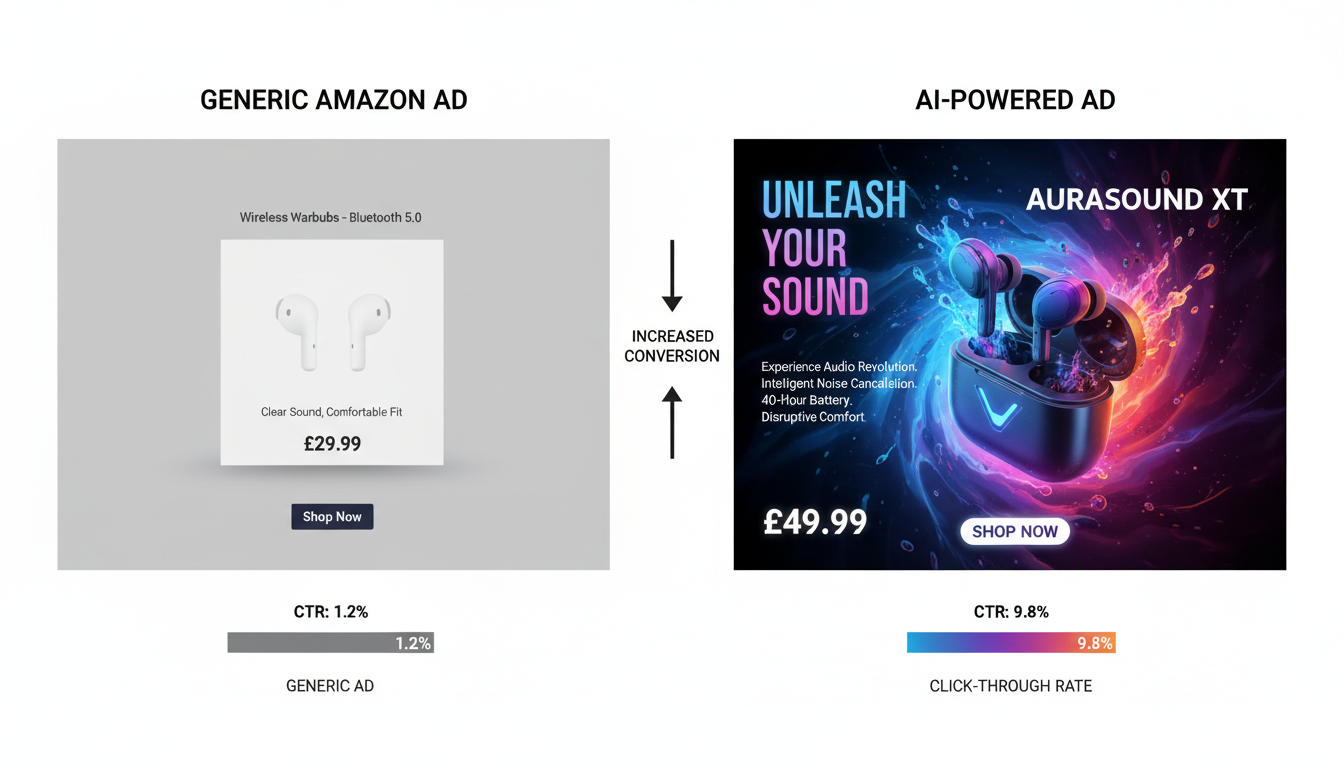
Optimized bids mean nothing if your creative does not capture attention. In a marketplace where shoppers see dozens of Sponsored Products results in a single search, your ad image and headline have milliseconds to earn a click. Yet most brands are running the same static creatives they launched with months — or even years — ago.
AI creative tools have fundamentally changed the economics of ad creative production. What once required a designer, a copywriter, and a two-week production cycle can now be generated, tested, and deployed in hours — with AI analyzing performance data to identify the winning combinations that drive the highest click-through rates for your specific audience.
What High-Converting AI Creatives Actually Look Like
Brands using AdAstraa's AdCreative+ platform to generate AI-powered ad assets follow three proven creative principles:
- Benefit-first headlines: AI identifies the top-performing benefit claims for your ASIN based on review sentiment analysis and competitor headline testing — and leads with the one that converts most.
- Dynamic visual variants: Generate 10–20 creative variations per product with different backgrounds, lifestyle contexts, and overlay text — then let AI select winners based on live CTR data.
- Seasonal and contextual adaptation: AI automatically updates creative assets for peak seasons (Prime Day, festive season, etc.), ensuring your ads stay relevant and timely without manual creative refreshes.
- Compliance-aware generation: Built-in guardrails ensure every generated creative meets Amazon's strict advertising policies — eliminating rejection delays that waste launch windows.
The compounding impact of better creatives is significant: a higher CTR tells Amazon's algorithm that your ad is relevant, which in turn lowers your effective CPC over time. Better creatives are not just a top-of-funnel play — they reduce your cost per conversion across the entire campaign.
Ready to generate high-converting Amazon ad creatives with AI?
AdCreative+ builds, tests, and deploys winning ad assets automatically — no designer needed.
See AdCreative+ in Action →Strategy 5: Anchor Every Decision to True Profit Per ASIN
Here is where most Amazon advertising strategies break down completely: brands optimize for ROAS and ACoS at the campaign level, while losing money at the product level. A campaign can show a healthy 4x ROAS on the surface while a handful of loss-making ASINs quietly drain profitability — and without granular, real-time profit analytics, you will never see it coming.
True Profit per ASIN accounting goes beyond advertising spend. It factors in FBA fees, return rates, COGS, storage costs, referral fees, and promotional discounts — giving you a single, honest number that tells you whether each product in your catalog is actually making money under its current ad strategy.
A Real-World Example: The Hidden Loss ASIN
Consider a D2C supplements brand running 14 active ASINs. Their overall campaign dashboard shows a respectable 28% ACoS and 3.6x ROAS. On the surface, everything looks healthy. But when a True Profit per ASIN analysis is applied, two SKUs in that portfolio are actually generating negative profit margins once FBA fees and high return rates are factored in — and those two SKUs are receiving 40% of the total ad budget.
Redirecting that budget to the seven highest-profit ASINs — guided by real profit signals rather than surface-level ROAS — is the kind of guaranteed, transformative reallocation that changes business trajectories. And it is only possible when your advertising management platform surfaces this data in real time, at the ASIN level.
The must-know metrics to track at the ASIN level are:
How to Combine All 5 Strategies for Compounding Campaign Performance
Each of the five strategies above delivers measurable results independently. But the ultimate performance gains come from running all five in a synchronized, interconnected system — where each layer amplifies the others.
Think of it as a flywheel. Buyer intent intelligence (Strategy 2) identifies your highest-value keywords. AI bid optimization (Strategy 1) maximizes your impression share for those terms while protecting margin. Negative keyword management (Strategy 3) eliminates the noise that dilutes your budget. AI-generated creatives (Strategy 4) convert that targeted traffic at peak efficiency. And True Profit per ASIN analytics (Strategy 5) continuously calibrates the entire system to maximize real profitability — not just vanity metrics.
This is the architecture behind what the best Amazon advertising management platforms deliver — and it is why brands that implement this full-stack approach consistently outperform peers who rely on point solutions or manual management. For a deeper look at how these elements connect in a unified platform, see the complete Amazon PPC management guide.
The brands winning on Amazon in 2025 and beyond are not the ones with the biggest budgets — they are the ones with the most intelligent advertising operating systems working behind the scenes, every single hour of every day.
Additional Resources
Deepen your understanding of AI advertising and Amazon campaign optimization with these authoritative external references:
- Amazon Advertising Help Center: Negative Keywords & Campaign Targets — Official documentation on how to add and manage negative keywords and product targets across Amazon ad campaigns.
- Amazon Advertising Statistics 2026: The Ultimate Benchmark Guide — Comprehensive data on ACoS benchmarks, CTR rates, ROAS averages, and AI adoption trends across Amazon's advertising ecosystem.
- Marketing Dive: Amazon's Annual Ad Revenue Passes $68B — In-depth analysis of Amazon's advertising growth strategy, full-funnel approach, and implications for brand advertisers in 2025.
- Extensiv: Amazon Keyword Research Techniques for 2025 — Practical guide covering primary and secondary keyword strategies, search term relevance, and how to optimize keyword structure for campaign efficiency.
- SQ Magazine: AI in Marketing Statistics — ROI, Tools & Trends — Aggregated research on AI adoption rates, ROI uplift benchmarks, and the most impactful automation use cases in modern marketing.
The Future of Amazon Advertising Belongs to the Brands That Automate Intelligently
The five strategies in this guide are not theoretical — they are the exact same proven frameworks that high-growth Amazon brands are using right now to outcompete sellers still relying on manual processes and gut instinct. The gap between those two groups will only widen as AI advertising tools become more sophisticated and more deeply integrated into the auction environment.
To recap the five powerful strategies:
- Deploy 24/7 AI bid optimization to capture every profitable impression and protect every margin point — automatically.
- Unlock buyer intent intelligence to target shoppers who are genuinely ready to purchase, not just browsing.
- Build an aggressive negative keyword system that reclaims wasted ad budget and sharpens campaign relevance month over month.
- Use AI creative generation to stop the scroll, earn the click, and continuously improve CTR through data-driven testing.
- Anchor every decision to True Profit per ASIN so budget always flows toward what actually moves the needle on your bottom line.
The technology to execute all five strategies — in a single, unified, always-on platform — exists today. The only question is whether you will implement it before your competitors do. Explore real brand results from AdAstraa's AI advertising platform to see these strategies in action.
Stop leaving profit on the table.
Join 1,500+ Amazon brands using AdAstraa's AI-powered advertising platform to automate bids, eliminate waste, generate winning creatives, and unlock True Profit visibility — 24/7, across every marketplace.
Launch Your AI Advertising Autopilot Today →