

Here is a number that should make you stop scrolling: 30–40% of your Amazon ad budget is being burned right now on keywords that will never generate a single sale.
That is not a dramatic estimate. It is the documented reality for the majority of Amazon sellers in 2025 — and it is exactly why AI marketing strategies are no longer optional. They are the essential operating system for any brand that wants to compete and profit on Amazon at scale.
Amazon advertising revenue grew 24% to $47.4 billion in 2024, with CPC costs rising 15% year-over-year across categories. The brands winning in this environment are not the ones with the biggest budgets — they are the ones deploying intelligent, automated, data-driven AI advertising that reacts faster, bids smarter, and eliminates waste around the clock.
This article breaks down 5 powerful, battle-tested AI marketing strategies that Amazon-first D2C brands, FMCG sellers, and ad agencies are using right now to slash ACoS, boost ROAS, and free themselves from the grind of manual campaign management.
Ready to stop wasting ad spend today?
🚀 Start Your Free AI Advertising Trial →Why Traditional Amazon PPC Management Is Broken in 2025
Manual Amazon campaign management was already exhausting three years ago. Today, it is simply unsustainable. A mid-sized Amazon brand running five product lines across Sponsored Products, Sponsored Brands, and Sponsored Display campaigns is juggling thousands of keyword bids, dozens of match types, shifting CPCs, and competitor strategy changes — all simultaneously.
The human brain cannot process that volume of variables in real time. By the time you analyze last week's search term report and make bid adjustments, the market has already moved. Your competitors running AI-powered PPC automation have made hundreds of micro-adjustments in that same window.
The Core Gaps Manual Management Cannot Fix
- Bid latency: Manual adjustments happen hours or days after performance data changes. AI systems react within minutes.
- Keyword bloat: Without intelligent negative keyword automation, non-converting terms keep bleeding your budget.
- Creative fatigue: Static ad creatives lose CTR over time, and manual A/B testing is too slow to keep pace.
- Profit blindness: Most sellers track ROAS, but not True Profit per ASIN — the metric that actually tells you if you are scaling profitably.
This is precisely where marketing AI delivers its most profound competitive advantage. Let us get into the strategies that are transforming Amazon brands right now.
Strategy 1: Deploy 24/7 AI Bid Optimization to Eliminate Budget Drain
The single most impactful AI marketing strategy available to Amazon sellers is continuous, automated bid optimization. Not hourly. Not daily. Continuous — adjusting bids in response to real-time signals like conversion rate shifts, competitor bid changes, time-of-day patterns, and shopper intent data.
Amazon's own suggested bids are engineered to maximize Amazon's revenue, not yours. A proven AI bidding engine works from your target ACoS, your product margin, and live performance data to set bids that protect profitability while maintaining visibility.
How Autopilot Bidding Works in Practice
Tools like AdAstraa's Autopilot bid management engine operate across 9 Amazon marketplaces simultaneously, making micro-adjustments 24 hours a day, 7 days a week. The system ingests conversion signals, category competitiveness data, and historical bid-to-sale ratios to predict the optimal bid for every keyword at every hour of the day.
Brands on AdAstraa's Growth plan have seen an average +41.8% ROAS lift within a single quarter — not by spending more, but by spending smarter. When bids are set by an AI that never sleeps and never misses a signal, ad spend stops being a cost center and starts becoming a growth engine.
"AI PPC optimization covers the repetitive, data-heavy tasks that consume hours of manual work each week — and it executes them with a precision no human team can match consistently." — Industry benchmark analysis, 2025
Key actions to take: Set a target ACoS range based on your product margin (not Amazon's suggested figure), then feed your historical 90-day conversion data into an AI bidding system. Let the machine calibrate. Resist the urge to override bids manually during the first two weeks of optimization — the AI needs clean data to learn your campaign's true performance curve.
Strategy 2: Use Buyer Intent Intelligence to Target Only High-Converting Shoppers
Not all Amazon search traffic is created equal. A shopper searching "protein powder" is browsing. A shopper searching "chocolate whey protein 2lb bag under $30 Prime" is ready to buy. The difference in conversion rate between these two search intents can be 10x or greater.
Most Amazon advertising strategies treat all traffic the same and pay a uniform bid regardless of purchase signal strength. AI-powered buyer intent intelligence changes this entirely by segmenting search traffic based on behavioral signals, search query specificity, historical purchase patterns, and seasonal demand curves.
The Breakthrough Role of Shopper Intent Data
AdAstraa's Shopper OS platform continuously maps buyer intent signals across your category, identifying the exact search terms and audience segments most likely to convert on your specific ASINs. Instead of bidding broadly and hoping for conversion, you are investing your budget precisely where purchase probability is highest.
This approach delivers a compounding advantage: every campaign cycle generates richer intent data, which refines targeting, which improves conversion rates, which lowers ACoS further. It is a self-reinforcing performance loop that manual campaign management can never replicate.
For FMCG brands where repeat purchase rate is a critical KPI, intent intelligence also identifies customers in their replenishment window — allowing remarketing campaigns to intercept them at the precise moment they are about to reorder.
Strategy 3: Generate High-Performance Ad Creatives with AI at Scale
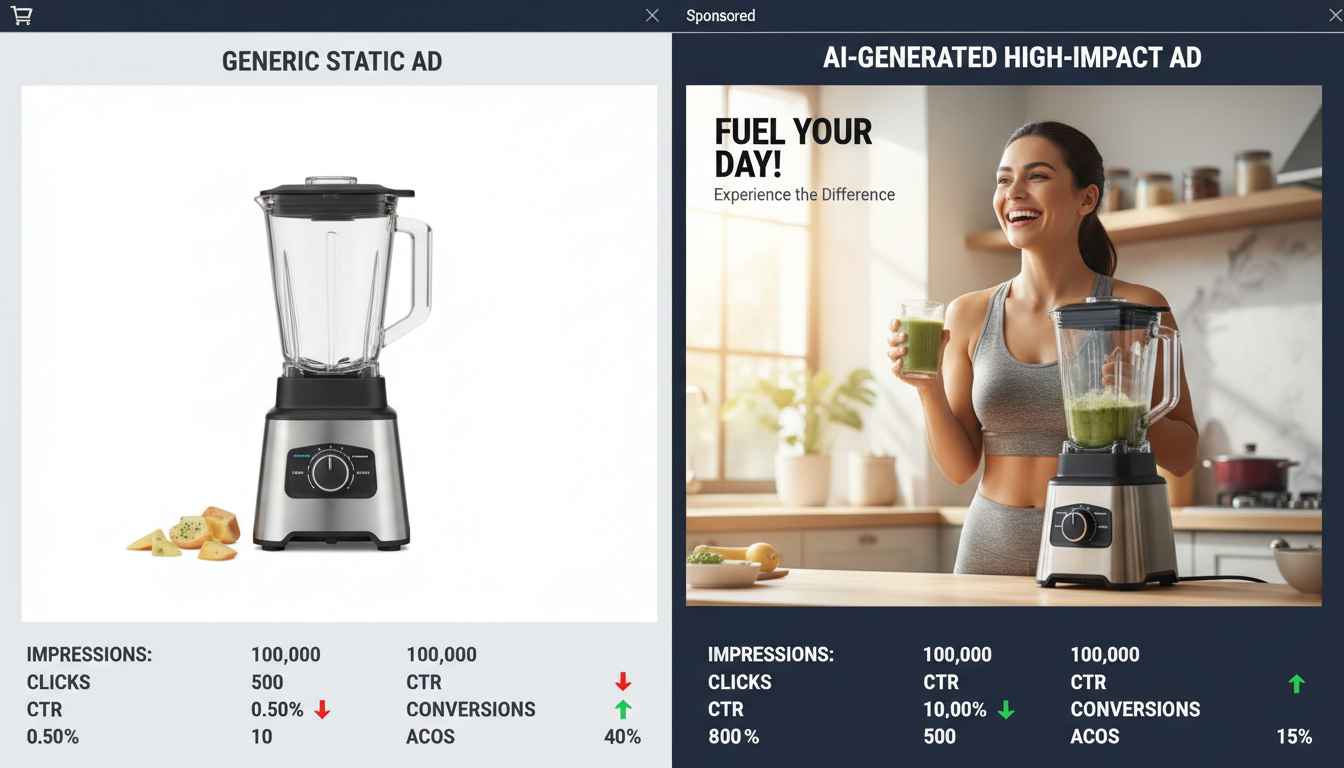
Creative quality is the most underestimated lever in Amazon advertising. Yet most brands are still running static product images with generic copy — the same assets they launched with six months ago. Creative fatigue is real, and it silently destroys CTR and conversion rates over time.
An AI ad creator solves this problem at scale, generating dozens of creative variants — lifestyle images, benefit-led headlines, A+ content modules, video thumbnails — in a fraction of the time and cost of traditional creative production. The result is continuous creative freshness without the agency retainer.
What AI-Powered Creative Generation Looks Like in Practice
AdAstraa's AdCreative+ tool ingests your brand guidelines, product catalog data, and historical ad performance metrics to generate creatives that are not just visually compelling — they are performance-engineered. Every asset is built around the benefit hooks and visual triggers that your specific category audience responds to.
Consider this real-world scenario: a mid-sized D2C supplements brand was running a single hero image across all Sponsored Brand campaigns. After switching to AI-generated creative rotation with 8 distinct variants, their average CTR increased by 34% within 45 days. The winning variant — a lifestyle shot with a transformation headline — was one the human creative team would have deprioritized based on gut feel. The AI identified it as the top performer based purely on engagement signal data.
Amazon's own research confirms that generative AI-powered advertising tools are enabling brands of all sizes to compete with creative quality previously reserved for enterprise advertisers with six-figure production budgets. The step-by-step democratization of premium ad creative is one of the most game-changing shifts in the history of the Amazon marketplace.
See how AI-generated creatives can transform your Amazon ad performance
🎨 Generate Your First AI Ad Creative Free →Strategy 4: Automate Negative Keyword Management to Instantly Stop Budget Bleed
If bid optimization is the engine of AI Amazon advertising, negative keyword automation is the brake system. Without it, your budget accelerates into irrelevant search queries and non-converting impressions regardless of how smart your bidding algorithm is.
The manual process of identifying and negating non-converting keywords is time-consuming, inconsistent, and always lagging. A search term that burns $80 with zero conversions might sit in your campaign for three weeks before a human reviewer catches it. An AI automation system flags it and negates it within 24–48 hours of hitting a defined click threshold with no conversion.
The Proven Framework for Intelligent Keyword Negation
Effective AI-driven negative keyword management operates on a tiered threshold model. Search terms that reach 15–20 clicks with zero conversions are auto-negated at the campaign level. Terms with a conversion rate below your category minimum are soft-negated and monitored. High-volume, low-intent terms identified through competitor mapping are proactively added to a brand-level negative list before they consume a single dollar of budget.
This approach can instantly recapture 15–25% of previously wasted ad spend and redirect it toward your highest-converting keyword clusters. When compounded over a quarter, the impact on True Profit per ASIN is dramatic.
Explore how AdAstraa approaches intelligent Amazon PPC campaign management with automated negative keyword layers built into every campaign structure — not bolted on as an afterthought.
| Keyword Status | Click Threshold | AI Action | Outcome |
|---|---|---|---|
| Zero conversions | 15–20 clicks | Auto-negate | Budget saved immediately |
| Below minimum CVR | 25–30 clicks | Soft negate + monitor | Reduced bid, watchlisted |
| Competitor low-intent | Proactive (0 clicks) | Proactive brand-level block | Budget never spent |
| High converting | Any | Graduate to exact match | Maximum bid control + ROAS lift |
Strategy 5: Track True Profit per ASIN — Not Just ROAS — with AI Analytics
Here is the uncomfortable truth about ROAS: it can look great while your business quietly loses money. A 5x ROAS on a product with a 15% margin, high return rate, and rising FBA fees may be deeply unprofitable. Yet most Amazon advertising management dashboards report ROAS in isolation, giving sellers a dangerously incomplete picture.
The most sophisticated AI marketing strategy is not about bidding or creatives — it is about measuring what actually matters. True Profit per ASIN accounts for ad spend, COGS, FBA fees, return rates, and storage costs to deliver a single, honest profitability score for every product in your catalog.
Why True Profit Visibility Changes Every Decision You Make
When you can see True Profit per ASIN in real time, your entire advertising strategy shifts. You stop scaling campaigns on products that look profitable but are not. You identify your genuinely high-margin ASINs and concentrate budget there. You catch margin erosion from fee changes before it becomes a quarterly shock.
AdAstraa's AI advertising platform integrates all cost variables — ad spend, fulfillment, COGS, promotions — to surface True Profit per ASIN on a single dashboard. This is the must-know intelligence layer that separates brands managing ad campaigns from brands managing profitable businesses.
One practical way to implement this strategy immediately: create a Profit Tier system for your catalog. Segment ASINs into three tiers — high margin, medium margin, and low margin. Apply your most aggressive AI-driven bidding to Tier 1. Apply conservative, defensive bidding to Tier 3. Redirect any Tier 3 savings directly into scaling Tier 1. The result is a self-funding growth model where profitability funds expansion.
How to Build Your Integrated AI Marketing Strategy on Amazon
The brands generating outsized results in 2025 are not applying these five strategies in isolation. They are running them as an integrated system — where buyer intent intelligence feeds the bid optimization engine, AI creatives are refreshed based on performance data, negative keyword automation protects every campaign, and True Profit analytics govern every scaling decision.
This is the architecture of an all-in-one advertising platform built for Amazon-first brands. It is what separates sellers who are perpetually chasing ACoS targets from brands that are compounding their competitive advantages quarter over quarter.
The Step-by-Step Implementation Sequence
- Audit your current ACoS and True Profit per ASIN — establish your real baseline before any optimization begins.
- Activate AI bid automation — import your campaign structure and set target ACoS ranges aligned to product margin tiers.
- Deploy buyer intent intelligence — map high-intent search clusters for each ASIN and restructure targeting accordingly.
- Implement automated negative keyword layers — set click-threshold rules and let the AI begin cleaning your search term reports daily.
- Launch AI creative rotation — generate a minimum of 5–8 creative variants per campaign and set performance-based auto-rotation.
- Review True Profit dashboards weekly — use the data to reallocate budget from low-margin to high-margin ASINs in each review cycle.
Explore AdAstraa's full suite of AI advertising strategies and tools designed specifically for Amazon-first brands who are done with wasted spend and ready to scale profitably.
Real-World Proof: What Happens When You Stack All 5 Strategies
Consider the trajectory of a mid-sized FMCG brand selling personal care products across Amazon India and Amazon UK. Before deploying an integrated AI marketing strategy, they were managing campaigns manually with a two-person in-house team. Their ACoS sat at 38%, ROAS was 2.6x, and approximately 35% of their ad budget was going to non-converting search terms. Sound familiar?
After activating AdAstraa's Autopilot bid engine, Shopper OS intent intelligence, and AdCreative+ AI creative rotation across their catalog — with True Profit per ASIN monitoring governing budget allocation — their results within 90 days were:
- ACoS reduced from 38% to 22% — a 42% improvement driven primarily by negative keyword automation and intelligent bid adjustment.
- ROAS increased from 2.6x to 4.1x — a 57% improvement powered by intent-driven targeting and AI creative performance.
- 18 hours of manual management time reclaimed per week — allowing the team to focus on product development and brand strategy rather than bid spreadsheets.
- 3 previously undetected loss-making ASINs identified via True Profit dashboards — allowing budget reallocation to top-performing products within the first month.
This is not an outlier outcome. It is what happens when AI marketing strategies are deployed systematically, not experimentally. The platform has now optimized ₹218 Crore in ad spend across 1,523 brands running on Autopilot — and the performance compounding effect grows with every campaign cycle.
Additional Resources
Deepen your knowledge of AI marketing strategies and Amazon advertising with these authoritative external resources:
-
AI in Marketing: How It Works, Key Applications, Examples — Amazon Ads Official Library
Amazon Ads' official guide to AI marketing tools, machine learning applications, and how generative AI is reshaping campaign optimization across the platform. -
34 AI in Marketing Statistics: Industry Trends — Shopify Blog
Comprehensive data-backed breakdown of how AI adoption in marketing is evolving, with key stats on productivity gains, campaign ROI, and AI tool usage across ecommerce businesses. -
Supercharging Ad Creative with AI: Amazon Bedrock & Nova — AWS for Industries
A deep-dive from AWS on how generative AI foundation models are transforming advertising creative production at scale, with real applications for brand and content teams. -
Amazon Ads Benchmarks by Industry (Updated Data) — Triple Whale
Industry-segmented benchmarks for ACoS, ROAS, CPA, and CVR across Amazon advertising categories — essential reference data for setting realistic performance targets. -
How Agentic AI Can Help Improve Ad Creative Performance — Amazon Ads Expert Advice
Expert perspective on how agentic AI connects buyer signals to creative strategy, delivering measurably stronger ad performance across sponsored placements.
The Bottom Line: AI Marketing Is Not a Future Strategy — It Is Today's Competitive Baseline
Amazon advertising in 2025 is not a level playing field. Brands that are still managing campaigns manually — reviewing search term reports weekly, adjusting bids in spreadsheets, recycling the same static creatives — are bringing a ruler to a benchmark fight against AI-powered competitors who are optimizing in real time, around the clock.
The five strategies in this guide are not theoretical. They are proven, operational, and delivering measurable results for hundreds of Amazon brands right now. The core principle connecting all five is simple: eliminate every dollar of waste, invest with surgical precision in what converts, and let AI handle the execution velocity that no human team can sustain manually.
Your ACoS does not have to be stuck at 35%. Your ROAS does not have to stagnate at 2.5x. Your team does not have to spend 20 hours a week on bid management. The technology to fix all three problems exists, it is accessible, and it is working right now for brands exactly like yours.
Read our AdAstraa blog for more in-depth guides on Amazon advertising, AI marketing strategies, and platform updates — or head straight to the platform and see what intelligent automation can do for your ad performance today.
Ready to Transform Your Amazon Ad Performance?
Join 1,523+ brands running on AdAstraa Autopilot.
Stop burning budget on non-converting keywords. Start compounding your ROAS with AI-powered bid optimization, buyer intent intelligence, and performance-engineered creatives — all in one platform.
🚀 Launch Your AI Advertising Strategy — Free Trial →