



Amazon's advertising revenue hit $47.4 billion in 2024 — a 24% year-over-year surge. Yet most sellers are still watching that budget disappear into non-converting keywords, guesswork bids, and campaigns that spend freely without delivering returns.
If your ACoS is creeping above 30%, your ROAS is flat, and your ad management hours feel like a second full-time job — you're not alone. The essential difference between brands that scale profitably on Amazon and those that bleed ad spend comes down to one thing: strategy backed by intelligent automation.
This guide breaks down 5 proven, game-changing Amazon advertising strategies that leading D2C brands are using right now to slash wasted spend, reclaim manual hours, and unlock sustainable growth — powered by AI tools built specifically for the Amazon ecosystem.
Stop bleeding ad spend. Start running campaigns on Autopilot.
Start Your Free Trial with AdAstraa →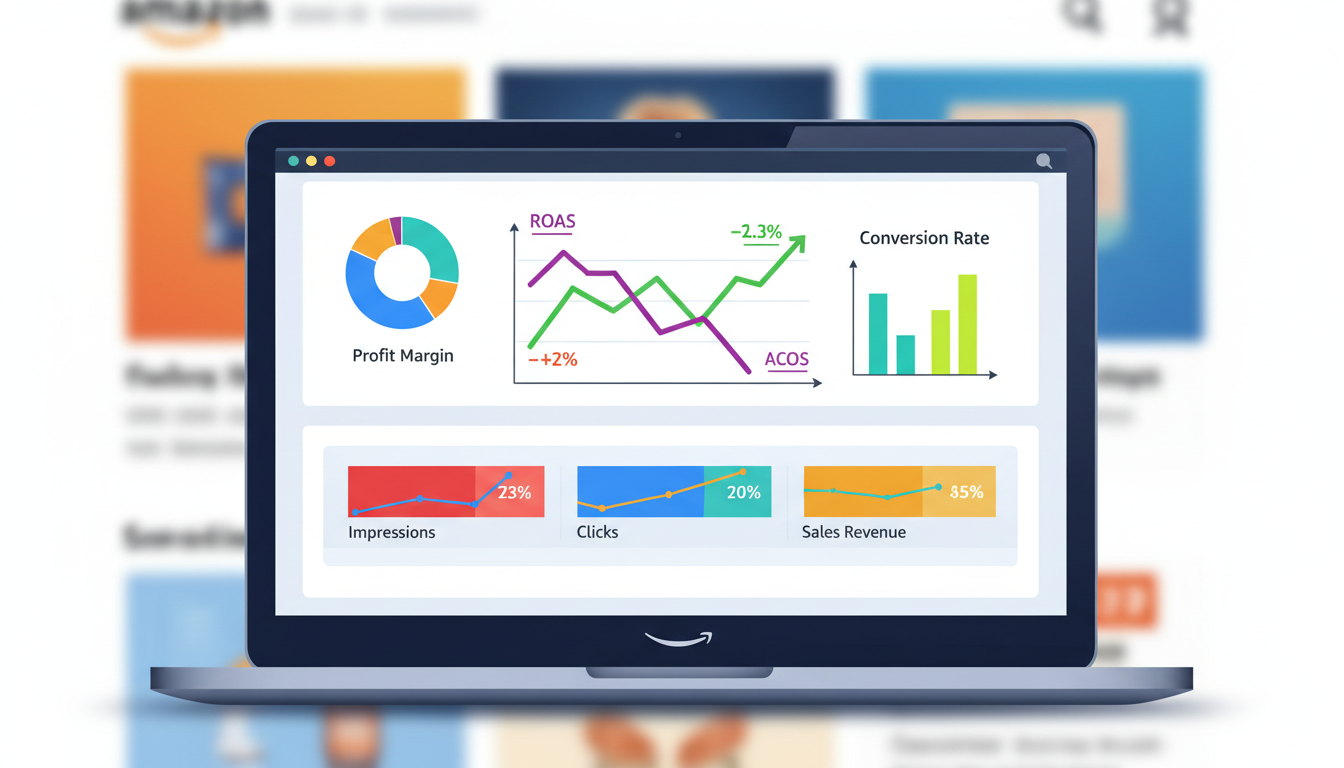
Why Most Amazon Advertising Campaigns Underperform
Here's the uncomfortable truth: running Amazon PPC without a structured strategy is the equivalent of leaving your front door open with a sign that says "take what you want." The platform is sophisticated. The competition is fierce. And CPC costs are rising 15% year-over-year across most categories.
The three most devastating mistakes brands make are:
- Bidding on everything indiscriminately — targeting broad-match keywords without negative keyword harvesting torches budget at scale.
- Manual optimization lag — by the time a human reviews last week's search term report and adjusts bids, market conditions have already shifted.
- Ignoring true profitability per ASIN — optimizing for ACoS alone without factoring in FBA fees, return rates, and COGS leads to campaigns that look healthy but destroy margin.
The breakthrough comes when you pair strategic intent with AI-powered execution. Tools like AdAstraa's AI advertising strategies platform bridge that gap — processing thousands of data signals simultaneously and making bid decisions in real time, not in weekly review cycles.
What Good Actually Looks Like: 2025 Benchmarks
According to current industry data, strong Amazon advertising performance in 2025 looks like:
| Metric | Average Benchmark | Top-Performer Target |
|---|---|---|
| ACoS | 20–40% | Below breakeven ACoS |
| ROAS | 2.5x–3.5x | 4x–5x+ |
| CVR (Conversion Rate) | 10–12% | 14%+ |
| CPC (avg. across categories) | $0.75–$3.50+ | Optimized via AI bidding |
Closing the gap between average and top-performer isn't about spending more. It's about spending smarter — and the five strategies below show you exactly how.
Strategy 1: Build a Surgical Campaign Architecture from Day One
The foundation of any powerful Amazon advertising strategy is campaign structure. Get this wrong and every optimization that follows is built on sand.
The step-by-step approach top-performing brands use is a three-tier structure:
The Proven Three-Tier Campaign Framework
- Tier 1 — Discovery (Auto Campaigns): Run broad auto campaigns with a conservative daily budget. These are your keyword intelligence harvesting machines. Let them run for 2–4 weeks, then mine the Search Term Reports for converting queries.
- Tier 2 — Conversion (Manual Exact & Phrase): Graduate proven performers from Tier 1 into tightly controlled manual campaigns. Use exact match for your highest-intent buyers and phrase match for moderate intent.
- Tier 3 — Defense (Branded + Competitor Targeting): Protect your brand terms with branded campaigns (typically low-cost, high-ROAS) and use ASIN-level targeting to poach shoppers from competitor product pages.
The critical rule: never mix match types within a single campaign. Mixing dilutes your ability to optimize bids at the keyword level and makes your Search Term Reports a tangled mess.
The Negative Keyword Obsession That Protects Every Rupee
Negative keywords are the most underutilized lever in Amazon PPC. Brands running AdAstraa's AI advertising platform automatically identify and suppress non-converting search terms — eliminating wasted spend on keywords that accumulate clicks but zero sales.
A standard rule of thumb: any keyword that receives 20 or more clicks with zero conversions should be negated immediately. AI-powered ad management tools do this continuously, not just when you remember to check.
Strategy 2: Replace Manual Bidding with AI-Driven PPC Automation
Manual bid management was a viable approach when you had 10 products and 50 keywords. It is categorically impossible to do well at scale. A mid-sized Amazon brand managing 100 ASINs across 3 ad types can easily have 50,000+ keyword-level bid decisions to make every single day.
This is precisely why AI-powered Amazon PPC automation is no longer a luxury — it's a competitive necessity.
How 24/7 Bid Optimization Changes the Economics
AdAstraa's Autopilot engine makes bid adjustments around the clock, responding to real-time conversion signals, competitor bid fluctuations, time-of-day purchase patterns, and inventory levels simultaneously. Manual teams review data weekly. Autopilot acts in minutes.
The commercial result is measurable: brands running on Autopilot see an average +41.8% ROAS lift compared to pre-automation baselines. That's not a marginal gain — that's the difference between a campaign that sustains itself and one that funds growth.
Day-Parting and Seasonal Bid Multipliers
Advanced Amazon PPC optimization isn't just about setting a single bid and hoping for the best. Conversion rates on Amazon fluctuate dramatically by hour, day of week, and season. AI platforms model these patterns and apply automated bid multipliers — increasing bids during peak purchasing windows and pulling back during low-conversion hours to protect TACoS.
"By the time you analyze last week's search term report and make adjustments, the market has already moved. AI-powered PPC optimization makes adjustments daily based on real conversion data."
Strategy 3: Leverage Buyer Intent Intelligence to Target Precisely
The most essential shift in modern Amazon advertising strategy is moving from keyword-based targeting to buyer intent-based targeting. These are not the same thing.
A keyword is a string of text. Buyer intent is the why behind that search. A shopper searching "protein powder" at 11pm on a mobile device after browsing fitness equipment has a fundamentally different purchase intent than one searching the same term during a midday desktop session. Identical keywords. Different conversion probability.
Using Shopper Intelligence to Outbid Smarter, Not Harder
AdAstraa's Shopper OS turns raw Amazon search behavior data into actionable buyer intent signals. It surfaces which search terms are actually driving purchases at the category level — revealing high-intent queries your competitors haven't discovered yet.
Instead of bidding equally on all keywords, Shopper OS enables brands to allocate budget proportional to purchase probability. The result is a leaner campaign structure that converts at a higher rate while spending less per acquisition.
Identifying High-LTV Products Worth Aggressive Investment
Not all ASINs deserve equal ad investment. Products with strong repeat purchase behavior — consumables, supplements, beauty staples — have a lifetime value (LTV) that justifies a higher initial ACoS because subsequent purchases are organic.
Mapping buyer intent data against repeat purchase patterns lets you make guaranteed-profitable decisions about which ASINs to aggressively advertise versus which to run conservatively. This is one of the most overlooked dimensions of a winning Amazon advertising strategy.
See which of your ASINs deserve aggressive ad investment — and which are quietly draining budget.
Explore Shopper OS Intelligence →
Strategy 4: Generate High-Converting Ad Creatives with AI
Your bid strategy determines whether shoppers see your ad. Your creative determines whether they click it. Most Amazon advertisers obsess over bids and completely neglect creative quality — and that's a massive competitive blind spot.
Sponsored Brands, Sponsored Display, and video ads all compete on visual impact and messaging relevance. A breakthrough ad creative that improves CTR by just 2–3 percentage points can dramatically lower your effective CPC without changing a single bid.
AI-Generated Creatives That Are Built to Convert
AdAstraa's AdCreative+ uses AI to generate product-first ad creatives tailored to Amazon's visual ecosystem. Rather than generic templates, AdCreative+ analyzes your product category, competitive landscape, and top-performing visual patterns to produce ad creatives optimized for Amazon's specific shopping context.
The practical benefit is speed and scale. What previously required a design team and days of iteration can now be generated, tested, and iterated in hours. Brands running AdCreative+ report higher CTR on Sponsored Brand campaigns, which directly reduces CPCs through Amazon's auction mechanics.
A/B Testing Creatives at Scale
The most effective approach is structured creative testing: run two to three creative variations per campaign, measure CTR and conversion rate over a statistically significant sample, then allocate budget entirely to the winner. AI platforms automate this rotation and flag winners automatically — eliminating the manual effort and guesswork.
Think of your ad creative as a silent salesperson. A powerful image paired with the right headline can double your CTR, halving your effective cost-per-click overnight. That's not a marginal gain — that's a structural cost advantage your competitors can't easily replicate.
Strategy 5: Optimize for True Profit per ASIN — Not Just ACoS
This is the secret most Amazon advertising courses never teach: ACoS is a vanity metric if you're ignoring true unit economics.
A product with a 22% ACoS sounds great — until you factor in a 15% FBA fee, a 5% return rate, $2.40 cost-of-goods variance, and Amazon's referral fee. That same product might actually be operating at negative profit. Meanwhile, a product with 35% ACoS but 60% gross margins could be your most profitable ASIN by a wide margin.
The Step-by-Step True Profit Calculation
Calculating True Profit per ASIN requires factoring in:
- Selling price minus Amazon referral fee (typically 8–15%)
- Minus FBA fulfillment fees (weight and size dependent)
- Minus Cost of Goods Sold (COGS)
- Minus ad spend allocated to that ASIN
- Minus return and refund provisions
- Minus storage fees (particularly relevant for slow-moving inventory)
What remains is your True Profit. AdAstraa's platform surfaces this calculation per ASIN in real time — giving brand managers and agency operators a living dashboard of actual profitability rather than advertising proxies.
Real-World Example: How a Beauty Brand Unlocked 38% More Margin
A mid-sized personal care brand managing 47 ASINs across skincare and haircare came to AdAstraa with a frustrating problem: their overall ACoS was a seemingly healthy 24%, but actual profit margins were thinning every quarter.
After connecting their account to AdAstraa's True Profit dashboard, they discovered that 11 of their 47 ASINs were actually operating at negative unit economics after factoring in all costs. They had been pouring ad spend into ASINs that looked good on the surface but were quietly destroying margin.
The step-by-step fix: they reallocated budget from the 11 loss-making ASINs toward their 8 highest-margin products. They also used Shopper OS to identify untapped high-intent keywords for those profitable products. Within 90 days, overall account ROAS improved by 38% — without increasing total ad spend by a single rupee.
That's the power of building your Amazon advertising strategy on real economics, not advertising metrics alone.
How to Put All 5 Strategies Together: The AI-First Amazon Advertising OS
Each of the five strategies above is powerful on its own. But the ultimate competitive advantage comes from operating them together as an integrated system — where campaign architecture feeds into AI bidding, which is informed by buyer intent signals, powered by high-converting creatives, and measured against true unit economics.
This is what AdAstraa is built to be: not a collection of disconnected tools, but a single AI-powered operating system for Amazon-first brands. Its four core engines work in concert:
- Autopilot — 24/7 AI bid optimization across all campaign types, in 9 marketplaces simultaneously.
- Shopper OS — Buyer intent intelligence that reveals what your actual customers are searching for and which ASINs they're most likely to purchase.
- AdCreative+ — AI-generated ad creatives optimized for Amazon's visual environment, reducing CPCs through improved CTR.
- EcomGPT — Automated customer operations that reduce support workload and protect seller metrics — because your organic rank and ad performance are deeply linked to your seller health score.
Over 1,523 brands are already running on AdAstraa's Autopilot. Together, they've optimized more than ₹218 Crore in ad spend — with an average ROAS lift of 41.8% across Growth plan accounts.
That's not a pitch. That's a benchmark you can hold us to.
For Agencies: Scaling Amazon Advertising Management Without Scaling Headcount
If you're an agency managing Amazon advertising for multiple brands, these strategies multiply your leverage — but only if you can execute them at scale without proportionally scaling your team.
AdAstraa's Partner Program is purpose-built for agencies that need to deliver elite campaign performance across dozens of client accounts simultaneously. The platform's multi-account dashboard surfaces portfolio-level performance anomalies, automatically flags accounts where ACoS is trending above target, and enables bid rules to be deployed across client accounts in bulk.
The result: agencies using AdAstraa report being able to manage 3–4x more client accounts per campaign manager — without any reduction in optimization quality. That's the kind of effortless scalability that turns a services business into a highly profitable operation.
5 Must-Know Mistakes That Silently Kill Amazon Ad Performance
Even with the right strategy in place, these operational errors will undercut your results instantly:
- Running out of budget before peak shopping hours. If your campaigns exhaust their daily budget by 2pm, you're missing the evening conversion window when most purchase decisions happen. Use AI-driven budget pacing to protect availability throughout the day.
- Advertising out-of-stock ASINs. Spending ad budget on a product that can't be fulfilled destroys campaign history and wastes every impression. Inventory-aware platforms automatically pause campaigns when stock drops below threshold.
- Optimizing campaigns during the attribution window. Amazon's attribution lag means recent sales data is incomplete. Making aggressive bid changes within a 7-day window leads to over-corrections. Wait for data to mature before acting.
- Ignoring placement bid adjustments. Top-of-search placements convert at significantly higher rates than rest-of-search. Allocating placement bid multipliers correctly can dramatically improve ROAS without changing base bids.
- Treating Sponsored Brands as secondary. Sponsored Brand campaigns have some of the highest new-to-brand customer acquisition rates on the platform. Under-investing here means leaving long-term customer acquisition on the table.
The Bottom Line: Strategy Is the Multiplier, AI Is the Engine
Amazon's advertising platform rewards brands that show up with both clear strategic intent and the operational infrastructure to execute at machine speed. The 5 strategies in this guide — surgical campaign architecture, AI-driven bid automation, buyer intent targeting, AI-generated creatives, and true profit optimization — aren't independent tactics. They're a compounding system.
Each strategy you implement multiplies the impact of the others. A better campaign structure gives AI bidding cleaner signals. Better creatives improve CTR, which lowers CPC, which gives your AI bidding engine more room to be aggressive. Buyer intent data focuses all of it on the keywords that actually convert. And true profit visibility ensures every dollar you spend is working toward sustainable growth — not just superficially healthy ACoS numbers.
The brands winning on Amazon in 2025 aren't necessarily spending more. They're operating smarter — with AI-powered platforms that eliminate waste, surface opportunities, and scale execution beyond what any human team can match alone.
You now have the blueprint. The question is whether you act on it before your competitors do.
Ready to build your AI-first Amazon advertising strategy?
Join 1,500+ brands already scaling profitably on AdAstraa's Autopilot platform.
Start Free — No Credit Card Required →Additional Resources
Deepen your understanding of Amazon advertising and AI-driven marketing strategy with these authoritative external sources:
- Amazon Ads Official Blog — Authoritative updates on Amazon advertising products, performance insights, and new campaign types directly from Amazon.
- Amazon Ads Benchmarks by Industry — Triple Whale — Comprehensive, regularly updated benchmark data for ACoS, ROAS, CPC, and CVR across major product categories.
- AI in Marketing Statistics 2025 — Intelliarts — Data-backed analysis of AI adoption rates, performance gains, and ROI benchmarks for AI-powered marketing tools.
- Amazon Seller Central: Advertising Help Hub — Official documentation on Sponsored Products, Sponsored Brands, and Sponsored Display campaign management from Amazon.
- Amazon PPC KPIs Explained — PPC Ninja — A thorough breakdown of every metric that matters in Amazon PPC, including ACoS, ROAS, TACoS, and breakeven calculations.