



Amazon sellers now spend over $10 billion on advertising annually — yet the average cost-per-click jumped 15.5% year-over-year to $1.12 in 2025. If your agency platform isn't actively fighting that cost creep, you're not just leaving money on the table. You're watching it evaporate, click by click.
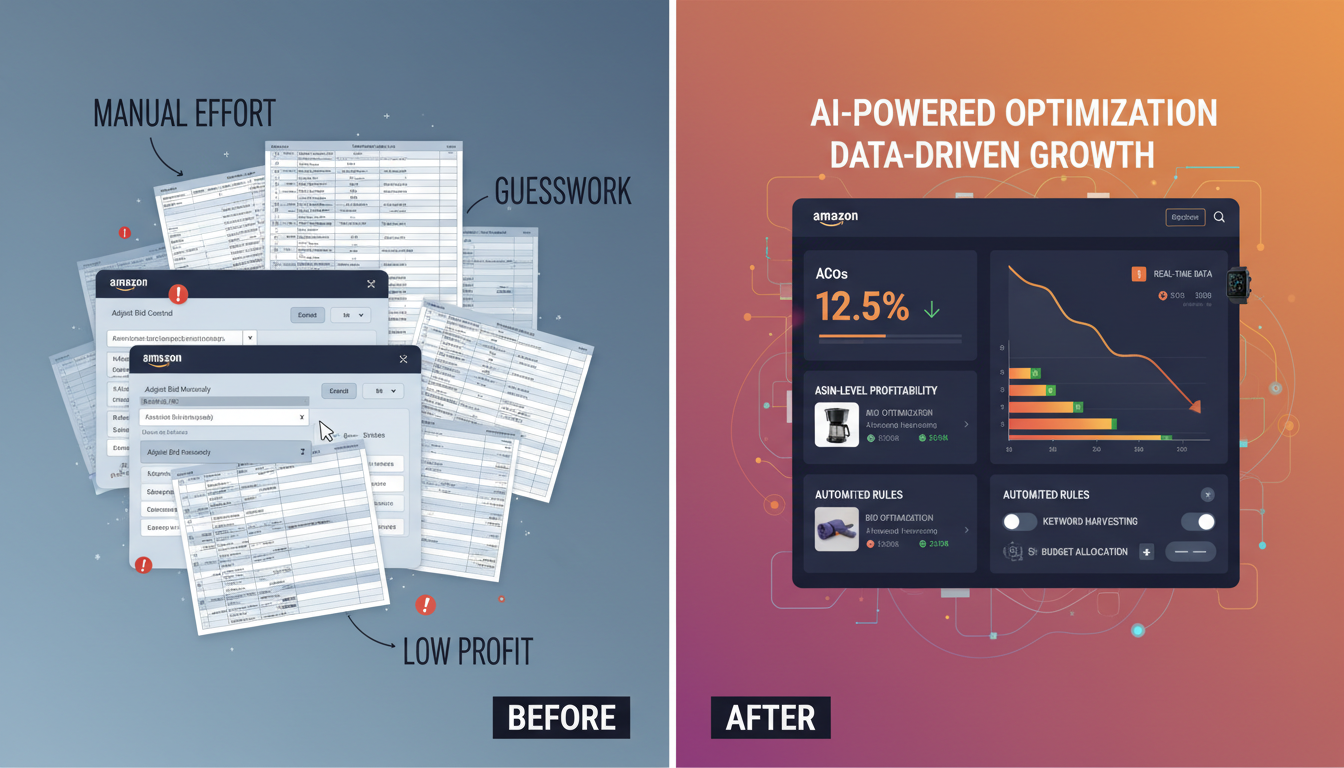
Whether you're a brand running solo or an ad agency managing a portfolio of accounts, the pressure to deliver lower ACoS, stronger ROAS, and real-time visibility has never been higher. The old way — spreadsheets, manual bid pulls, and gut-feel keyword decisions — is officially dead.
This guide breaks down the essential criteria for evaluating Amazon ad management platforms, what separates the great tools from the glorified dashboards, and how the right AI-powered advertising platform can become the backbone of every high-performing account you manage.
Stop guessing. Start growing — with AdAstraa's AI-powered ad management.
Try AdAstraa Free Today →
Why the Right Agency Platform Changes Everything for Amazon Sellers
Let's be direct: Amazon's native Seller Central is built for listing, not for breakthrough ad management. It gives you data, but it doesn't give you decisions. And in a marketplace where your competitor's AI is adjusting bids every 15 minutes, logging in twice a week to tweak campaigns is a losing strategy.
Agency platforms and Amazon seller tools exist to bridge that gap — automating the mechanical work of PPC pay-per-click advertising so your team can focus on strategy, creative, and growth. The best platforms don't just save time. They generate compounding returns by making smarter, faster, data-driven decisions at scale.
The Real Cost of Manual PPC Management
Consider a mid-size FMCG brand running 40 active campaigns across Sponsored Products, Sponsored Brands, and Sponsored Display. A campaign manager spending even 90 minutes daily on bid adjustments, negative keyword harvesting, and budget pacing is burning roughly 540 hours per year on tasks a quality platform handles in seconds.
Now multiply that across 20 client accounts in an agency. The math becomes brutal — and the margins disappear long before the invoices go out.
The proven solution isn't hiring more people. It's deploying the right tools that turn your team's expertise into scalable, automated execution.
5 Must-Know Criteria for Choosing an Amazon Ad Management Platform
Not every tool deserves a spot in your agency stack. Here's the step-by-step framework serious operators use when evaluating agency platforms for Amazon advertising management.
1. Bid Automation That Actually Works 24/7
The most powerful platforms don't just schedule bid changes — they respond to live market signals around the clock. Look for systems that adjust bids based on conversion probability, time-of-day performance data, and competitive pressure — not just a static rule you set on Monday morning.
AdAstraa's Autopilot engine runs 24/7 bid optimization across every campaign, dynamically responding to shopper behavior in real time. The result: brands consistently see ACoS reductions without sacrificing the top-of-search placement that drives rank and revenue.
2. Keyword and Buyer Intent Intelligence
The biggest silent killer of click PPC performance isn't high CPCs — it's non-converting keywords consuming 30–40% of your budget. An essential platform feature is continuous, automated negative keyword harvesting combined with shopper intent signals that tell you why someone searched, not just what they typed.
This is where buyer intent intelligence tools — like AdAstraa's Shopper OS — provide a game-changing edge. By mapping real purchase behavior to keyword clusters, Shopper OS identifies which search terms are research queries versus ready-to-buy signals, letting you bid confidently on the terms that actually convert.
3. True Profitability Visibility Per ASIN
Blended ROAS metrics look great in a pitch deck. They're misleading in the real world. A platform that shows you aggregate performance across an entire catalog is hiding the 20% of ASINs that are destroying your overall margin.
Proven agency platforms give you ASIN-level True Profit — factoring in ad spend, FBA fees, COGS, and returns — so you know exactly which products to scale, which to throttle, and which to pull entirely. This granular visibility is what separates a profitable Amazon brand from one with impressive top-line revenue and devastating margin leakage.
4. Multi-Account Management Built for Agencies
If you're running an agency managing multiple Amazon seller accounts, your platform must support multi-client workflows — unified dashboards, client-level access controls, and consolidated reporting that doesn't require exporting CSVs into a spreadsheet at 11pm.
The best platforms treat agencies as first-class users, not an afterthought. Look for white-label reporting options, team permission structures, and the ability to apply tested optimization rules across accounts with a single action. Check out AdAstraa's agency partner program to see what a purpose-built agency experience actually looks like.
5. AI Creative and Content Capabilities
Ad performance doesn't live in bids alone. Creative quality — from Sponsored Brand headlines to product imagery and A+ content — directly affects CTR, conversion rates, and ultimately your ACoS. Platforms that separate creative from performance management are forcing you to context-switch constantly.
Look for integrated AI-generated ad creative tools that let you test and iterate on copy and visuals without leaving the platform. AdAstraa's AdCreative+ does exactly this — generating on-brand ad creatives at scale, informed by performance data from live campaigns.
Real-World Example: How an FMCG Brand Reclaimed Ad Budget Going Live on Amazon
Consider a mid-market health and personal care brand that launched live on Amazon with an aggressive PPC strategy — $40,000 in monthly ad spend across 6 parent ASINs and 80+ child variations. Within 90 days, ACoS had ballooned to 48%, well above their break-even threshold of 32%.
The root cause? Three compounding problems that manual management couldn't catch fast enough:
- Non-converting broad match keywords consuming 38% of budget with zero attributed sales in 30 days
- Flat bids across all hours when 60% of their category's conversions happened between 6–10pm
- Two ASINs with negative True Profit that were still being actively bid on due to blended-metric reporting
After migrating to an AI-powered ad management platform with 24/7 bid optimization, buyer intent keyword filtering, and ASIN-level profit tracking, the brand achieved:
| Metric | Before | After 60 Days |
|---|---|---|
| ACoS | 48% | 27% |
| ROAS | 2.1x | 3.7x |
| Wasted Ad Spend | $15,200/mo | $4,100/mo |
| Weekly Management Hours | 14 hrs | 3 hrs |
The breakthrough wasn't a bigger team or a bigger budget. It was deploying the right intelligence layer on top of their existing campaigns. See similar transformations documented in AdAstraa's brand case studies.
💡 Key Takeaway: ACoS benchmarks across Amazon categories range from 20–40%. If your current platform isn't actively moving you toward the lower end of your category range, it's not doing its job — you're just paying for a fancier spreadsheet.
What the Best Amazon Seller Tools Have in Common
After evaluating the landscape — from enterprise agency platforms to boutique AMZ seller tools — the ultimate differentiators come down to a short, essential list of shared capabilities.
They Replace Rules With Intelligence
Legacy platforms let you build rule-based automation — "if ACoS exceeds X, lower bid by Y%." Modern platforms powered by machine learning replace those rigid rules with adaptive models that learn from your specific account's conversion patterns, seasonality, and competitive dynamics.
The difference in outcomes is not incremental. It's a fundamental shift in what's possible. Instantly acting on micro-signals that a human manager would miss entirely — a spike in category search volume, a competitor going out of stock — is only possible at the intelligence layer.
They Unify Paid and Organic Performance Data
Pay-per-click advertising doesn't exist in a vacuum. Every dollar you spend on Sponsored Products affects your organic rank, your Best Seller Rank, and your product's long-term velocity. The best platforms surface these relationships — showing you how PPC investment today translates to organic lift tomorrow.
AdAstraa's Shopper OS buyer intelligence tool connects shopper search behavior to campaign performance, giving you a unified view of how paid and organic interact across every ASIN in your catalog.
They Automate Customer Operations, Not Just Ads
The most forward-looking Amazon seller tools are expanding beyond PPC into customer operations — review management, Q&A optimization, and post-purchase communications. When customer signals feed back into ad strategy (high return rate on an ASIN → reduce bids before investigating), the loop closes and efficiency compounds.
Tools like AdAstraa's EcomGPT automate these customer-facing operations, keeping brand reputation strong while freeing up the human hours that were previously buried in reactive inbox management.
Red Flags to Avoid When Selecting an Ad Agency Platform
Choosing the wrong advertising management platform is an expensive mistake — not just in subscription fees, but in the compounding cost of underperformance. Here are the guaranteed warning signs to watch for during any evaluation:
- Percentage-of-spend pricing with no performance guarantee. If a platform charges 3–5% of your ad spend regardless of results, their incentives are misaligned with yours. They profit more when you spend more — not when you spend smarter.
- No ASIN-level profit visibility. Any platform showing only blended campaign metrics is actively obscuring the information you need to make profitable decisions.
- Reporting that requires manual exports. In 2025, live-on-Amazon performance data should be available in real time, not in a PDF that arrives on the 3rd of the month.
- No negative keyword automation. If you have to manually identify and add negative keywords, you're fighting a losing battle against budget waste at scale.
- No dedicated agency tier. Platforms not built for agency workflows will create friction at every turn — from onboarding clients to delivering white-label performance reviews.
“The best ad management platform isn't the one with the most features — it's the one that makes every dollar you spend work harder, and every hour your team spends work smarter.”
Is your current platform passing these tests?
Run a free AdAstraa audit and find out exactly where your ad spend is leaking.
Get My Free Ad Audit →Why AdAstraa Is the Game-Changing OS for Amazon-First Brands and Agencies
Most agency platforms do one thing reasonably well. AdAstraa was built to do everything exceptionally well — because real Amazon growth doesn't happen in silos.
As an all-in-one ad operating system, AdAstraa's purpose-built AI tools work in concert:
- Autopilot — 24/7 AI bid optimization that eliminates non-converting spend and defends profitable placements without human intervention
- Shopper OS — Buyer intent intelligence that maps real purchase signals to keyword strategy, so every campaign dollar chases conversions, not clicks
- EcomGPT — Automated customer operations that protect your brand's reputation and feed behavioral signals back into ad strategy
- AdCreative+ — AI-generated ad creatives built for conversion, tested against live performance data, eliminating the creative bottleneck that slows most agencies
Together, these tools give brands and agencies a single, unified command center for every dollar of Amazon ad spend — from first impression to final purchase to True Profit per ASIN. Explore the full AdAstraa platform overview to see how each module connects.
For agencies specifically, the effortless multi-client workflow, white-label reporting, and flat-fee pricing model mean you can take on more accounts without burning out your team — and actually deliver the results that grow client relationships into long-term retainers.
Additional Resources
For deeper research into Amazon advertising management, PPC strategy, and agency platform benchmarks, these authoritative sources provide valuable context:
- 📘 Amazon Advertising — Understanding Ad Products (Official Guide) — Amazon's official breakdown of ad types, bidding mechanics, and key performance metrics like ROAS and impressions.
- 📊 Amazon Advertising Statistics 2025 — Sequence Commerce — Comprehensive, regularly updated data on CPC trends, category benchmarks, and seller growth statistics.
- 🔬 Amazon PPC Advertising Ultimate Guide — Jungle Scout — In-depth beginner-to-advanced guide on PPC campaign types, keyword targeting, and ad strategy fundamentals.
- 📈 Amazon Ads ACoS, ROAS & CPC Benchmarks by Category — Category-level performance benchmarks to evaluate whether your current ACoS and ROAS are competitive or lagging.
- 🏛️ Amazon Ads Partner Directory (Official) — Amazon's official directory of verified advertising partners and agency platforms meeting Amazon's performance standards.
The Bottom Line on Amazon Ad Management Platforms
The Amazon advertising landscape has never been more competitive — or more expensive. With average CPCs climbing year after year and organic visibility becoming harder to earn, the difference between a profitable brand and a struggling one often comes down to a single variable: the quality of the agency platform or AMZ seller tool behind the campaigns.
The ultimate platform isn't the cheapest, the most feature-bloated, or the most talked-about in forums. It's the one that connects bid intelligence, buyer intent data, creative performance, and True Profit visibility into a single, unified system that works around the clock — so you don't have to.
For agencies, that means taking on more accounts with more confidence. For brands, it means finally knowing that every dollar you put into pay-per-click advertising is working as hard as possible toward profitable, sustainable growth.
AdAstraa was built precisely for this moment in Amazon commerce — when the brands that win aren't necessarily the ones with the biggest budgets, but the ones with the smartest systems behind every campaign.
Ready to Transform Your Amazon Ad Performance?
Join hundreds of brands and agencies already scaling smarter with AdAstraa.
No long-term contracts. No percentage-of-spend pricing. Just results.
Start Your Free AdAstraa Trial →