


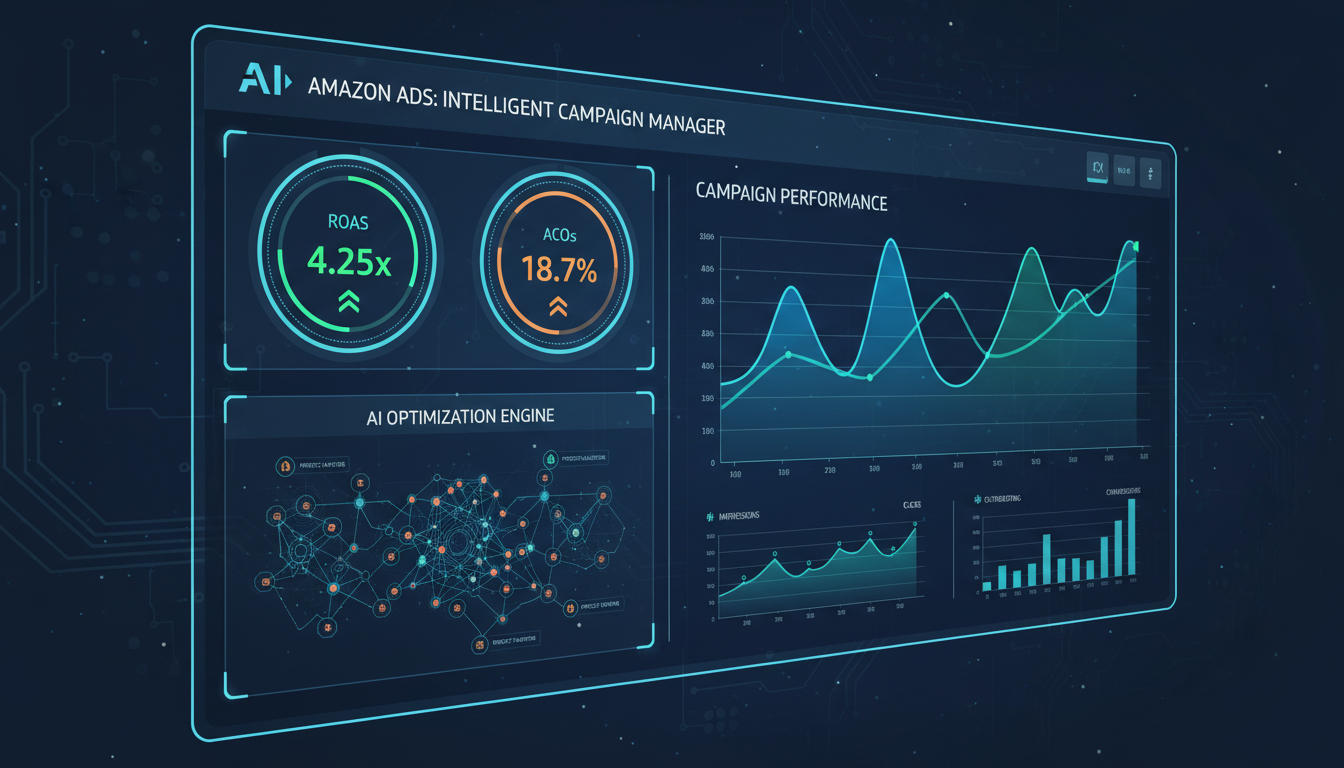
Here's a number that should stop every Amazon brand owner cold: Amazon's advertising revenue surpassed $56.2 billion globally in 2025 — making it the third-largest digital ad platform on the planet. Yet most brands running Amazon ecommerce ad campaigns are still relying on manual bid adjustments, guesswork targeting, and bloated keyword lists that silently drain their margins every single day.
If you've ever stared at a rising ACoS and wondered where all your ad spend actually went, you're not alone. The landscape of digital marketing advertising on Amazon has changed irrevocably — and the brands that understand how to deploy AI intelligently inside their ad campaigns are pulling away from the competition at a pace that manual management simply cannot match.
This guide breaks down the five most proven, high-impact ways AI is transforming Amazon ecommerce ad campaigns — and exactly how growth-focused brands are using these capabilities to reclaim margin, cut waste, and scale profitably.
Ready to put AI to work on your Amazon ad campaigns right now? Stop leaving money on the table.
Start Your Free AdAstraa Trial Today →
Why AI and Amazon Advertising Are an Unstoppable Combination
Amazon's marketplace has never been more competitive. With CPC costs rising 15% year-over-year and third-party sellers spending up to 127% more on Sponsored Products ads than established brands relative to their revenue, the pressure on marketing budgets is immense. Manual campaign management — tweaking bids once a week, reviewing search term reports every fortnight — is no longer a viable strategy.
AI changes the equation entirely. Machine learning algorithms can process millions of data signals — conversion rates, time-of-day performance, competitor bid shifts, inventory levels, seasonal demand — and act on them in real time. No human team can match that velocity.
According to AdAstraa's AI advertising intelligence suite, brands that shift to AI-driven campaign management consistently see 30–50% reductions in time spent on manual ad operations — freeing teams to focus on strategy, product innovation, and growth.
Manual Campaign Management vs. AI-Driven Optimization
| Capability | Manual Management | AI-Powered Management |
|---|---|---|
| Bid Adjustments | Weekly or daily, manually | 24/7, every few minutes |
| Negative Keywords | Reactive, after waste occurs | Proactive, predictive blocking |
| Budget Allocation | Static, campaign-level | Dynamic, ASIN-level in real time |
| Creative Testing | A/B tests, slow iterations | Continuous multivariate optimization |
| Profit Visibility | Spreadsheets, delayed data | Real-time True Profit per ASIN |
1. Effortless 24/7 Bid Optimization That Never Sleeps
The single biggest drain on Amazon ad campaign performance is stale bids. A keyword that converts brilliantly at 9 AM on a Monday may bleed spend dry at 11 PM on a Saturday. Human managers simply cannot monitor and adjust bids with the granularity the platform demands.
AI-powered autopilot systems like AdAstraa's Autopilot engine monitor every active campaign around the clock. They process real-time signals — conversion rate fluctuations, competitor bid changes, placement data, and historical patterns — and adjust bids at a keyword level within minutes, not days.
The result is a dramatic reduction in wasted impressions and clicks from non-converting search terms, while high-intent moments are captured at the optimal bid price. Brands consistently report ACoS reductions of 20–35% within the first 30 days of switching to AI autopilot bidding.
The Intelligence Behind Smarter Bids
Modern AI bidding engines don't just react to data — they predict it. By training on millions of Amazon auction signals, these systems learn which keyword-ASIN combinations have the highest probability of converting at a given moment, day, or seasonality window. The bid is then set not to win the auction at any cost, but to win it profitably.
This is a game-changing departure from rule-based bidding, where you might say "increase bid by 10% if ROAS exceeds 4x." AI bidding models weigh dozens of variables simultaneously and find the mathematically optimal response — something no human-authored rule can replicate.
“AI autopilot bidding isn't about spending less — it's about spending every dollar where it has the highest probability of generating profitable return. That's the essential shift in mindset modern Amazon brands need.”
2. Breakthrough Buyer Intent Intelligence for Smarter Targeting
Running digital marketing ads on Amazon without understanding buyer intent is like printing flyers and dropping them from a helicopter. You might reach someone interested — but you're paying an enormous premium for the miss rate.
AI-driven buyer intent intelligence changes this by analyzing behavioral signals at scale: which search terms precede purchases, how shoppers navigate through competitor ASINs, what price sensitivity looks like across product categories, and where in the purchase funnel a shopper currently sits.
AdAstraa's Shopper OS is built precisely for this purpose. It surfaces the high-intent keyword clusters and ASIN-level audience segments that manual keyword research routinely misses — giving brands a structural targeting advantage that compounds over time.
The Secret Weapon: Predictive Negative Keyword Automation
One of the most powerful — and most underutilized — applications of AI in Amazon advertising campaigns is predictive negative keyword management. Rather than waiting for a search term to waste $50 in clicks before you add it as a negative, AI systems identify low-intent search term patterns before they drain budget.
This is especially critical for FMCG brands and D2C sellers with tight margins where every click has to earn its place. By eliminating non-converting keyword waste proactively, brands reclaim a portion of their budget that can be reallocated to proven, high-converting terms — delivering an immediate ROAS boost without increasing total spend.
- Behavioral pattern analysis — AI identifies click patterns associated with non-purchase intent across thousands of ASINs
- Category-level learning — Negative keyword models are trained per product category, not just per account
- Continuous refinement — As Amazon's search ecosystem evolves, so does the negative keyword model
- Zero manual review — Automation means your search term report works for you 24/7, not the other way around
Mid-Article Resource
See exactly how AdAstraa's Shopper OS and Autopilot eliminate wasted ad spend and drive profitable growth for Amazon-first brands.
Explore AdAstraa's Full Platform →3. AI-Generated Ad Creatives That Drive Instant Conversion Lifts
Great bidding and targeting will only take you so far. The creative quality of your Amazon digital marketing adverts — the images, headline copy, and A+ content — has a direct, measurable impact on CTR and conversion rate. A 0.1% improvement in CTR on a high-volume campaign can translate to thousands of dollars in additional revenue monthly.
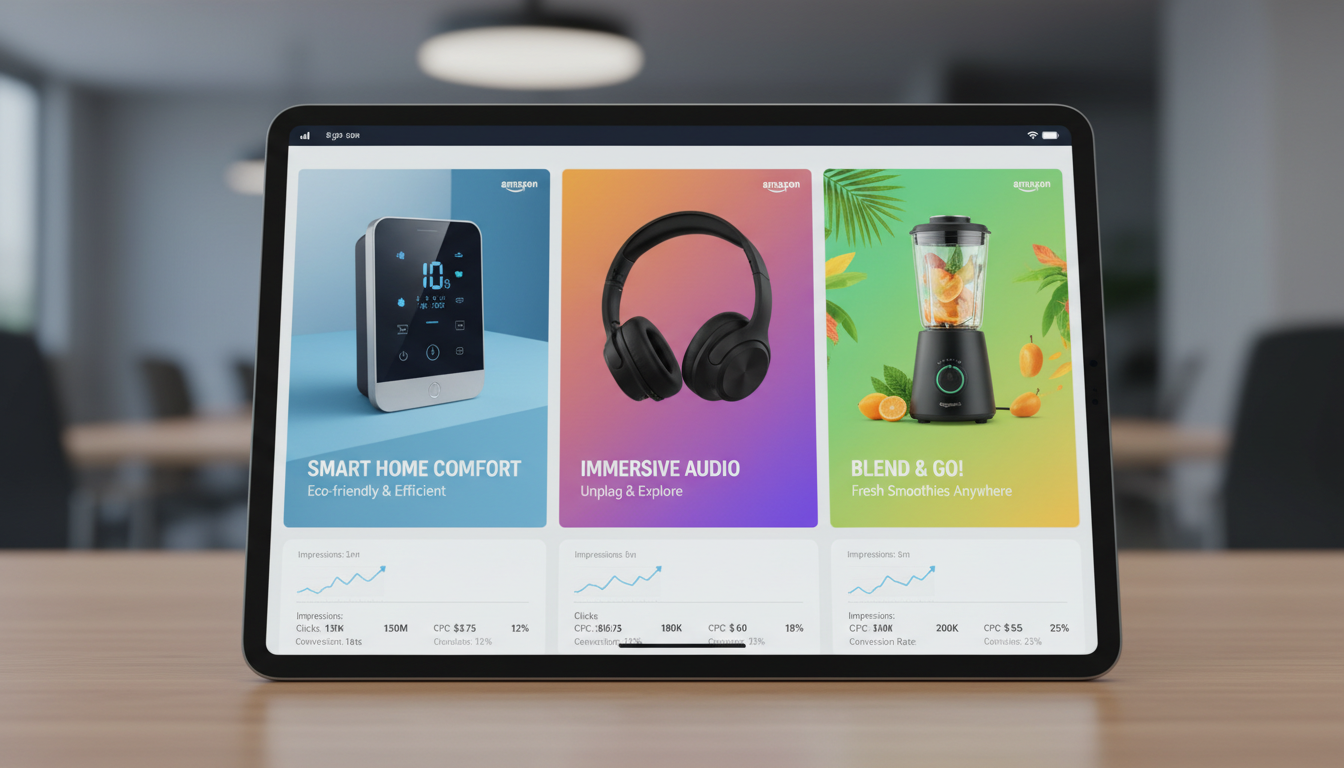
Traditional creative production is slow, expensive, and difficult to test at scale. AI changes all three constraints simultaneously. AdAstraa's AdCreative+ generates high-performing, Amazon-optimized ad creatives using AI — producing multiple creative variants in minutes rather than weeks, each tailored to specific audience segments, placement types, and seasonal triggers.
Dynamic Creative Optimization: How AI Finds Your Best Ad
Amazon's own platform now uses Dynamic Creative Optimization (DCO) — a technology that automatically assembles ad variants from a pool of headlines, images, and copy to serve the combination most likely to resonate with a given shopper. AI-native platforms go further, generating those creative assets in the first place and continuously learning from engagement data to improve future variations.
For brands running Sponsored Brands, Sponsored Display, or DSP campaigns, this represents a step-by-step shift in how creative strategy works: from periodic manual refreshes to a living, self-improving creative ecosystem that gets better every single week.
Real-World Example: How a Pet Supplies Brand Scaled CTR by 34%
Consider Boxie, a pet supplies brand that increased Amazon Canada's ordered revenue by 55.4% while improving ROAS by 34.2% on just 0.5% more ad spend. The key lever? Smarter creative deployment combined with tighter audience targeting — precisely the combination that AI-powered platforms are engineered to deliver.
The breakthrough was not a bigger budget — it was better signal interpretation. AI surfaced the exact creative formats, messaging angles, and placement combinations that the brand's core buyer segment responded to, eliminating the creative waste that had historically dragged down their ROAS.
4. Real-Time Profit Visibility Across Every ASIN in Your Catalog
Here's an uncomfortable truth: most Amazon brands don't know their true profit per ASIN. They know their ACoS. They might know their revenue. But when you factor in FBA fees, return rates, cost of goods, promotional discounts, and ad spend — the actual profit picture is dramatically different from what the Seller Central dashboard shows.
This visibility gap is one of the most dangerous silent killers in Amazon ecommerce. Brands pour advertising budget into campaigns that look profitable on the surface — only to discover at end of quarter that those campaigns were eroding margin at the ASIN level.
AI-powered operating systems solve this by aggregating data from every cost layer and surfacing True Profit per ASIN in real time. This transforms advertising campaign decisions from revenue-based to profit-based — a fundamental shift that changes which keywords you bid on, which products you promote, and where you allocate budget across your catalog.
Inventory-Aware Campaign Management: The Must-Know Advantage
Advanced AI campaign systems go one step further: they integrate live inventory data directly into bid and budget decisions. When an ASIN's inventory drops below a threshold, the system automatically reduces ad spend on that product — preventing the devastating double-loss of driving traffic to an out-of-stock listing that then tanks organic ranking.
Conversely, when inventory is plentiful and margin is strong, the system can aggressively scale ad spend to capture market share before competitors do. This is the kind of essential, powerful intelligence that separates profitable Amazon brands from those perpetually fighting fires.
- ASIN-level P&L dashboards — See revenue, cost, ad spend, and true profit for every product in one view
- Margin-aware bidding thresholds — AI automatically caps bids when True Profit per ASIN dips below your target floor
- Stock-synchronized spend scaling — Budget follows inventory in real time, protecting organic rank
- Cross-ASIN budget reallocation — Ad spend flows automatically toward highest-margin, highest-velocity products
5. Automated Customer Operations That Fuel Repeat Purchase Revenue
Winning the first sale on Amazon is expensive. The economics of Amazon ecommerce advertising campaigns only truly work when you maximize customer lifetime value — and that requires a guaranteed system for post-purchase engagement, review generation, and retention.
This is where AI-powered customer operations platforms become a hidden multiplier on your ad investment. EcomGPT by AdAstraa automates the entire post-purchase customer journey: follow-up messaging, review requests, Q&A responses, and customer service interactions — all handled by a large language model trained on Amazon ecommerce best practices.
Why does this matter for your advertising campaign performance? Because reviews directly impact conversion rate, and conversion rate directly impacts the efficiency of every ad dollar you spend. A product with 500 reviews and a 4.6-star rating will convert paid traffic at dramatically higher rates than an identical product with 50 reviews — lowering your effective ACoS without changing a single bid.
Building a Full-Funnel Digital Marketing and Advertising Engine
The most sophisticated Amazon brands no longer think of digital marketing and advertising as a linear funnel. They design a complete loop: AI-optimized ads drive new buyers → automated post-purchase journeys convert them into reviewers and repeat buyers → stronger reviews and repeat purchase velocity improve organic rank and conversion rate → improved conversion rate makes every future ad dollar more efficient.
This compounding flywheel effect is the ultimate competitive moat in Amazon ecommerce — and AI is the engine that makes it spin at a scale no manual team can sustain. Explore the full picture of what this looks like in practice across AdAstraa's brand case studies.
How to Build a Winning AI-Powered Amazon Advertising Strategy in 2025
Understanding the five AI capabilities above is step one. Implementing them in the right sequence is where most brands stumble. Here's the proven framework for brands transitioning from manual to AI-powered Amazon ad campaign management:
- Audit your current ACoS by ASIN, not just by campaign. Most brands discover that 20% of their ASINs are responsible for 80% of their ad waste. This diagnosis is the foundation of every profitable AI strategy.
- Implement 24/7 AI bid optimization first. This delivers the fastest, most measurable ROI and immediately frees budget for reallocation. Focus on your highest-volume campaigns first.
- Activate buyer intent intelligence to rebuild your keyword architecture. Replace volume-based keyword targeting with intent-signal-based targeting. Remove the non-converters. Amplify the high-probability terms.
- Upgrade your creative pipeline with AI generation and testing. Commit to having at least three creative variants per ad group in active rotation at all times. Let performance data — not opinions — decide what stays.
- Connect your ad data to your full P&L at the ASIN level. Make every campaign decision through the lens of True Profit per ASIN, not revenue or ACoS alone.
- Automate post-purchase operations to compound conversion rates over time. Every incremental review improvement is a permanent upgrade to your ad efficiency.
For a deeper dive into the strategic layer of this framework, explore AdAstraa's AI advertising strategies resource — built specifically for Amazon-first brands navigating competitive, margin-sensitive markets.
Additional Resources
Deepen your knowledge of AI-powered digital marketing advertising on Amazon with these essential reads from authoritative sources:
- Amazon Ads: What is Return on Ad Spend (ROAS)? — Official Guide — Amazon's official breakdown of ROAS calculation, benchmarks, and how it should guide your digital marketing campaign decisions.
- Harvard DCE: AI Will Shape the Future of Marketing — A research-backed perspective from Harvard Professional Development on how predictive AI models are transforming advertising strategy across ecommerce and beyond.
- Forbes: Small Brands Spend Three Times More on Amazon Ads Than Big Brands — Data-driven Forbes analysis of the Amazon advertising spend disparity between third-party sellers and established brands — and what it means for your strategy.
- Amazon Advertising Statistics 2025–2026: The Ultimate Reference Guide — Comprehensive benchmark data including average ACoS, ROAS, CTR, and AI adoption statistics across Amazon ad types and categories.
- HubSpot: 2025–2026 Marketing Statistics, Trends & Data — The definitive industry benchmark report covering PPC ROI, ecommerce advertising performance, and AI's growing role in digital marketing and advertising.
The Bottom Line: AI Is Not the Future of Amazon Advertising — It's the Present
With Amazon's advertising revenue surpassing $56 billion and CPCs rising every quarter, the margin for inefficiency in your Amazon ecommerce ad campaigns is shrinking fast. Brands that continue to rely on manual bid management, reactive keyword strategies, and fragmented creative processes are not just leaving growth on the table — they are actively falling behind competitors who have already made the AI transition.
The five strategies outlined in this guide — 24/7 AI bid optimization, buyer intent intelligence, AI-generated creatives, real-time ASIN-level profit visibility, and automated customer operations — are not theoretical. They are live capabilities used by the fastest-growing Amazon brands right now, delivering measurable, proven improvements in ROAS, ACoS, and True Profit per ASIN every single month.
The only question is: how long can you afford to wait?
Ready to Transform Your Amazon Ad Campaigns?
Join the Amazon-first brands already using AdAstraa to eliminate wasted ad spend, lower ACoS, and unlock True Profit per ASIN — all on autopilot.
Start Your Free AdAstraa Trial Now →