
📊 Did you know that up to 47% of marketing budgets are wasted on non-converting spend?
For Amazon brands running pay-per-click campaigns, that number isn't just alarming — it's a daily reality. Keywords that burn through budget without a single conversion. Bids adjusted too late. Creatives that fail to capture buyer intent. And hours of manual management that could be better spent growing your brand.
The good news? AI advertising has fundamentally changed what's possible. Brands that deploy the right AI advertising platform — one built specifically for Amazon's competitive ecosystem — are now seeing ACoS drop by double digits, ROAS climb past projections, and entire campaign workflows run on autopilot.
In this guide, you'll discover 6 powerful, proven AI advertising strategies that Amazon-first brands are using right now to eliminate waste, reclaim hours, and scale profitably. Whether you're a D2C founder, FMCG brand manager, or agency running dozens of accounts, these strategies are your essential playbook.
🚀 Ready to stop guessing and start winning on Amazon?
Join 1,500+ brands running smarter campaigns with AdAstraa's AI-powered ad OS.
Start Your Free Trial Today →
Why Traditional Amazon PPC Management Is Broken
Manual Amazon PPC campaign management made sense when sellers had five products and three campaigns. In 2025, the average growing brand manages dozens of ASINs across Sponsored Products, Sponsored Brands, and Sponsored Display — each with hundreds of keywords, match types, and bid variables.
The volume of decisions required every single day is simply beyond human capacity to handle profitably. By the time you analyze last week's search term report and adjust bids accordingly, the market has already moved. Competitors have changed their strategies. Conversion rates have shifted. Your manual guardrails are already outdated.
This is exactly why AI and advertising have become inseparable for high-growth Amazon brands. Artificial intelligence processes thousands of real-time data signals — conversion probability, seasonality, competitor bid pressure, inventory levels, time-of-day patterns — and acts on them instantly, at a scale no human team can match.
The result? Brands that embrace AI for advertising don't just save time. They fundamentally outperform brands still stuck in manual mode, achieving lower ACoS, higher ROAS, and genuine competitive advantage.
The Hidden Cost of Manual PPC Management
Consider a brand managing 40 SKUs with an average of 200 active keywords each. That's 8,000 bid decisions requiring daily attention — before you've even looked at search term reports, negative keyword harvesting, or budget pacing. The time cost alone is staggering.
But the real damage is in what doesn't get done: keywords that should have been negated weeks ago, profitable search terms that never got promoted to exact match, and budgets exhausted on peak-hour irrelevant traffic. AI advertising tools solve all of these problems systematically and simultaneously.
Strategy 1: Deploy 24/7 AI Bid Optimization for Effortless ACoS Control
The single most game-changing shift an Amazon brand can make is replacing scheduled manual bid reviews with continuous, AI-driven bid optimization. This is the core of what AdAstraa's AI advertising platform calls Autopilot — a system that adjusts every keyword bid, every hour, based on live performance data.
Unlike rule-based automation that simply says "if ACoS exceeds 30%, reduce bid by 10%," AI-powered bidding is predictive. It analyzes historical conversion patterns, current competition levels, time-of-day conversion rates, and seasonal trends simultaneously to forecast the optimal bid that maximizes profitable conversions in the next 24-hour window.
How Predictive Bidding Works in Practice
When a competitor increases aggression on your core keywords, AI responds within minutes — not at your next weekly review. When a product experiences a conversion rate spike (perhaps due to a review milestone or a competitor going out of stock), AI increases bids to capitalize on the window before it closes.
This level of responsiveness is guaranteed to compound over time. Small bid improvements made hundreds of times per day, across thousands of keywords, add up to meaningful ACoS reductions and ROAS gains that manual management simply cannot replicate.
"AI-powered Amazon PPC automation saves sellers 10+ hours weekly while delivering performance improvements through bid accuracy and competitive response that rule-based systems cannot achieve."
— Helium 10 Research, 2025
Strategy 2: Use Buyer Intent Intelligence to Target Shoppers Who Actually Convert
Not all traffic is equal. The most essential upgrade you can make to your targeting strategy is moving from keyword-volume thinking to buyer-intent thinking. This distinction is where most Amazon brands silently hemorrhage budget.
A shopper searching "protein powder" is browsing. A shopper searching "whey isolate 5lb chocolate unflavored no artificial sweeteners" is ready to buy. AI for marketing can identify these high-intent signals in real time and concentrate your budget where conversion probability is highest.
AdAstraa's Shopper OS does exactly this — it maps buyer intent patterns at scale, surfacing the search terms and audience segments most likely to convert for your specific ASINs. The result is a targeting strategy that's built on real purchase behavior, not assumed keyword relevance.
Systematic Negative Keyword Harvesting
The flip side of intent intelligence is aggressive negative keyword management. AI continuously monitors search terms generating clicks without conversions and automatically adds them as negatives before they drain further budget. This isn't a weekly task anymore — it's a continuous, automated process running in the background.
Brands using AI-driven negative keyword harvesting typically see a meaningful reduction in wasted spend within the first 30 days. That reclaimed budget can then be reallocated to proven converting search terms, creating a compounding improvement in overall campaign efficiency.
Strategy 3: Generate High-Converting AI Ad Creatives at Scale
Most Amazon brands treat creative as an afterthought — a static banner created once and left to underperform for months. In a marketplace where visual differentiation is increasingly decisive, this is a breakthrough opportunity for brands willing to treat creative as a performance lever.
AI-powered ad creative generation changes the equation entirely. Instead of briefing a design team, waiting days for revisions, and testing one or two variations, AI can generate dozens of high-converting creative assets — tailored to specific audience segments, seasonality, and product positioning — in minutes.
AdAstraa's AdCreative+ is purpose-built for Amazon-first brands, generating Sponsored Brand imagery, video thumbnails, and A+ Content visuals that align with your brand voice while being optimized for click-through and conversion performance. Every creative is backed by performance data, not guesswork.
AI-Powered Creative Testing Without the Guesswork
Traditional A/B testing on Amazon is slow and statistically noisy. AI accelerates this process by analyzing creative performance signals across impressions, CTR, and conversion data simultaneously — and automatically scaling the winners while retiring underperformers.
According to AI Digital's 2025 Media Trends Report, AI-driven dynamic creative optimization boosts engagement rates by up to 40% compared to static creative approaches. For Amazon brands competing on Sponsored Brand placements, that lift in CTR can be the difference between a profitable and a break-even campaign.
⚡ See how AI creatives, autopilot bidding, and intent intelligence work together
Explore AdAstraa's full suite of purpose-built AI tools for Amazon-first brands.
Explore the AdAstraa Platform →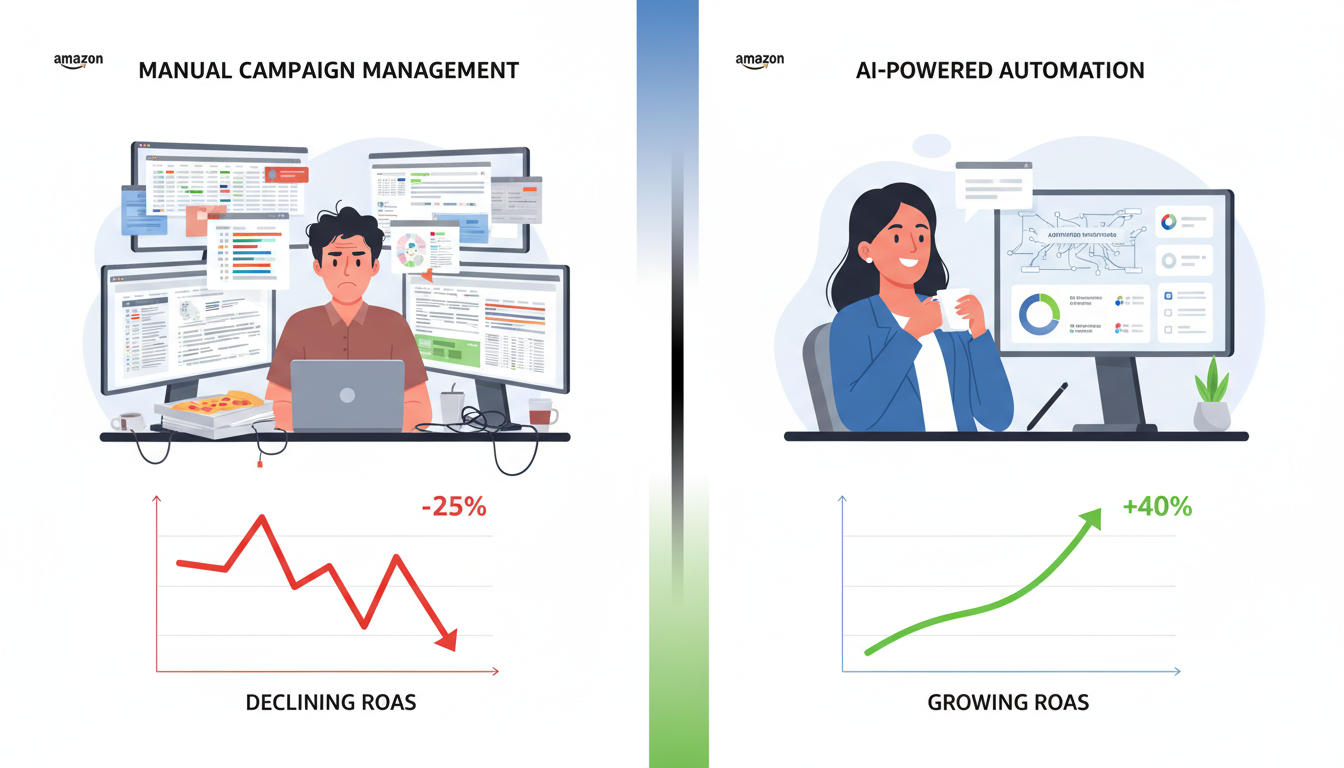
Strategy 4: Unlock True Profit Visibility with AI-Driven Marketing Analytics
Here is a must-know truth that most Amazon brands discover too late: ACoS and ROAS alone do not tell you whether you are actually profitable. A campaign running at 18% ACoS can still be destroying margin if your COGS, FBA fees, return rates, and promotional discounts are eating the spread.
This is why marketing analytics AI — specifically tools that calculate True Profit per ASIN — is one of the most powerful upgrades available to Amazon sellers in 2025. When you know your real profitability at the product level, every budget and bidding decision becomes sharper.
AdAstraa's platform surfaces True Profit per ASIN in real time, integrating ad spend, fulfillment costs, returns, and revenue into a single source of truth. This means your campaign management tools are always operating with complete financial context — not just ad-level metrics that paint an incomplete picture.
Real-World Example: How Profit Visibility Changes Decision-Making
Consider a personal care brand running campaigns on five hero SKUs. Without True Profit visibility, they're optimizing toward a 22% ACoS target across all five. With AI-driven profit analytics, they discover that two SKUs have higher FBA fees and return rates that make 22% ACoS unprofitable — while two others are leaving money on the table at that same target.
The breakthrough insight allows them to set differentiated ACoS targets per ASIN, concentrating spend on genuinely profitable products and pulling back from margin-negative campaigns. The outcome: overall ad spend stays flat, but net profit climbs significantly — a result that was invisible before AI analytics illuminated it.
Explore real AdAstraa case studies to see how brands are using profit-level visibility to make smarter advertising decisions.
Strategy 5: Automate Customer Operations to Reclaim Hours and Protect ASIN Health
The connection between customer operations and advertising performance is one of the most underestimated relationships in Amazon selling. Your ad campaigns drive traffic to listings. Those listings succeed or fail based on reviews, Q&A engagement, and buyer satisfaction signals. A slow response to negative feedback doesn't just hurt reputation — it directly undermines the conversion rate that your ad spend is funding.
Marketing workflow automation extends beyond bids and budgets. AdAstraa's EcomGPT automates customer-facing communications — review responses, Q&A answers, and buyer messaging — using AI trained on e-commerce context and brand voice. With a median response time of 2.1 seconds, it ensures no buyer interaction goes unanswered.
The Advertising–ASIN Health Feedback Loop
When buyers get fast, helpful responses to their questions and concerns, conversion rates improve. When conversion rates improve, your Quality Score improves. When your Quality Score improves, Amazon rewards you with better ad placement at lower cost-per-click. The entire advertising flywheel accelerates — but it starts with effortless customer engagement powered by AI.
This is the strategic advantage that brands using a complete all-in-one advertising platform hold over those using fragmented point solutions. Every component reinforces the others.
Strategy 6: Build a Scalable AI Advertising Operating System, Not a Stack of Disconnected Tools
Here is where most brands make a costly mistake: they bolt together five or six point solutions — one tool for bid management, another for keyword research, another for creative, another for analytics — and end up with a fragmented stack that creates more work, not less.
True ad campaign automation and scalable growth require an integrated operating system where data flows seamlessly between every function. When your bid optimizer shares conversion data with your creative tool, creatives improve. When your analytics platform feeds buyer intent signals into your targeting system, targeting sharpens. The compounding value of integration is what separates genuine AI transformation from incremental tool adoption.
This is the philosophy behind AdAstraa's design as an Amazon advertising platform — not a collection of tools, but a unified operating system built for Amazon-first brands. Autopilot, Shopper OS, EcomGPT, and AdCreative+ are engineered to work together, sharing data and reinforcing each other's performance in real time.
What a Truly Integrated AI Ad Platform Delivers
With an integrated marketing management platform, you gain a single source of truth for all performance data. You eliminate the manual work of reconciling reports from multiple tools. You reduce the risk of conflicting optimization decisions — for example, one tool increasing bids on a keyword that another tool has flagged as low-converting.
| Capability | Fragmented Tools | AdAstraa Integrated OS |
|---|---|---|
| Bid Optimization | Isolated, rule-based | Predictive AI, 24/7 (Autopilot) |
| Targeting Intelligence | Keyword volume-based | Buyer intent-driven (Shopper OS) |
| Creative Generation | Manual design workflow | AI-generated, performance-tested (AdCreative+) |
| Customer Ops | Manual or outsourced | Automated AI responses (EcomGPT) |
| Profit Visibility | ACoS/ROAS only | True Profit per ASIN, real-time |
See the full platform breakdown on AdAstraa's product overview page, or explore transparent pricing for every growth stage.
How to Start Implementing AI Advertising Strategies on Amazon Today
The most common question brands ask is: where do I start? The answer is simpler than most expect. You don't need to overhaul everything overnight. A step-by-step approach — starting with the highest-impact, lowest-friction changes — delivers results quickly while building confidence to expand.
- Audit your current ACoS and identify your worst-performing keywords. These are your immediate wins — AI can begin negating and reallocating budget within hours of onboarding.
- Activate Autopilot on your top-spending campaigns first. Let 24/7 bid optimization run for two weeks and compare performance to your baseline before expanding.
- Connect Shopper OS to your ASIN catalog and review the buyer intent map for your hero products. You will likely discover high-converting search terms you are not yet targeting.
- Generate your first batch of AI creatives with AdCreative+ and A/B test against your current Sponsored Brand assets. Even one stronger creative will compound across millions of impressions.
- Enable EcomGPT for customer communications and measure the impact on review velocity and response completeness over 30 days.
- Review True Profit per ASIN and adjust your campaign targets to reflect actual margin reality — not just ad-level metrics.
Each step builds on the previous one. Within 90 days, most brands using this framework report meaningful ACoS reductions, significant time savings, and a clearer picture of where their Amazon ad spend is actually generating profit. Review advanced AI advertising strategies to take your approach even further.
Additional Resources
Deepen your knowledge with these authoritative external sources on AI advertising, Amazon PPC strategy, and marketing automation:
- 📘 Amazon Advertising — Official Sponsored Products Guide — Amazon's authoritative resource on campaign types, bidding strategies, and targeting options for sellers.
- 📊 Statista — AI Use in Marketing: Statistics & Facts — Comprehensive data on AI adoption rates, marketing ROI, and industry benchmarks.
- 🎓 Harvard Business Review — AI-Powered Marketing: Pitfalls and Opportunities — Strategic framework for implementing AI in marketing from one of the world's leading business publications.
- 🔬 McKinsey & Company — AI-Powered Marketing Reaches New Heights — Research-backed analysis of how generative AI is transforming marketing performance and ROI.
- 📑 Amazon Seller Central — Advertising Best Practices — Official Amazon guidance on campaign structure, keyword strategy, and performance optimization.
The Future of Amazon Advertising Belongs to AI-First Brands
The six strategies outlined above aren't futuristic concepts — they are live, proven capabilities being deployed by Amazon's fastest-growing brands right now. The brands that win in 2025 and beyond will be those that treat AI advertising not as a feature to add, but as the operating foundation of their entire Amazon presence.
Manual campaign management isn't just slow — it's becoming a structural competitive disadvantage. Every week you spend on manual bid reviews, spreadsheet analysis, and static creatives is a week your AI-powered competitors are compounding their edge through automated intelligence that never sleeps.
The transition doesn't have to be overwhelming. Start with one strategy. Measure the impact. Expand from there. The ultimate goal is a fully integrated AI advertising OS that runs your campaigns, surfaces your profits, engages your buyers, and scales your brand — while you focus on what humans do best: building products people love.
🎯 Your AI-powered Amazon advertising OS is ready.
Join over 1,500 brands running smarter, more profitable campaigns on AdAstraa — with 24/7 Autopilot, Shopper OS, AdCreative+, and EcomGPT working together for you.
Get Started Free — No Credit Card Required →