


Here is a stat that should stop every Amazon seller cold:
More than 19 lakh sellers are now competing on Amazon India alone — and the average Google Ads CPC has climbed to $2.69 per click in 2024. Meanwhile, a click on Amazon Sponsored Products costs just $0.91 on average. If you are still splitting your budget blindly between Google advertising pricing and Amazon PPC without a structured strategy, you are almost certainly leaving serious revenue on the table.
Whether you are accessing Amazon Seller Central India or scaling into Amazon Seller Central US, the ad landscape in 2024 has never been more competitive — or more full of opportunity for sellers who know exactly where to invest.
This guide breaks down 7 proven, game-changing strategies that high-performing Amazon brands use to dominate ad auctions, reduce wasted spend, and achieve breakthrough ROAS — without overpaying for Google sponsored ads or burning through PPC budgets in the dark.
Stop guessing. Start winning. AdAstraa's AI Autopilot optimizes your Amazon bids 24/7 — so every rupee and dollar works harder.
Start Your Free Trial Today →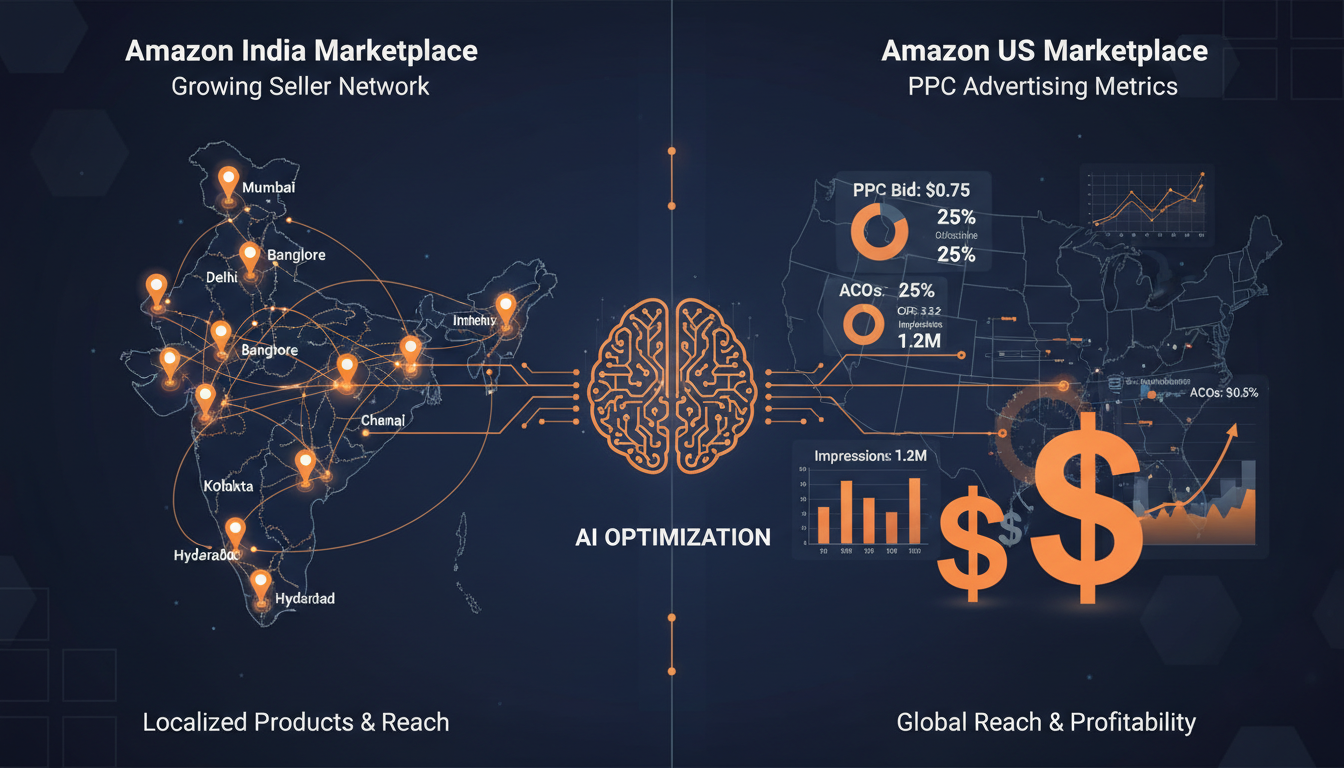
The Dual Marketplace Opportunity: Amazon India vs. Amazon US
Amazon India posted ₹25,406 crore in revenue in FY2024 — a 14% year-on-year growth — while enabling over $20 billion in cumulative ecommerce exports from India between 2015 and 2025. The US marketplace, meanwhile, remains Amazon's largest store, trusted by more American consumers than any other brand.
For sellers logged into Amazon Seller Central India, the domestic opportunity is surging: 168 million products sold, 100 million+ registered users, and festive season GMV that rivals global benchmarks. For Indian brands eyeing Amazon Seller Central US, Amazon Global Selling has onboarded 200,000+ exporters into 18+ global marketplaces.
The essential insight is this: both marketplaces are won or lost in the ad auction. And the brands winning that auction consistently are not spending more — they are spending smarter.
Why Ad Strategy Matters More Than Budget Size
In 2024, more than 55,000 independent sellers generated over $1 million in sales on Amazon globally. The differentiator was not an unlimited budget — it was disciplined, data-driven ad management. Understanding google adwords price benchmarks alongside Amazon PPC costs is the first step to allocating intelligently.
Google sponsored ads cost an average of $2.69 per click on the Search Network, while legal and finance verticals push CPCs to $10–$50. Amazon Ads, by comparison, average just $0.91 per click for Sponsored Products — and those clicks come from shoppers already in buy mode. The math, for most Amazon-first brands, is clear.
Strategy 1: Master Sponsored Products Before You Scale Anything Else
Sponsored Products remain the highest-intent, most cost-effective ad format available to both Amazon India and Amazon US sellers. Yet most sellers waste their first 30 days by running only broad or auto campaigns and never graduating winning search terms to exact-match manual campaigns.
The essential framework: launch an auto campaign at a conservative budget, let it run for 14–21 days, then mine the Search Term Report inside Seller Central for terms generating 3+ orders below your target ACoS. Promote those terms to exact-match manual campaigns with more aggressive bids.
Negative Keywords: The Secret Lever Most Sellers Ignore
Adding negative keywords is the single fastest way to stop bleeding ad spend. Brands that actively maintain negative keyword lists typically reduce wasted spend by 15–30% within the first month. This is not optional maintenance — it is a must-know discipline for any seller serious about profitability.
AdAstraa's AI advertising tools automate this process entirely, scanning every search term daily and eliminating non-converting keywords before they drain your budget. What takes a human analyst hours per week happens in real time, around the clock.
Strategy 2: Decode True Ad Costs Across Platforms Before Allocating Budget
One of the most common and costly mistakes Amazon sellers make is comparing Google advertising pricing and Amazon PPC without accounting for purchase intent. Here is a straightforward breakdown every seller should internalize:
| Platform | Avg. CPC (2024) | Buyer Intent | Best For |
|---|---|---|---|
| Amazon Sponsored Products | ~$0.91 | Very High | Bottom-of-funnel sales |
| Google Search Ads | ~$2.69 | Medium–High | Brand awareness + traffic |
| Google Display Ads | ~$0.63 | Low | Retargeting, top-of-funnel |
| Amazon Sponsored Brands | $0.80–$2.00 | High | Brand discovery on Amazon |
The critical insight: Google PPC price is inherently higher because users are earlier in the funnel. When you drive Google traffic to your Amazon listings, you capture Amazon's Brand Referral Bonus (up to 10% of sales revenue) — making the blended cost of that external traffic far more palatable. But leading with Amazon Ads for direct conversions almost always delivers superior immediate ROAS for product-first brands.
The Proven Budget Allocation Framework
A practical starting point: allocate 70–80% of your total ad spend to Amazon PPC (Sponsored Products first, then Sponsored Brands), and reserve 20–30% for Google Ads driving external traffic to your top-performing ASINs. Adjust quarterly based on ROAS data from each channel.
Learn how AdAstraa's Shopper OS buyer intent intelligence identifies which ASINs deserve your highest ad investment before your competitors figure it out.
Strategy 3: Automate Bid Management With AI — Stop Reacting, Start Predicting
Manual bid management is arguably the biggest hidden cost in Amazon advertising. A skilled human analyst can check and adjust bids once or twice a day — but Amazon's auction changes by the minute. Every hour your bids are not optimized is an hour you are either overpaying for clicks or ceding position to a competitor.
Sellers who switch to AI-powered 24/7 bid optimization consistently report ACoS reductions of 20–35% within the first 60 days, without sacrificing impression share on their highest-converting terms.
Real-World Example: How an FMCG Brand Reclaimed 18 Hours per Week
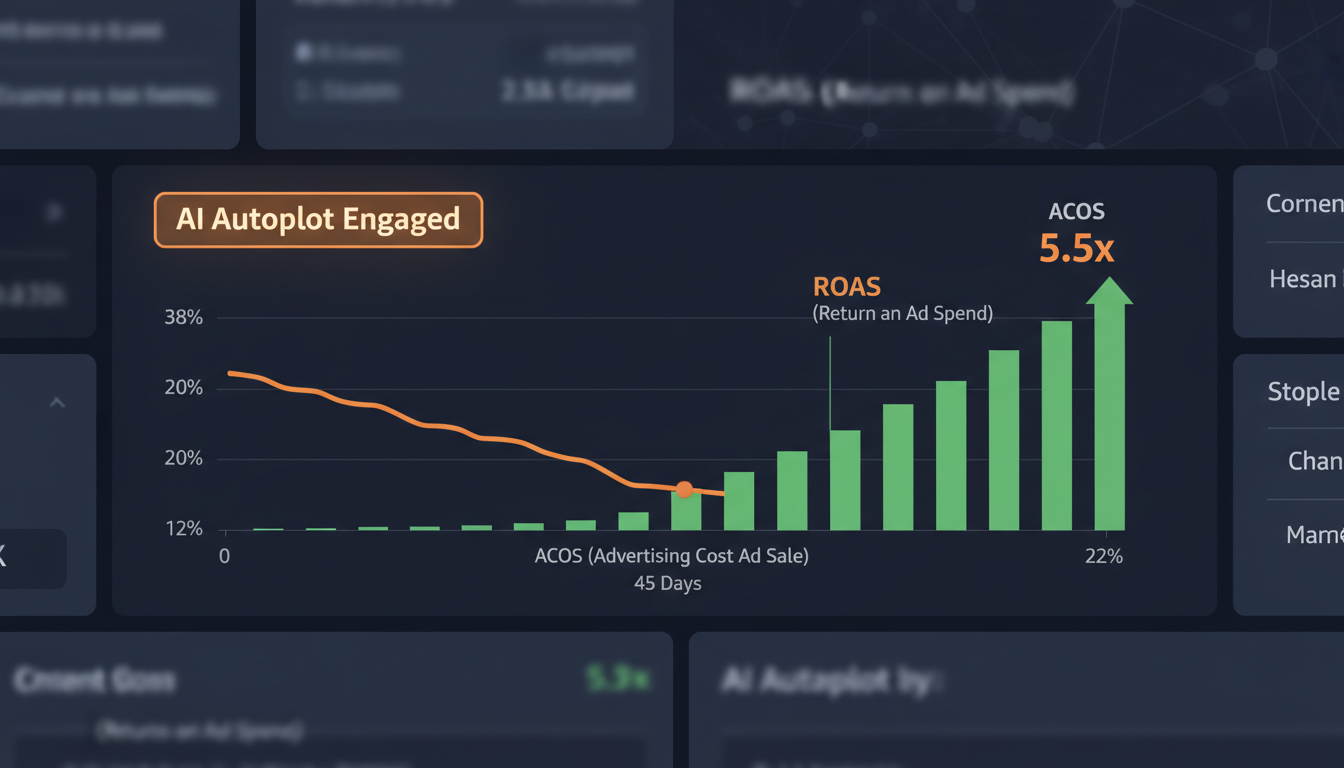
An Indian FMCG brand selling personal care products on both Amazon India and Amazon US was spending 18+ hours per week manually adjusting bids across 12 active campaigns. ACoS hovered at 38% — nearly 10 points above their category benchmark. After deploying AdAstraa Autopilot, their ACoS dropped to 22% in 45 days. More importantly, their ad managers redirected those 18 weekly hours toward creative testing and new ASIN launches — activities that compound over time.
This is the essential shift every scaling brand must make: from reactive bid management to predictive, AI-driven optimization that runs even while you sleep.
Explore how AdAstraa's full platform overview connects bid automation, creative intelligence, and profitability tracking into one unified operating system.
Ready to automate your Amazon ad campaigns and finally see your True Profit per ASIN? Join hundreds of India and US brands already scaling with AdAstraa.
Activate AI Autopilot Now →Strategy 4: Leverage Shopper Intent Data to Bid on the Right Keywords
Not all keywords are created equal — and on Amazon, bidding on the wrong ones is more dangerous than not bidding at all. The most successful Amazon sellers in both India and the US build their keyword strategy around buyer intent signals, not just search volume.
There are three levels of buyer intent on Amazon: informational (browsing), comparative (evaluating options), and transactional (ready to buy). Your highest bids should always go on transactional, exact-match keywords — terms that include brand names, specific product attributes, or high-intent qualifiers like "buy," "best," or product-specific descriptors.
India-Specific Keyword Intelligence: What Amazon Shopping India Searches Look Like
Amazon shopping India has distinct search behaviour. Indian shoppers frequently search in hybrid English-Hindi patterns, include price-sensitivity terms ("under 500," "budget"), and respond strongly to festive season modifiers during Diwali, Holi, and Independence Day sales. Sellers who tailor their keyword strategies to these patterns — rather than importing US keyword lists verbatim — consistently outperform during high-GMV periods.
For US-bound sellers, American customers search with product-specific attribute language: size, quantity, ingredient, certification ("organic," "BPA-free," "FDA-approved"). Mastering the distinction between Indian and US search intent is the step-by-step discipline that separates export winners from also-rans.
Strategy 5: Run High-Converting Ad Creatives That Stop the Scroll
The most powerful bid optimization in the world cannot save a weak creative. On Amazon, your product image is your ad — and for Sponsored Brands and video ads, your creative quality directly determines your click-through rate, which in turn influences your Quality Score and effective CPC.
Brands that invest in A/B-tested, audience-specific ad creatives achieve CTRs 2–4x higher than category averages. Higher CTR means lower effective cost-per-click and better ad placement — a compounding advantage that grows over time.
AI-Generated Creatives for Scale: From Days to Minutes
For brands managing dozens or hundreds of ASINs, producing high-quality creatives at scale used to mean expensive design agencies and multi-week turnaround times. AI creative generation has fundamentally changed this equation. Tools like AdAstraa AdCreative+ generate conversion-optimized ad creatives for every product variant in minutes — enabling rapid testing cycles that were previously impossible for resource-constrained teams.
The result: brands can now run guaranteed creative improvements across their entire catalog continuously, rather than waiting weeks to refresh a single hero product's assets.
Strategy 6: Track True Profit per ASIN — Not Just Revenue or ACoS
ACoS is a useful metric. Revenue is a vanity metric. True Profit per ASIN — accounting for ad spend, Amazon fees, cost of goods, FBA charges, and returns — is the only number that actually tells you whether a product is worth advertising at its current bid level.
Many sellers are unknowingly running campaigns on ASINs that look profitable on ACoS but are loss-generating on a fully-loaded margin basis. This is one of the most common and painful breakdowns we see among brands scaling from Amazon India to Amazon US — the unit economics that work in one market simply do not translate directly to the other due to differing fee structures, shipping costs, and competitive dynamics.
Building Your Profitability Dashboard Inside Seller Central
Both Amazon Seller Central India and Amazon Seller Central US offer native reporting tools — Business Reports, Advertising Reports, and the FBA Revenue Calculator — but stitching these together into a real-time profitability view requires significant manual effort. Sellers managing this manually report spending 6–12 hours per week on reconciliation alone.
AdAstraa delivers real-time True Profit per ASIN visibility natively — eliminating spreadsheet reconciliation entirely. Explore the complete Amazon PPC guide to understand how profitability-first thinking should shape every bid decision you make.
"In 2024, more than 55,000 independent sellers generated over $1 million in sales on Amazon. The defining characteristic of every one of them is disciplined profitability tracking — not just revenue chasing." — Amazon Seller Central
Strategy 7: Build a Cross-Marketplace Ad Flywheel Between India and the US
The most sophisticated Amazon brands are not treating India and the US as separate, isolated businesses. They are building a cross-marketplace flywheel where wins in one market fund and inform strategy in the other.
Here is how the flywheel works in practice: Products that achieve strong organic ranking and reviews on Amazon India become the validated test bed for US listing optimization. Search term data from India campaigns surfaces keyword themes that map to US buyer language. Festive season learnings from the Great Indian Festival refine bidding strategy ahead of US Prime Day and Black Friday.
Using Amazon's Brand Referral Bonus to Offset Google Advertising Pricing
For brands investing in Google sponsored ads to drive external traffic to Amazon listings, Amazon's Brand Referral Bonus (BRB) is a game-changing mechanism that most sellers underutilize. Amazon rewards sellers with up to 10% of attributed sales revenue for traffic converted through external sources — effectively reducing your net google ppc price by a significant margin.
Combined with Amazon Attribution tags, this creates a closed-loop measurement system where you can definitively compare the cost-effectiveness of every dollar spent on Google Ads against every rupee spent on Amazon PPC — and allocate dynamically to whatever is delivering the strongest blended ROAS. This is the AI advertising strategy the most successful cross-marketplace brands are running today.
The Ultimate Amazon Ad Action Plan: Your 90-Day Roadmap
Putting all 7 strategies into motion requires a sequenced approach. Trying to implement everything simultaneously is a proven path to execution paralysis. Here is the essential 90-day order of operations:
- Days 1–14: Audit existing campaigns. Identify and add negative keywords. Pull Search Term Reports from Seller Central. Establish your ACoS baseline by marketplace.
- Days 15–30: Graduate top-converting search terms to exact-match manual campaigns. Set up ASIN-level profitability tracking. Begin auto campaign for any untagged search terms.
- Days 31–60: Activate AI bid automation. Launch creative A/B tests on your top 5 ASINs. Set up Amazon Attribution for any Google Ads campaigns driving Amazon traffic.
- Days 61–90: Analyze cross-marketplace ROAS data. Reallocate budget from underperforming ASINs to top performers. Begin cross-marketplace expansion planning if operating on India only.
The sellers who follow a step-by-step, sequenced roadmap like this consistently outperform those who chase individual tactics in isolation. Discipline compounds — and so does ad efficiency when you build it systematically.
Additional Resources
Deepen your Amazon advertising and ecommerce knowledge with these authoritative sources:
- Amazon Global Selling: Exports Digest 2025 — Official Amazon data on India's $20 billion export journey and the path to $80 billion by 2030.
- Jungle Scout: Amazon Statistics 2024 — Comprehensive benchmark data on third-party seller performance, category trends, and advertising ROI across Amazon marketplaces.
- WebFX: How Much Does Google Ads Cost in 2024? — In-depth analysis of Google advertising pricing, CPC benchmarks by industry, and ROI considerations for ecommerce brands.
- DemandSage: Amazon Statistics & Market Share 2024 — Worldwide Amazon revenue data, marketplace growth metrics, and seller performance statistics.
- Amazon: How to Sell from India to the US (Official Guide) — Step-by-step Amazon Global Selling framework for Indian brands expanding into the US marketplace.
Final Thoughts: The Brands That Win Are the Ones That Systematize
The gap between an Amazon seller who is profitable and one who is not rarely comes down to product quality or even price. It comes down to ad discipline. Understanding how Google advertising pricing compares to Amazon PPC costs, knowing how to mine Seller Central for winning search terms, automating bids with AI, and tracking True Profit per ASIN — these are the powerful, compounding behaviours that separate breakthrough brands from the rest of the marketplace.
Whether you are managing Amazon shopping India campaigns during the festive season rush or scaling your catalog into Amazon Seller Central US for the first time, the 7 strategies in this guide give you a proven, systematic foundation to build on.
The question is not whether you can afford to implement these strategies. It is whether you can afford not to — when your competitors are already doing it with AI.
Your Next Step is Simple.
Let AdAstraa's AI Autopilot, Shopper OS, and AdCreative+ do the heavy lifting — while you focus on building the brand. Join Amazon sellers across India and the US who have already reclaimed their ad budgets and their time.
Get Started Free with AdAstraa →