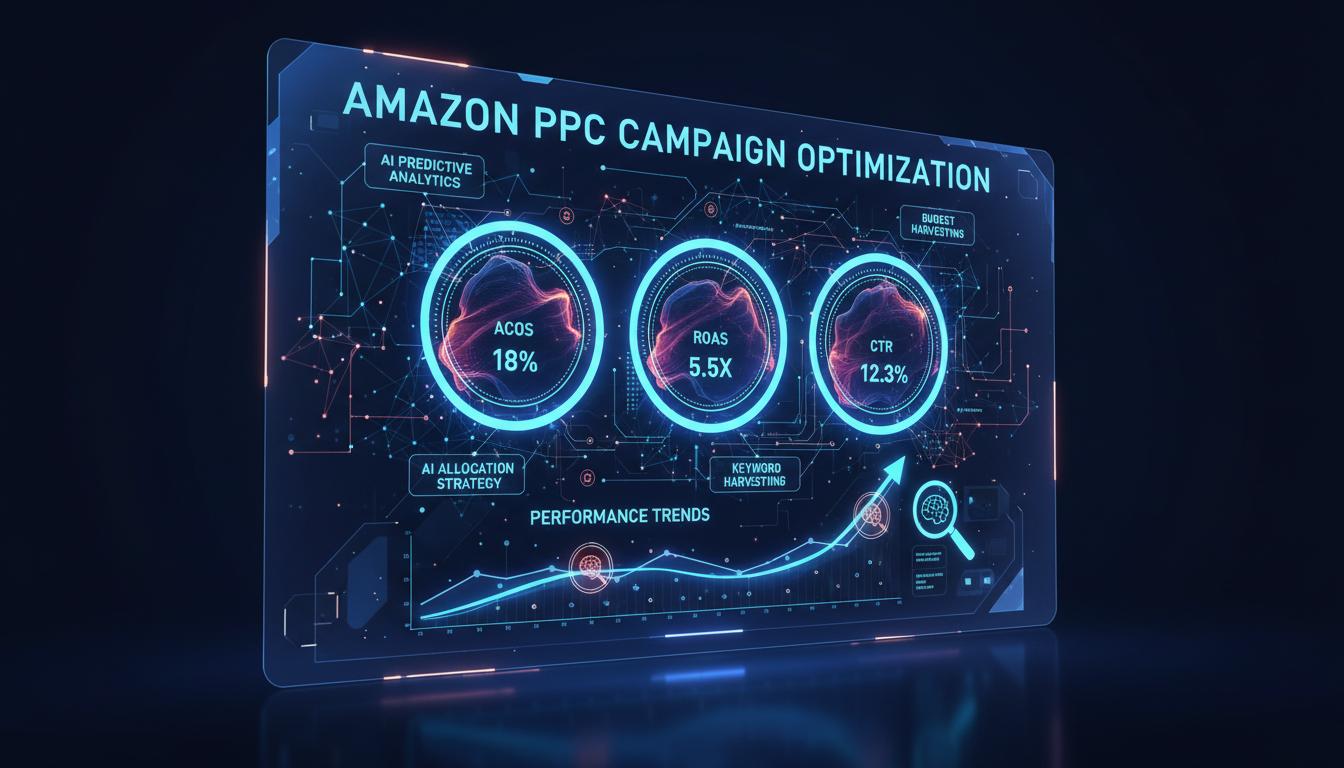
Over 30% of Amazon ad spend is funneled into search terms that will never generate a single sale.
If you're an Amazon brand spending thousands of dollars per month on PPC, that number should stop you cold. You're not just leaving money on the table — you're actively handing it to your competitors while your ACoS climbs and your margins erode, week after week.
The good news? This is entirely preventable. The brands that are scaling profitably in 2025 aren't spending more — they're spending smarter. They've moved beyond manual spreadsheet bidding and keyword guessing and embraced a new class of AI-powered Amazon PPC campaign optimization that operates 24/7, learns from every impression, and cuts waste in real time.
In this guide, you'll find 7 proven, step-by-step strategies that top-performing Amazon brands are using right now to slash ACoS, reclaim lost ROAS, and finally get clarity on what's truly profitable at the ASIN level.
Ready to stop burning your ad budget? AdAstraa's Autopilot runs 24/7 bid optimization so you don't have to.
Activate AI Campaign Optimization — Free →
1. Eliminate Non-Converting Keywords Before They Drain Your Budget
The single most powerful lever you can pull in Amazon PPC campaign optimization isn't finding new winning keywords — it's ruthlessly eliminating the ones costing you money without driving a single conversion.
According to data from AdAstraa's platform, brands running AI-automated ad management have seen ACoS reductions of 20–35% simply by systematically identifying and negating irrelevant search terms. Amazon's own advertising revenue hit $47.4 billion in 2024, growing 24% year-over-year — and a massive portion of that comes from advertisers paying for clicks that never convert.
How to Build a Bulletproof Negative Keyword Strategy
Download your Search Term Report weekly. Look for any term with more than 10 clicks and zero orders — these are your budget killers. Add them as exact-match negatives at the campaign level immediately.
Go further by categorizing waste: competitor brand terms you can't win, irrelevant modifiers (e.g., "free," "DIY," "how to"), and broad match bleed terms that have drifted far from your product's intent. A structured Amazon PPC management framework treats negative keyword harvesting as a non-negotiable weekly ritual, not an afterthought.
With AI-powered tools like AdAstraa's Autopilot, this process happens automatically — the system flags, reviews, and negates poor performers in real time, without waiting for a weekly manual review cycle.
2. Master Campaign Structure for Maximum Bidding Control
Poorly structured campaigns are silent killers. When you lump your best-sellers, new launches, and defensive brand campaigns under one roof, you lose the ability to allocate budget intelligently — and your ROAS suffers for it.
The most effective Amazon advertising campaign architecture separates targeting intent into distinct layers. Here's the essential structure every serious brand should implement:
- Auto Campaigns — Used as discovery engines. Mine these for converting search terms to push into manual campaigns.
- Manual Broad Match Campaigns — Cast a wider net for keyword discovery with a capped budget.
- Manual Phrase Match Campaigns — Mid-funnel intent. Balance reach with relevance.
- Manual Exact Match Campaigns — Your performance engine. Allocate the majority of budget here, bidding aggressively on proven converters.
- Branded Defense Campaigns — Protect your own brand terms from competitor conquest.
- Competitor Conquest Campaigns — Target rival ASINs and brand terms strategically with controlled bids.
Portfolio-Level Budget Rules That Prevent Overspend
Use Amazon's Portfolio feature to set hard monthly budget caps across campaign groups. This prevents any single campaign from consuming budget meant for top performers during high-traffic days.
Combine this with AI-powered advertising management to enable dynamic budget shifting — automatically moving spend from underperformers to high-converting campaigns during peak hours.
3. Deploy AI-Powered Bid Optimization for Real-Time Precision
Manual bidding is the biggest bottleneck in Amazon PPC management. By the time you review last week's data and adjust bids today, the market has already shifted. Competitors have changed their strategies. Shopper intent patterns have evolved. You're always reacting to yesterday's reality.
AI-powered bid optimization eliminates this lag entirely. Platforms built on machine learning analyze hundreds of performance signals — conversion rate, placement, time of day, device type, shopper history — and adjust bids every few hours rather than every few weeks.
"Brands on AdAstraa's Autopilot have reported a +41.8% average ROAS lift within a single quarter — not from spending more, but from bidding smarter on every single keyword, every single hour."
Placement Bid Modifiers: The Overlooked Edge
Top-of-search placement consistently delivers the highest conversion rates on Amazon, often 2–3x better than rest-of-search. Yet most brands leave this lever untouched.
Use placement bid modifiers to boost bids by 50–100% for top-of-search on your highest-converting exact match keywords. Use your Search Term Report data to validate performance before scaling. Explore advanced AI advertising strategies to see how machine-learning-driven placement optimization works at scale.
See exactly where your ad spend is going and which keywords are silently killing your margins.
Get Your Free PPC Profitability Audit →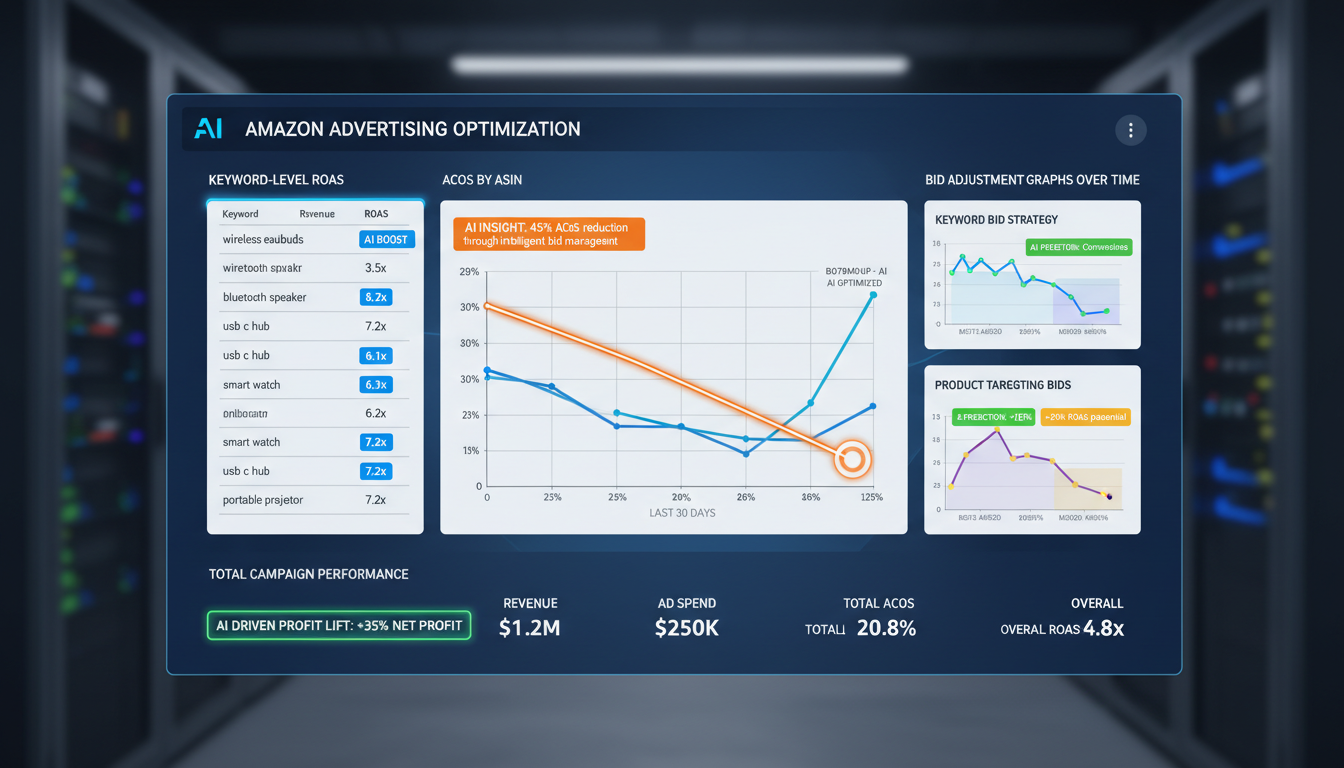
4. Use Buyer Intent Intelligence to Target Ready-to-Buy Shoppers
Not all Amazon shoppers are equal. Someone searching "best protein powder for weight loss" is fundamentally different from someone searching "protein powder." One is browsing. The other is buying. Your ad strategy should reflect that difference.
Buyer intent intelligence maps search behavior patterns to purchase probability. By understanding which keywords carry the strongest purchase signals — based on real shopping data, not guesswork — brands can concentrate their bids where conversion is most likely.
The Untapped Power of Long-Tail Keyword Targeting
Long-tail keywords (three or more words) typically carry lower CPCs and far higher purchase intent. A shopper typing "organic turmeric curcumin 500mg capsules 120 count" is not window shopping. They know exactly what they want.
Yet most brands concentrate their budgets on high-volume head terms, where competition is fierce and CPC is exorbitant. A game-changing shift is to build entire campaigns around long-tail, high-intent clusters — often called "intent pockets" — where you face less competition and win conversions at dramatically lower cost.
AdAstraa's Shopper OS does exactly this: it maps buyer intent signals across your category to surface the highest-probability converting keywords your competitors have missed.
5. Measure True Profit Per ASIN — Not Just ACoS
Here's an uncomfortable truth: your ACoS can look great while your business is actually losing money. ACoS only measures the efficiency of ad-attributed revenue. It tells you nothing about fulfillment costs, returns, referral fees, storage fees, or the true margin left on every unit sold.
Brands that genuinely optimize Amazon advertising campaigns track True Profit per ASIN — a complete picture that factors in all costs against all revenue to tell you which products actually make money after Amazon takes its cut.
Why TACoS Is the Metric You Should Actually Care About
TACoS (Total Advertising Cost of Sale) divides your total ad spend by your total revenue — not just ad-attributed revenue. A healthy, growing brand on Amazon should see its TACoS trend downward over time as organic rank improves and organic sales increase as a share of total revenue.
A rising TACoS signals over-reliance on paid traffic. A falling TACoS signals that your advertising is building organic momentum. Tracking this metric weekly at the ASIN level is an essential discipline for any brand serious about Amazon campaign optimization.
| Metric | What It Measures | Healthy Benchmark |
|---|---|---|
| ACoS | Ad spend ÷ Ad-attributed revenue | 20–35% (category-dependent) |
| ROAS | Ad revenue ÷ Ad spend | 2.5x–5.0x |
| TACoS | Ad spend ÷ Total revenue | <10% for established brands |
| True Profit/ASIN | Net revenue minus all costs | Positive margin after all fees |
6. Transform Your Ad Creative With AI-Generated, High-Converting Visuals
A technically perfect PPC campaign still fails if the creative doesn't stop the scroll. On Amazon, where every search results page is a visual battlefield, your ad creative is often the difference between a click and a pass.
Most brands treat creative as a one-time effort: shoot some product photos, write a headline, and call it done. But the brands winning in 2025 are running continuous creative testing — iterating on headlines, imagery, and lifestyle contexts at a pace that was previously impossible without a full creative production team.
Why Sponsored Brands Video Is the Breakthrough Format of 2025
Sponsored Brands Video ads auto-play in search results, occupying dramatically more visual real estate than standard ads. Early data consistently shows video ads delivering 2–5x higher CTR compared to static Sponsored Products in the same category.
The barrier used to be production cost and time. With AdCreative+ by AdAstraa, brands can generate on-brand, high-converting ad creatives — including video-ready assets — using AI, in a fraction of the time and cost of traditional production. Your creative pipeline becomes effortless and always on.
The Step-by-Step Creative Testing Process That Works
- Run two headline variations against each other for a minimum of 2 weeks.
- Measure CTR and Conversion Rate independently — a high CTR with low conversion usually means a mismatch between headline promise and product page delivery.
- Test lifestyle imagery versus pure product imagery for your category.
- Rotate winning creatives every 6–8 weeks to combat creative fatigue.
- Use AI tools to generate new variants at scale without creative burnout.
7. Build a Fully Automated Amazon Advertising Workflow That Scales Itself
The ultimate goal of every Amazon PPC campaign optimization effort is to build a system that improves continuously — without requiring your team to manually intervene every single week. This is where true scale becomes possible.
The most sophisticated brands on Amazon treat their ad operations like a self-improving machine: rules-based automation handles routine tasks, AI handles complex bid and budget decisions, and human strategists focus exclusively on high-level growth decisions.
The Three Layers of Intelligent Amazon Advertising Automation
Layer 1 — Rules-Based Automation: Set up automated rules in Amazon Seller Central for basic hygiene tasks — pause campaigns that exceed a target ACoS threshold, increase budgets on campaigns hitting budget caps by 2pm, and send alerts on anomalous spend spikes. These are your safety nets.
Layer 2 — AI-Driven Optimization: This is where platforms like AdAstraa create a decisive edge. Autopilot uses machine learning to adjust keyword bids, allocate budget across campaigns, harvest negative keywords, and surface new keyword opportunities — all in real time, 24 hours a day. There is no human team fast enough to replicate this speed or depth of analysis.
Layer 3 — Strategic Intelligence: The third layer is the human layer. Armed with clean, AI-generated insights on True Profit per ASIN, keyword intent mapping, and creative performance data, your team makes high-value decisions: which new products to launch, which categories to expand into, and how to allocate overall marketing budget for maximum return.
Real-World Example: How an FMCG Brand Recovered ₹1.2 Cr in Wasted Ad Spend
An established FMCG brand selling health supplements on Amazon India was running 140+ active campaigns with a manual management team spending 20+ hours per week on bid adjustments. Their ACoS had crept up to 48% — well above their 28% target margin.
Within 30 days of activating AdAstraa's Autopilot and Shopper OS, the brand's AI system identified over 3,200 non-converting search terms that had been silently consuming budget for months. Bids were restructured across all exact match campaigns using intent-tier logic, and placement modifiers were applied based on conversion data by ASIN. The result: ACoS dropped to 31% in 45 days, ROAS improved by 38%, and the team reclaimed 18 hours per week previously lost to manual management. Read more real results in our case studies.
Additional Resources
Deepen your knowledge of Amazon PPC campaign optimization and AI advertising with these authoritative external sources:
- Amazon Ads Official Guide: Understanding ACoS — The authoritative explanation of Amazon's core PPC metric, directly from Amazon Ads.
- Amazon Ads: AI in Marketing — Key Applications & Examples — How Amazon itself defines and applies AI marketing tools across the advertising ecosystem.
- Helium 10: 18 Amazon PPC Strategies to Boost Your Sales — A well-regarded industry blog covering advanced keyword research and campaign scaling tactics.
- Triple Whale: Amazon Ads Benchmarks by Industry — Data-driven ACoS, ROAS, CPA, and CVR benchmarks broken down by category to contextualize your performance.
- AWS Machine Learning Blog: Marketing & Advertising — Technical insights from Amazon Web Services on how machine learning is transforming ad campaign management.
The Brands That Win on Amazon Are Already Using These Strategies
Amazon advertising has reached a level of complexity where manual management is no longer a viable strategy — it's a liability. CPC costs rise every year. Competition intensifies every quarter. The brands that will dominate the next 24 months are those building intelligent, automated, and continuously optimizing ad operations right now.
The 7 strategies outlined in this guide — from eliminating non-converting keywords and restructuring campaigns, to deploying AI bid optimization, buyer intent intelligence, True Profit tracking, breakthrough creative, and fully automated workflows — represent the essential playbook for Amazon PPC campaign optimization in 2025.
These aren't theoretical frameworks. They're the exact mechanisms powering over 1,500 brands running on AdAstraa's Autopilot, collectively managing hundreds of crores in optimized ad spend across 9 marketplaces.
The question is no longer whether AI-powered campaign optimization works. The only question left is how much longer you can afford to wait.
Stop optimizing manually. Start winning automatically.
Join 1,500+ brands using AdAstraa to cut ACoS, boost ROAS, and scale profitably on Amazon — without the manual grind.
Start Your Free Trial with AdAstraa Today →