
Amazon sellers waste an estimated 25–40% of their ad budgets on non-converting clicks every single month. That is not a rounding error — that is your profit margin walking out the door.
If you are running Amazon PPC campaigns manually, you are playing a slow, expensive game against algorithms that never sleep. Amazon's ad platform generated $56.2 billion in revenue in 2024 — and the brands capturing the lion's share of that value are not doing it with spreadsheets and gut instinct. They are doing it with AI.
This guide breaks down seven essential, battle-tested Amazon PPC strategies powered by artificial intelligence — strategies that eliminate wasted spend, consistently lower ACoS, and unlock scalable ROAS gains without burning out your team.

Stop leaving profit on the table. Let AI run your Amazon ads 24/7.
AdAstraa's Autopilot engine optimizes every bid, every keyword, every hour — so you don't have to.
Start Your Free Trial Today →1. Deploy AI-Powered Bid Automation to Reclaim Hours and Revenue
Manual bid management is the single most time-consuming — and most imprecise — task in Amazon advertising. A human can realistically adjust bids once or twice a day. An AI engine running 24/7 can make those adjustments every single hour based on real conversion signals, time-of-day patterns, and competitive dynamics.
The difference is not incremental. It is transformational. AI advertising platforms like AdAstraa's Autopilot continuously ingest performance data across every ASIN, keyword, and match type — then recalibrate bids to keep campaigns inside your target ACoS window without manual intervention.
What Effective Bid Automation Must Do
- Adjust bids at keyword and placement level, not just at the campaign level
- React to intraday patterns — peak shopping hours warrant higher bids; off-peak hours should pull back spend
- Use rolling conversion windows (7-day, 14-day) to avoid over-penalising keywords in their ramp-up phase
- Set hard ACoS guardrails so automation never exceeds your profitability threshold
Brands using AI-based bid automation consistently report a 15–30% reduction in wasted ad spend within the first 30 days, simply by eliminating the over-bidding and under-bidding that manual processes can't catch in real time.
2. Use AI Negative Keyword Intelligence to Stop Bleeding Budget
Every click you receive on an irrelevant search term is money that cannot convert — and it is raising your ACoS with every impression. Research consistently shows that negative keywords are one of the highest-leverage levers in Amazon PPC, yet most sellers treat them as an afterthought.
AI changes this entirely. Instead of manually combing through Search Term Reports every week, an intelligent platform automatically surfaces non-converting queries, clusters them semantically, and adds them as negatives before they drain your budget further.
A Proven Three-Tier Negative Keyword Framework
- Tier 1 — Immediate negatives: Any search term generating 10+ clicks with zero conversions should be negated without debate
- Tier 2 — Conditional negatives: Terms with high spend but ACoS exceeding 2× your target should be flagged and reviewed weekly
- Tier 3 — Structural negatives: Category-level terms (e.g., competitor brand names you can't win on) applied account-wide
AI systems handle Tier 1 and Tier 2 automatically. Explore how AdAstraa's Shopper OS buyer intent intelligence goes even deeper — analysing which search patterns signal high-intent buyers versus casual browsers, so your ads only spend on shoppers who are genuinely ready to purchase.
3. Build a Scalable AI-Optimised Campaign Structure from Day One
A poorly structured Amazon PPC account is like a leaking pipe — no matter how much water (budget) you pour in, pressure bleeds out everywhere. Most brands running into ACoS problems are not suffering from bad keywords; they are suffering from campaign architecture that makes optimisation impossible.
The gold-standard structure separates intent signals at every level. Use Auto campaigns for discovery, then graduate winning terms into Manual Exact Match campaigns where AI can bid with surgical precision. Broad and Phrase Match campaigns act as the middle layer — catching intent variations while feeding new data upstream.
The Power of Single Keyword Ad Groups (SKAGs)
For your highest-revenue ASINs, consider isolating your top 10–20 converting keywords into their own ad groups. This gives your AI bid engine clean, unambiguous performance data per keyword — dramatically improving optimisation accuracy. You will see lower CPCs, higher Quality Scores, and more predictable ACoS.
This architecture pairs powerfully with AdAstraa's comprehensive Amazon PPC guide, which walks through campaign buildout frameworks that AI tools can optimise from day one.
4. Unlock Game-Changing Creative Performance with AI Ad Generation
Here is a truth that most Amazon sellers overlook: your creative is a bid multiplier. A Sponsored Brand or Sponsored Display ad with a compelling headline and visually optimised banner can deliver 2–3× higher CTR on the same keyword bid — effectively reducing your cost per click without touching your bids at all.
Manually producing, testing, and iterating ad creative across dozens of ASINs and campaigns is a full-time job. AI ad generators have made this effortlessly scalable. Modern AI creative tools like AdCreative+ can generate on-brand, conversion-optimised ad creative variations in minutes — then programmatically test them to identify winning combinations across audience segments.
A Step-by-Step AI Creative Testing Framework
- Generate 4–6 headline variations using AI, targeting different emotional triggers (value, urgency, social proof)
- Run each variation for a minimum of 500 impressions before drawing conclusions
- Let AI identify the statistically significant winner and auto-pause underperformers
- Feed winning creative insights back into your listing copy and A+ Content for compounding organic benefits
"Companies using AI-driven marketing automation report an average ROI of $5.44 for every $1 spent within the first three years — and 76% see positive ROI within the first year alone." — Revenue Memo, 2025
5. Target with Surgical Precision Using Buyer Intent AI Signals
Not all shoppers searching on Amazon carry equal commercial intent. Someone searching "protein powder" is in discovery mode. Someone searching "whey protein isolate unflavoured 5lb subscribe and save" has their credit card ready. The difference in conversion rate between these two intent layers can be 10× or greater.
Traditional keyword targeting treats both shoppers identically. AI-powered buyer intent engines do not. They analyse search query patterns, order history signals, product detail page behaviour, and seasonal demand shifts to classify shoppers by purchase probability — then bias your ad delivery and bids toward the highest-intent audiences.
Three Buyer Intent Signal Layers AI Can Decode
- Keyword specificity: Long-tail queries with specific product attributes indicate high purchase intent
- Behavioural context: Shoppers who viewed your product detail page but didn't convert represent warm retargeting opportunities
- Competitive displacement: Shoppers actively comparing your ASIN against a specific competitor signal a decisive moment worth bidding aggressively on
See buyer intent intelligence in action for your ASINs.
AdAstraa's Shopper OS maps the exact moments your customers are most ready to buy — and tells your campaigns to show up then.
Explore Shopper OS Free →6. Make Breakthrough Decisions with Real-Time AI Marketing Analytics
Amazon's native reporting is powerful — but it runs on a 48-hour attribution delay, which means by the time you see data, the campaign has already burned through two days of budget. In a competitive category with rising CPCs (up 10–15% year-over-year across most verticals), that lag is extremely costly.
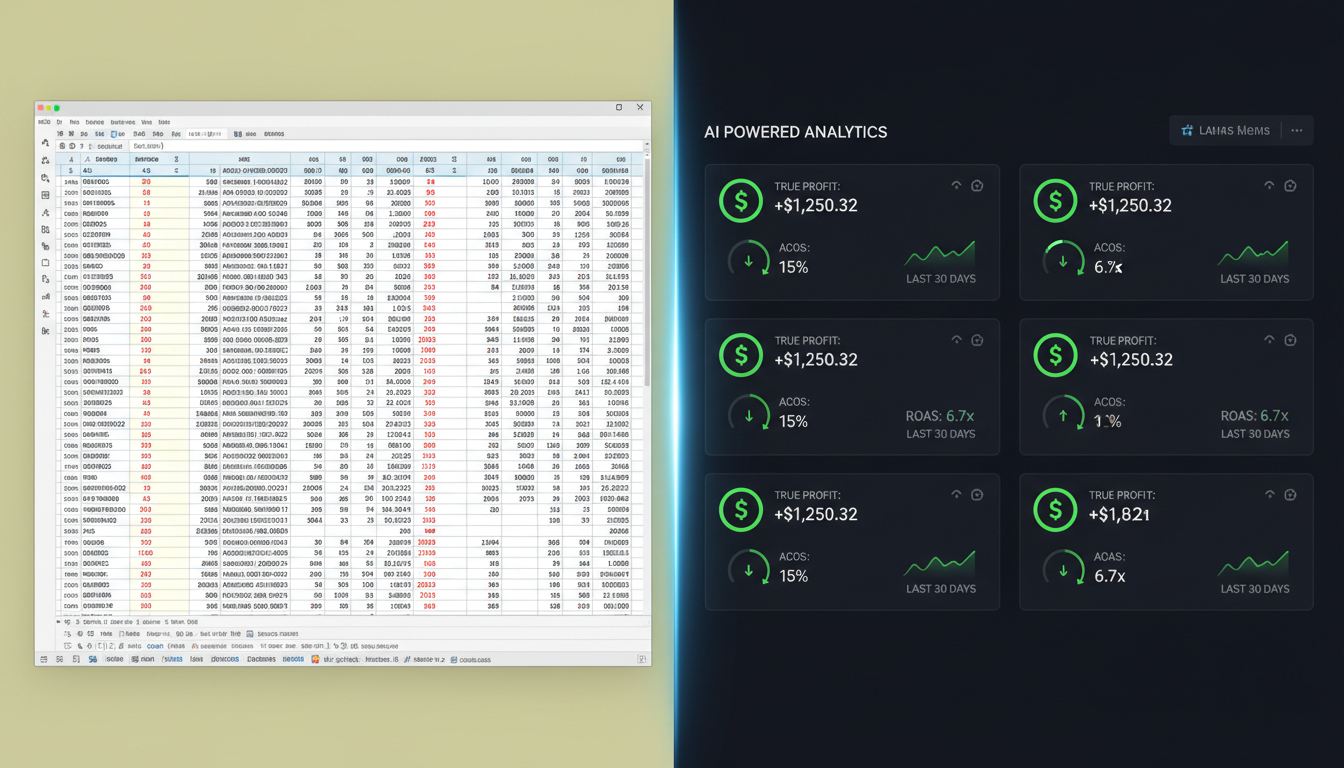
AI-powered marketing analytics platforms ingest data in real time, surfacing True Profit per ASIN — not just ad-attributed revenue, but actual margin after ad spend, Amazon fees, COGS, and fulfilment costs are factored in. This is the essential metric that separates profitable scaling from vanity scaling.
Why True Profit per ASIN Changes Everything
Consider a real-world scenario: a supplements brand is scaling its Amazon Sponsored Products campaigns aggressively. Reported ROAS looks healthy at 4.2×. But once Amazon referral fees (15%), FBA fulfilment ($4.80/unit), storage fees, and COGS are factored in, the actual margin on their hero ASIN is near zero. Without True Profit visibility, they would continue scaling — straight into a loss.
AI analytics dashboards catch this instantly. They flag ASINs where ad spend is eroding margin, recommend bid reductions or budget caps, and surface underinvested ASINs where increased spend would generate genuine net profit. This is not reporting — it is intelligent profit management.
7. Build a Fully Automated Amazon Advertising Workflow with AI
The ultimate competitive advantage in 2025 is not just using AI tools in isolation — it is building an end-to-end automated advertising workflow where every component feeds and improves the next. This is the must-know infrastructure shift that separates scaling brands from stagnating ones.
Here is what that workflow looks like in practice, built on the AdAstraa operating system:
| Workflow Layer | AI Tool | Output |
|---|---|---|
| 24/7 Bid Optimisation | Autopilot | Lower ACoS, reclaimed hours |
| Buyer Intent Signals | Shopper OS | Higher CTR, stronger ROAS |
| Creative Generation & Testing | AdCreative+ | Higher CVR, reduced creative cost |
| Customer Operations | EcomGPT | Faster reviews, repeat purchase lift |
| Profit Analytics | AdAstraa OS | True Profit per ASIN visibility |
Each layer of the workflow is interconnected. Creative insights from AdCreative+ inform which audience segments Shopper OS should prioritise. Bid decisions from Autopilot are recalibrated using True Profit signals from the analytics layer. Customer interactions processed through EcomGPT feed review velocity, which improves organic ranking, which in turn lowers the baseline bids you need for any given keyword.
This is not a collection of point solutions. This is a self-reinforcing growth system — and it is the breakthrough model that is redefining what serious Amazon advertising looks like in 2025.
Real-World Example: From 48% ACoS to Profitable Scale in 60 Days
A UK-based FMCG brand selling personal care products on Amazon UK came to AdAstraa with a common but painful problem: their hero SKU was generating strong sales volume, but ACoS had crept to 48% — nearly double their break-even threshold of 25%. Manual optimisation by their in-house team was consuming 15+ hours per week with no meaningful improvement.
Within the first week of deploying AdAstraa's Autopilot, 312 non-converting search terms were automatically negated. Bids were restructured around 18 high-intent exact match keywords identified by Shopper OS. AdCreative+ generated four new Sponsored Brand headline variations, with the top performer achieving a 2.4× higher CTR than the original.
After 60 days, ACoS dropped to 22% — below break-even threshold — while total ad-attributed revenue increased by 34%. The in-house team reclaimed 12 hours per week, redirecting that capacity toward product expansion and listing optimisation.
Explore more results like this on our AdAstraa case studies page.
Additional Resources
- Amazon Ads: Official Sponsored Products Getting Started Guide — Amazon's own resource for understanding Sponsored Products campaign structure, bidding mechanics, and targeting fundamentals.
- IAB Internet Advertising Revenue Report: Full Year 2024 — Comprehensive industry report covering $258.6 billion in digital ad revenue, with key data on retail media growth and commerce media trends.
- Marketing Automation ROI Statistics 2025 — Revenue Memo — Deep-dive analysis of marketing automation returns, including the $5.44 ROI benchmark and 76% first-year positive ROI statistic cited in this article.
- Amazon Ads Benchmarks by Industry — Triple Whale — Updated industry-level performance benchmarks for ACoS, ROAS, CVR, CPM, and CPA across Amazon advertising categories.
- Amazon Advertising Statistics 2025 — Sequence Commerce — Authoritative aggregation of Amazon advertising data, platform trends, and AI-driven ad innovation benchmarks for sellers and agencies.
The Bottom Line: AI Is Not Optional for Amazon Advertising Anymore
Amazon's advertising platform is growing faster than any other major digital ad channel. With $56.2 billion in ad revenue in 2024 and CPC costs rising double digits year-over-year, the brands that continue to manage campaigns manually will find the gap between themselves and AI-optimised competitors widening every quarter.
The seven strategies outlined here are not theoretical. They are the exact playbook that the most profitable Amazon brands are executing right now — and every single one of them is more powerful, faster, and more precise when driven by AI.
Whether your immediate priority is cutting ACoS, reclaiming management hours, scaling into new ASINs, or simply understanding your true profit margins for the first time — the starting point is the same: replace manual guesswork with intelligent, always-on automation.
AdAstraa is built for exactly this moment. From AI advertising strategies to full-stack Amazon PPC automation, every tool in the platform is purpose-built for Amazon-first brands that are serious about profitable, scalable growth.
Ready to cut ACoS, boost ROAS, and automate your Amazon ads?
Join hundreds of Amazon brands already scaling profitably with AdAstraa's AI-powered advertising OS. No setup fees. No lock-in contracts. Just results.
Get Started Free with AdAstraa →