


Here's a number that should make any Amazon seller pause: Amazon fees alone consume 30–40% of an FBA seller's revenue before a single ad is placed. Add PPC into the mix and total charges routinely exceed 40–50% of the sale price. That's not a budget. That's a bleed.
Whether you're a D2C brand, an FMCG giant, or a growing e-commerce company in India trying to scale on Amazon, uncontrolled Amazon seller costs are the silent killer of profitability. High ACoS, runaway bids, non-converting keywords, and opaque fee structures quietly devour margins that took years to build.
The good news? There's a game-changing way to flip the script. In this guide, you'll get 7 proven, step-by-step strategies to slash your Amazon seller costs, make every rupee or dollar of your media purchase work harder, and finally achieve the ROAS your brand deserves.
🚀 Stop letting wasted ad spend eat your margins. AdAstraa's AI-powered Autopilot optimizes bids 24/7 so you don't have to.
Start Your Free Trial Today →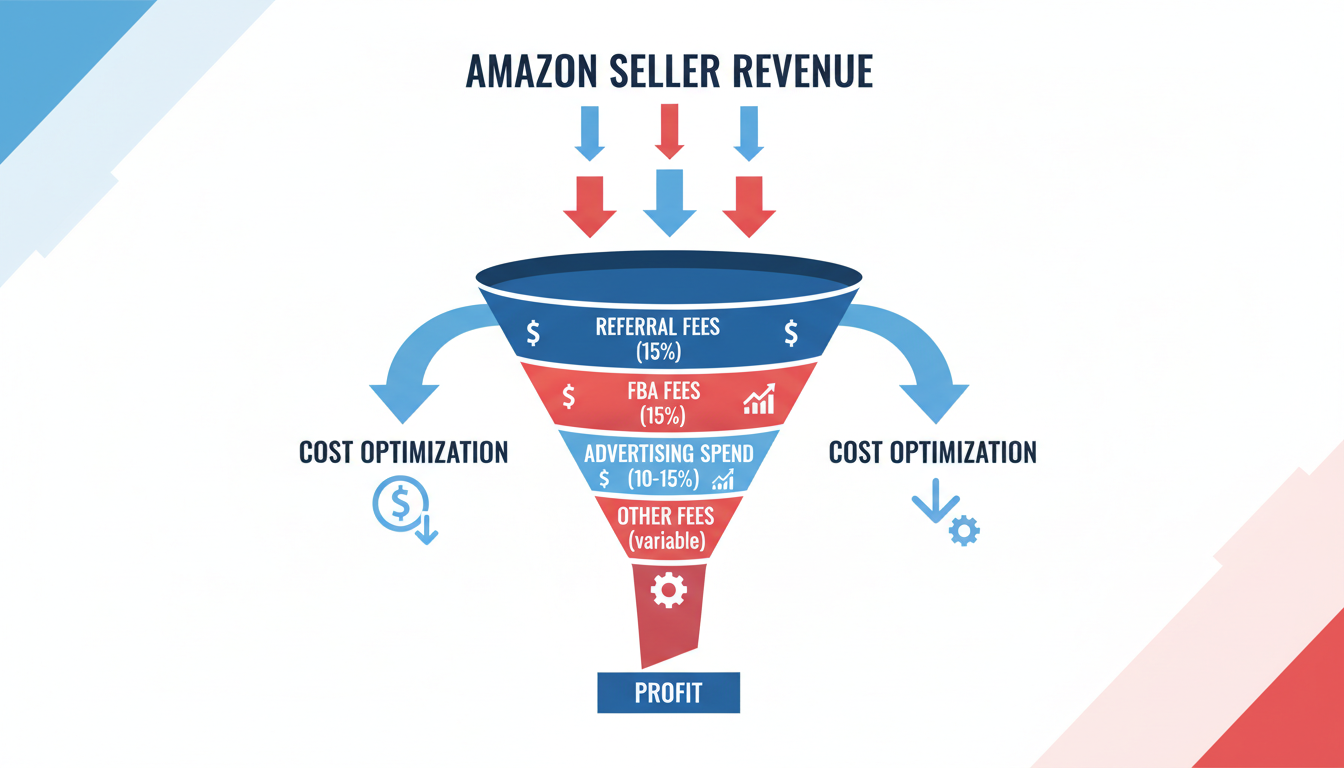
Understanding the Full Scope of Amazon Seller Costs in 2025
Before you can cut costs, you need to see them clearly. Most sellers fixate on ACoS while ignoring the layered fee structure quietly eroding their margins every single day.
Here's the essential breakdown every Amazon seller — especially those running pay-per-click in digital marketing — must internalize:
| Cost Type | Typical Range (2025) | Impact Level |
|---|---|---|
| Referral Fees | 6%–45% of sale price | 🔴 High |
| FBA Fulfillment Fees | ~15% of sale price | 🔴 High |
| PPC / Advertising Spend | 5%–25% of revenue | 🔴 High |
| Selling Plan Fee | $39.99/month (Professional) | 🟡 Medium |
| Storage Fees | Varies by season & size | 🟡 Medium |
| Returns & Refund Admin | Up to $5.00 or 20% of referral | 🟢 Lower |
The average cost-per-click (CPC) on Amazon in 2025 sits at $1.12 — a 15.5% jump year-over-year. In categories like Health & Beauty or Supplements, CPC can spike to $7.00+. For e-commerce companies in India and globally scaling brands, this kind of CPC inflation makes AI-powered advertising optimization not a luxury — but a business necessity.
Why ACoS Alone Tells You Half the Story
Most sellers obsess over Advertising Cost of Sale (ACoS). But ACoS doesn't account for organic halo effect, true profit per ASIN, or blended return on ad spend. Chasing a low ACoS in isolation can actually cause you to under-bid on high-converting terms.
The smarter metric? True Profit per ASIN — combining fees, COGS, returns, and ad spend into a single profitability view. AdAstraa's platform surfaces this in real time, giving you clarity that Amazon Advertising login dashboards simply don't provide.
Strategy 1: Deploy AI-Powered Bid Optimization to Stop the Bleed Instantly
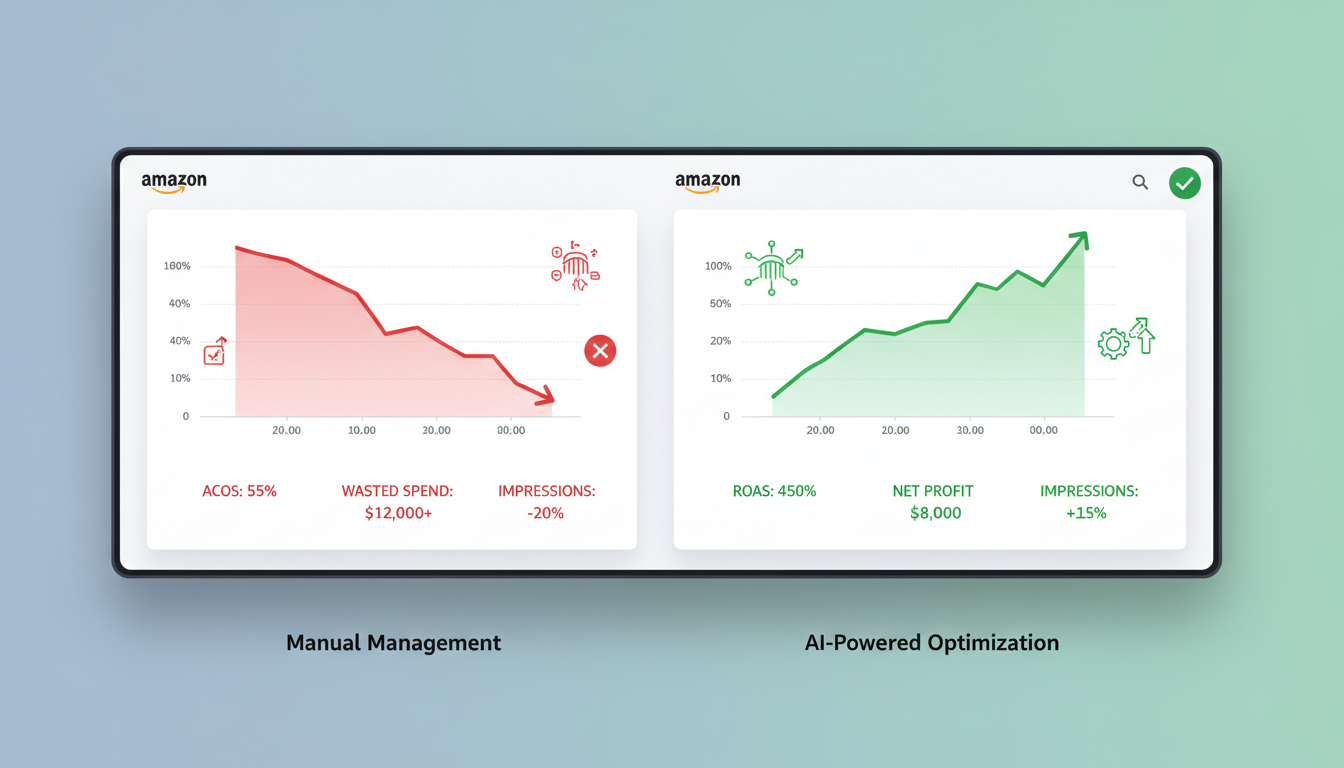
Manual bid management is the single biggest source of wasted ad spend on Amazon. Humans can't adjust bids at 3 AM when your competitor drops their price and your conversion rate tanks. AI can — and does.
Amazon's own advertising ecosystem generated $56.2 billion in ad revenue in 2024, up 20% year-over-year. With that level of competition, static bids are essentially a donation to your rivals. The sellers who are winning are those who leverage real-time bid automation.
The 24/7 Autopilot Advantage
AdAstraa's Autopilot engine monitors thousands of keyword signals simultaneously — time of day, competitor bids, conversion rate trends, and historical placement data — and adjusts bids in real time without any manual intervention.
The result? Sellers using AI-powered bid management consistently report a 20–35% reduction in wasted ad spend within the first 60 days. That's not theoretical. That's documented campaign performance from brands that stopped treating PPC digital marketing like a set-and-forget exercise.
"Sellers using AI for ad optimization see 25–40% better ROAS compared to those managing campaigns manually." — Sequence Commerce, 2025 Amazon Advertising Statistics
Strategy 2: Ruthlessly Prune Non-Converting Keywords to Lower ACoS
Here's a brutal truth about pay-per-click in digital marketing on Amazon: a significant portion of your keyword portfolio is actively draining your budget without generating a single sale.
Non-converting keywords — often broad match terms pulling in irrelevant shopper intent — are the number-one driver of inflated ACoS. Eliminating them isn't optional; it's essential. Industry data shows the average Amazon PPC conversion rate in 2025 is 10.33%. If your keywords are converting at 1–2%, you're paying for traffic that was never going to buy.
Systematic Search Term Harvesting vs. Guesswork
Effective keyword pruning requires a systematic process: pull search term reports weekly, identify terms with high spend and zero (or near-zero) conversions, and add them as negative keywords immediately. Then, promote proven converters into exact match campaigns with tighter bid control.
AdAstraa's Shopper OS takes this further with buyer intent intelligence — surfacing not just what shoppers search, but why they're searching it and how likely they are to convert on your specific ASIN. This is the breakthrough difference between keyword management and keyword intelligence.
Strategy 3: Track True Profit Per ASIN — Not Just Ad Metrics
Your Amazon advertising login dashboard shows clicks, impressions, and ACoS. What it doesn't show you is whether any given ASIN is actually profitable after all fees, returns, and ad costs are netted out.
This is one of the most powerful — and most ignored — levers in Amazon seller rate optimization. A product with a 15% ACoS can still be unprofitable if its referral fee is 20%, FBA costs eat another 18%, and return rates spike during certain seasons.
How Per-ASIN Analysis Changes Decision-Making
When you see True Profit per ASIN in real time, you can make powerful decisions: shift ad budget from marginally profitable SKUs to high-margin winners, identify products that need price adjustments, and sunset SKUs that look good on ACoS but are destroying overall profitability.
AdAstraa's platform delivers this visibility out of the box — something that generic digital marketing services in India and global markets routinely miss because they're optimizing for ad metrics, not business outcomes.
Strategy 4: Upgrade Ad Creative to Drive Higher CTR and Better Conversion Rates
Even a perfectly optimized bid means nothing if your ad creative fails to stop the scroll. With CTR up 39.4% year-over-year for top Amazon advertisers in 2025, the gap between average and great creative has never been wider.
Video ads on Amazon show 2.6x higher engagement than static images. Sponsored Brand ads with compelling lifestyle imagery consistently outperform product-on-white formats in high-competition categories like Beauty, Home, and Health.
AI-Generated Creatives: The Unfair Advantage in Digital Marketing
Creating and A/B testing multiple ad variations used to require a design team, a budget, and weeks of turnaround time. AdAstraa's AdCreative+ tool generates performance-optimized ad creatives automatically — slashing production costs while enabling rapid iteration across your entire catalogue.
For e-commerce companies in India managing hundreds of ASINs, this is a game-changing capability. Scale your creative output without scaling your team — and let the algorithm identify winning formats before your next media purchase cycle.
💡 Want to see how AI creatives and Autopilot bidding work together? Explore AdAstraa's full platform — purpose-built for Amazon-first brands.
Explore AdAstraa Free →Strategy 5: Build a Campaign Structure That Separates Intent Layers
One of the most proven — yet most violated — rules in Amazon PPC management is running all keyword types in a single campaign. Mixing broad, phrase, and exact match keywords in one ad group destroys your ability to control costs at a granular level.
The step-by-step framework used by high-performing Amazon brands separates campaigns by intent tier:
- Discovery Campaigns: Broad and auto campaigns with conservative bids — designed to harvest new search terms, not to drive profitability.
- Conversion Campaigns: Exact match only, built from proven converters. Maximum bids, tight targeting, and the highest budget allocation.
- Brand Defense Campaigns: Protect branded search terms from competitors poaching your traffic — often the lowest ACoS campaigns in your account.
- Competitor Conquest Campaigns: Strategic, limited-budget campaigns targeting rival ASINs and branded keywords with a premium to steal market share.
This tiered structure — combined with AdAstraa's comprehensive Amazon PPC guidance — creates a self-funding machine where discovery campaigns constantly feed your conversion campaigns with fresh, validated keywords.
Dayparting and Placement Modifiers: The Secret Multiplier
If your product converts at 3x the rate between 7 PM and 11 PM, why are you paying full bids at 6 AM? Dayparting — adjusting bids by time of day — is a must-know tactic that can reduce wasted spend by 15–25% in isolation.
Similarly, Top-of-Search placements typically deliver 30–40% higher conversion rates but also command premium CPCs. Your bid modifiers must reflect actual conversion data, not guesswork. AdAstraa's Autopilot handles these adjustments automatically, using real performance data — not industry averages.
Strategy 6: Automate Customer Operations to Protect Margins and Seller Rates
Amazon seller rates — including account health metrics, review velocity, and return rates — directly impact your ability to advertise effectively. A high return rate tanks your conversion rate, inflates your effective ACoS, and, if severe enough, triggers Amazon review processes that restrict ad visibility.
Customer experience is inseparable from ad performance. This is why the smartest brands are deploying AI to automate customer operations — not just ad management.
EcomGPT: Turning Customer Operations Into a Competitive Moat
AdAstraa's EcomGPT tool automates buyer communications, review solicitation, return management responses, and Q&A handling across your catalogue. For brands managing hundreds of SKUs, this eliminates thousands of manual tasks per month while keeping Amazon account health metrics firmly in the green.
Higher review velocity improves organic rank, which lowers your reliance on paid advertising. Lower returns reduce wasteful ad spend on products with fulfilment or listing issues. The compounding effect on profitability is powerful and measurable.
Strategy 7: Adopt a Unified Ad OS — Real-World Results That Prove the Model
Individual tactics matter. But the brands achieving the greatest reduction in Amazon seller costs in 2025 aren't just deploying one tool — they're running a fully unified advertising operating system where every layer talks to every other layer.
Consider what that looks like in practice:
Mini Case Study — FMCG Brand on Amazon India: A mid-scale FMCG brand managing 120+ ASINs across Health and Home categories was burning approximately 28% of revenue on ads, with an average ACoS of 34% and no visibility into per-ASIN profitability. After switching to a unified AI operating system approach — combining 24/7 bid automation, buyer intent data, and automated creative testing — they reduced ACoS to 19% within 90 days, recovered $40,000+ in monthly ad waste, and increased ROAS from 2.9 to 5.1.
Results are representative of the performance improvements achievable with AI-driven ad optimization.
This is the essential model: Autopilot optimizes bids in real time. Shopper OS surfaces the highest-intent keywords. AdCreative+ ensures your creative wins the click. EcomGPT protects account health. And AdAstraa ties them all together with True Profit visibility across every single ASIN in your catalogue.
For brands serious about building a scalable AI advertising strategy, this unified approach is the only one that delivers sustainable, compounding results — not just a one-time ACoS improvement.
Essential Bonus: Managing Amazon Seller Prices During Peak Seasons
Amazon's competitive pricing algorithm reacts in near real time. During peak periods — Prime Day, Diwali, Black Friday — your Amazon seller prices directly affect both organic and paid visibility. Products priced above market average during high-traffic windows see dramatic drops in conversion rate, causing your ACoS to spike even without any change to your bids.
The breakthrough approach is dynamic price monitoring tied directly to your bid strategy. When your conversion rate drops due to a price disadvantage, your AI engine should automatically reduce bids to protect ACoS — and flag the pricing issue for human review. This closed-loop approach is built into AdAstraa's Autopilot, ensuring that no single variable — including Amazon seller prices — can silently destroy your campaign efficiency.
Additional Resources
Deepen your knowledge of Amazon seller costs, PPC digital marketing, and e-commerce growth with these authoritative external sources:
- 📘 Amazon Advertising Learning Console — Amazon's official training hub covering Sponsored Products, Sponsored Brands, and DSP campaign fundamentals.
- 📊 Amazon Seller Central: Fee Schedule Overview — The official breakdown of all Amazon seller fees, referral rates, and FBA cost structures updated in real time.
- 📈 HubSpot 2025 Marketing Statistics — Comprehensive benchmark data covering e-commerce, PPC digital marketing, and digital advertising performance metrics globally.
- 🏛️ FTC Advertising Disclosure Guidelines — Essential compliance reference for brands running paid digital advertising across Amazon and other platforms.
- 🌐 Statista: Amazon Third-Party Seller Market Share — Data on the growth of Amazon's seller marketplace, competitive intensity, and the scale of third-party ad spending.
The Bottomline: Amazon Seller Costs Are Controllable — If You Have the Right System
The brands winning on Amazon in 2025 aren't the ones with the biggest budgets. They're the ones with the most intelligent systems. Every strategy in this guide — from AI bid optimization and keyword pruning, to per-ASIN profitability and automated creatives — is designed to give you one thing: complete control over every dollar you spend on Amazon.
Amazon seller costs don't have to be a black hole. With the right AI-powered operating system, they become a precision instrument — one that generates guaranteed returns on every media purchase, from Sponsored Products to Sponsored Brands to DSP.
The gap between brands that scale profitably and those that stay stuck is not intelligence or effort. It's the tools they use. AdAstraa was built specifically to close that gap — for D2C brands, FMCG companies, digital marketing services teams in India, and Amazon-first businesses worldwide.
Ready to stop losing money and start scaling profitably?
Join Amazon-first brands already using AdAstraa to lower ACoS, eliminate waste, and grow ROAS — all on autopilot.
Book Your Strategy Session — It's Free →