



Here's a number that should stop you cold: Amazon's advertising revenue hit $56.2 billion in 2024 — and your competitors are spending a growing share of it to outrank you.
If your Amazon advertising campaigns are burning budget without delivering predictable profit, you're not alone. Rising cost-per-click, keyword bloat, and manual bid management have turned Amazon PPC into an expensive guessing game for thousands of brands.
The difference between sellers who scale profitably and those who hemorrhage ad spend comes down to strategy — specifically, a step-by-step system built around buyer intent, AI-powered optimization, and ruthless efficiency. This guide gives you exactly that.
Ready to stop guessing and start winning on Amazon?
Launch Your Free AdAstraa Trial — Start Optimizing Today →
Why Your Amazon Advertising Strategy Is Make-or-Break in 2025
Amazon is no longer the scrappy marketplace it once was. With 56% of U.S. consumers starting their product searches on Amazon, the platform has become the most commercially-intent-rich advertising environment on the internet.
That commercial gravity means competition is fierce. Average cost-per-click has been rising 10–15% year-over-year across most product categories. Running unfocused campaigns today doesn't just waste money — it actively funds your rivals' visibility.
A winning Amazon PPC advertising approach needs to operate on three fronts simultaneously: eliminating wasted spend, targeting buyers at the exact moment of intent, and scaling what's already working. The eight strategies below address each of these imperatives with precision.
ACoS vs. ROAS: The Metrics That Actually Matter
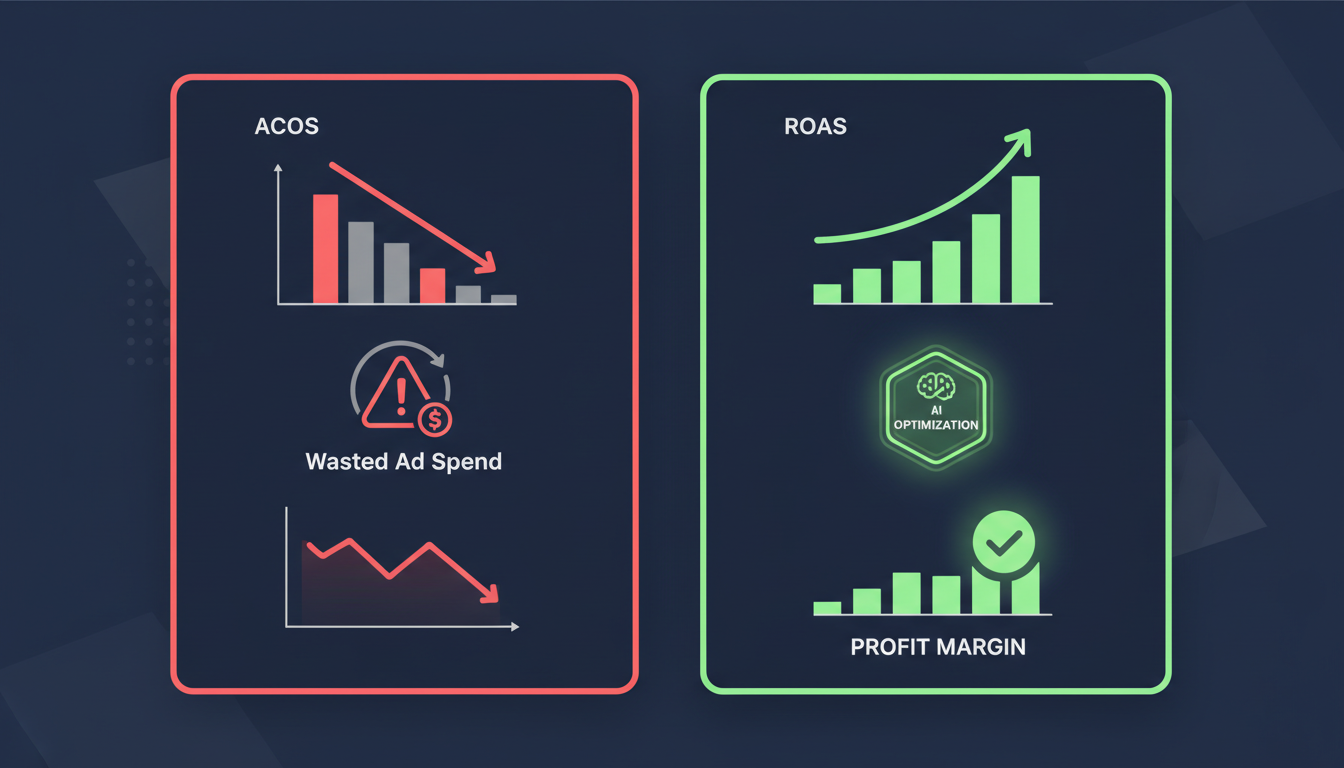
Before diving into tactics, align your team on the two most essential KPIs. ACoS (Advertising Cost of Sales) is your ad spend divided by ad revenue — lower is more efficient. ROAS (Return on Ad Spend) is the inverse — higher means more revenue per dollar spent.
Obsessing over one number while ignoring the other is a guaranteed path to either over-spending or under-scaling. The goal is a system that lowers ACoS on mature keywords while increasing ROAS through smarter targeting and creative — not a single lever you pull once.
Strategy 1: Ruthless Negative Keyword Management
The single fastest way to lower ACoS is to stop paying for clicks that will never convert. Negative keywords are the most powerful — and most underused — tool in Amazon PPC management.
Most sellers audit their negative keyword lists monthly at best. That's like bailing water from a leaking boat once a week. High-performing brands review search term reports weekly, aggressively pushing non-converting terms to negative exact and negative phrase lists.
How to Build a Negative Keyword Engine
- Pull your Search Term Report weekly and filter for keywords with 5+ clicks and zero conversions
- Identify intent mismatches — terms that describe a different product category, a competitor brand, or an irrelevant use case
- Add these as negative exact-match at the ad group level and negative phrase-match at the campaign level
- Build a master negative keyword list across your account to prevent the same waste from recurring in new campaigns
The impact is measurable and near-immediate. Agencies consistently report ACoS cuts of 20–30% within weeks purely from disciplined negative keyword hygiene — no bid changes required.
Strategy 2: Segment Campaigns by Buyer Intent Tier
Running all your keywords in a single broad-match campaign is the advertising equivalent of shouting into a crowd and hoping the right person hears you. Granular campaign segmentation is a game-changing unlock that transforms vague traffic into predictable revenue.
Structure your campaigns into three clear intent tiers:
- Discovery Tier (Broad/Auto): Used for keyword research and prospecting. Budget is intentional but capped. Search term data from here feeds the tiers below.
- Conversion Tier (Phrase/Exact): Contains your proven, high-converting terms with aggressive bids. This is where the majority of your budget lives.
- Brand Defense Tier: Isolates your branded keywords to protect market share and maintain low ACoS on your most loyal buyers.
This architecture lets you scale intelligently. When a keyword graduates from discovery to conversion, you increase its budget with confidence because the data already proves it converts. This is the core logic behind Shopper OS, AdAstraa's buyer intent intelligence engine, which automatically maps keyword behavior to purchase-readiness signals.
Strategy 3: AI-Powered Bid Optimization That Never Sleeps
Manual bid management is the biggest hidden cost in Amazon advertising. Every hour a campaign runs sub-optimally — during peak traffic windows you didn't budget for, or with stale bids that haven't absorbed last week's conversion data — is money left on the table or thrown away.
AI-powered advertising software changes the equation entirely. Machine learning models can process performance signals — conversion rate, time-of-day patterns, competitor bid fluctuations, and ASIN-level profitability — and adjust bids in near real-time. Humans simply cannot operate at this speed or data depth.
What 24/7 Bid Automation Actually Looks Like
AdAstraa's Autopilot feature operates continuously, analyzing bid performance at the keyword and placement level simultaneously. When a keyword's conversion rate spikes during a specific daypart, Autopilot raises the bid to capture share. When a keyword's ACoS drifts above target, it trims spend before waste accumulates.
Research from AI PPC practitioners consistently shows 30–76% performance improvements over manual optimization when AI tools are deployed correctly with human strategic oversight. The key phrase is "with oversight" — AI without strategy is just fast guessing.
"The brands that grow are those who treat PPC as a system, not a set of isolated campaigns. You don't need a campaign structure. You need a control system."
— Amazon PPC Growth Agency, 2025
Strategy 4: Unlock True Profit Visibility per ASIN
Here's an uncomfortable truth: most Amazon sellers optimizing for ACoS are optimizing for the wrong number. ACoS measures advertising efficiency, not business profitability. You can have a great ACoS on a product that's losing money after COGS, FBA fees, and returns.
True Profit per ASIN is the essential metric that collapses the gap between advertising performance and actual business health. It accounts for ad spend, Amazon fees, landed cost, refund rates, and promotional discounts — giving you a single, unambiguous number for each product.
How to Build True Profit Visibility Into Your Workflow
The breakthrough comes when this data is connected directly to your bidding decisions. If ASIN A returns $4.20 of true profit per unit sold and ASIN B returns $1.10, it's rational to bid significantly more aggressively for ASIN A even if both products carry similar ACoS percentages.
AdAstraa's all-in-one advertising platform surfaces this exact view — real-time True Profit per ASIN — directly inside the campaign management interface, so every bid decision is grounded in actual margin, not surface-level ad metrics.
Strategy 5: Match Type Mastery and Granular Campaign Structure
Keyword match types are not a "set it and forget it" decision — they are a dynamic optimization lever that separates average sellers from top-performing brands. Each match type serves a distinct purpose in the funnel.
- Broad Match: Maximizes discovery reach; ideal for research campaigns. Watch costs closely and harvest aggressively.
- Phrase Match: Balances reach with intent; captures search patterns around your core keyword.
- Exact Match: Surgical precision for your highest-converting, most proven keywords. Budget here confidently.
The proven best practice is to run each match type in its own dedicated campaign — never mixing them. Mixing match types obscures performance data, makes bid management imprecise, and slows your ability to identify what's actually driving conversions.
Advanced practitioners take this further by separating top-performing exact-match keywords into individual single-keyword campaigns (SKAGs). While more management-intensive manually, this approach becomes effortless with the right AI marketing strategies and automation infrastructure.
Strategy 6: AI-Generated Ad Creatives That Actually Convert
Clicks are only half the battle. Once a shopper sees your Sponsored Brand or Sponsored Display ad, the creative — the image, headline, and copy — determines whether they click or scroll past. Most brands treat creatives as an afterthought. Top brands treat them as a conversion multiplier.
The challenge is that producing and testing multiple creative variants at scale is historically time-consuming and expensive. This is where AI ad generators become an essential part of the modern Amazon advertising stack.
Real-World Example: Creative Testing at Scale
Consider a mid-sized FMCG brand selling protein supplements on Amazon. Manually producing and testing new Sponsored Brand creatives took their team 2–3 days per variant. After integrating an AI creative platform, they generated 8 headline-image combinations in under 20 minutes and identified the top performer within 72 hours of live A/B testing.
The winning creative reduced their cost-per-click by 18% simply by aligning the headline benefit statement more precisely with the search term intent of the ad group. That 18% CPC reduction compounds across every impression and click for the remainder of the campaign lifecycle.
AdAstraa's AdCreative+ module automates this entire workflow — generating on-brand Sponsored Brand and Display creatives, launching A/B tests automatically, and routing budget to the proven winner without human intervention.
See how AdCreative+ generates high-converting Amazon ad creatives in minutes — not days.
Explore AdAstraa's AI Ad Tools Free →Strategy 7: Sponsored Brand and Display Layering for Full-Funnel Dominance
Sellers who run only Sponsored Products are leaving significant revenue on the table. A complete, powerful Amazon advertising campaign strategy layers all three ad types across the buyer journey to maximize both reach and conversion.
Think of it as a funnel with three acceleration points:
- Sponsored Products (Bottom Funnel): Capture high-intent, ready-to-buy shoppers at the keyword level. This is your highest-converting, most direct revenue driver.
- Sponsored Brands (Mid Funnel): Build awareness and category authority when shoppers are comparing options. Custom headline copy and your brand logo create memorable impressions that influence the final click.
- Sponsored Display (Re-Engagement): Recapture shoppers who viewed your product page but didn't convert. Display retargeting is one of the highest-ROI placements available for established ASINs.
The breakthrough insight here is that these ad types don't just work in parallel — they reinforce each other. A shopper who sees your Sponsored Brand ad at the top of search results and then encounters your Sponsored Display retargeting ad 24 hours later is far more likely to convert than one exposed to only a single touchpoint.
Strategy 8: Marketing Automation with AI to Reclaim Operational Time
The most underrated cost in Amazon advertising isn't ad spend — it's the hours of skilled human time consumed by repetitive campaign management tasks. Bid adjustments, search term harvesting, budget pacing, performance reporting: these activities can easily consume 15–20 hours per week for a brand managing 10+ ASINs.
AI-powered marketing workflow automation reclaims those hours and redirects human talent toward genuinely strategic decisions — new product development, creative direction, competitive positioning, and growth planning.
The AdAstraa Autopilot Approach
AdAstraa's Autopilot module is built specifically for Amazon-first brands and agencies that manage significant ad portfolios. It continuously monitors campaign performance across every ASIN, adjusts bids at keyword-level granularity, pauses non-converting campaigns, and escalates edge cases for human review — all without manual intervention.
Combined with EcomGPT for automated customer operations and Shopper OS for buyer intent intelligence, the result is an end-to-end Amazon advertising management platform that operates at a speed and depth impossible to match with manual processes.
The compounding benefit is enormous. A 15-hour weekly time saving redirected toward strategy and product development, sustained over 12 months, is the equivalent of adding a part-time growth strategist to your team — at zero additional labor cost.
Putting It All Together: Your Amazon Advertising System
The eight strategies above are not standalone tactics — they are interconnected components of a single high-performance system. Negative keyword management feeds cleaner data into bid optimization. AI bid optimization runs more efficiently when campaign structure is granular. Creative testing improves CTR, which lowers effective CPC, which gives bid optimization more headroom to scale.
This is what separates brands building sustainable, compounding growth from those stuck in the treadmill of escalating ad spend and stagnant ROAS.
| Strategy | Primary Impact | Time to See Results |
|---|---|---|
| Negative Keyword Management | Lower ACoS 20–30% | 1–2 weeks |
| Campaign Intent Segmentation | Improved CVR & ROAS | 2–4 weeks |
| AI Bid Optimization | Spend efficiency, scale | Immediate–2 weeks |
| True Profit per ASIN | Smarter budget allocation | Immediate |
| Match Type Mastery | Cleaner data, lower CPC | 2–3 weeks |
| AI Ad Creatives | Higher CTR, lower CPC | 3–7 days testing |
| Full-Funnel Ad Layering | Market share growth | 4–6 weeks |
| Marketing Automation | Time reclaimed, consistency | Immediate |
Additional Resources
Deepen your understanding of Amazon advertising with these authoritative external sources:
- Amazon Ads Official Guide: Understanding ACoS — Amazon's definitive resource on calculating and optimizing Advertising Cost of Sales for sponsored products campaigns.
- Statista: Amazon Advertising in the U.S. — Statistics & Facts — Comprehensive data on Amazon ad revenue growth, market share, and digital advertising trends through 2025.
- Harvard Business Review: How Businesses Should Use Retail Media — Strategic framework from HBR on integrating retail media networks into a broader brand growth strategy.
- FTC Endorsement and Advertising Guidelines — Essential compliance reference for brands running sponsored content and influencer campaigns alongside Amazon advertising.
- eMarketer: Amazon Advertising Research & Forecasts — Industry-leading analyst forecasts on Amazon ad spend growth, retail media competition, and advertiser behavior.
The Bottom Line: Build a System, Not a Campaign
Amazon advertising in 2025 rewards brands that operate with precision, speed, and intelligence — qualities that are structurally impossible to maintain through manual management alone. The eight strategies in this guide are your blueprint for building a self-reinforcing advertising machine that lowers ACoS, compounds ROAS, and reclaims the hours your team should be spending on growth.
The brands that will dominate their categories over the next two to three years are not the ones with the biggest budgets — they're the ones with the smartest systems. AI-powered campaign management, granular segmentation, true profit visibility, and automated creatives are no longer optional upgrades. They are the guaranteed baseline for competitive brands.
The question isn't whether you need these capabilities. It's how quickly you can deploy them.
Stop Guessing. Start Scaling.
AdAstraa's AI-powered platform gives Amazon brands 24/7 bid optimization, buyer intent intelligence, automated creatives, and real-time True Profit visibility — in one unified operating system.
Start Your Free AdAstraa Trial Now →