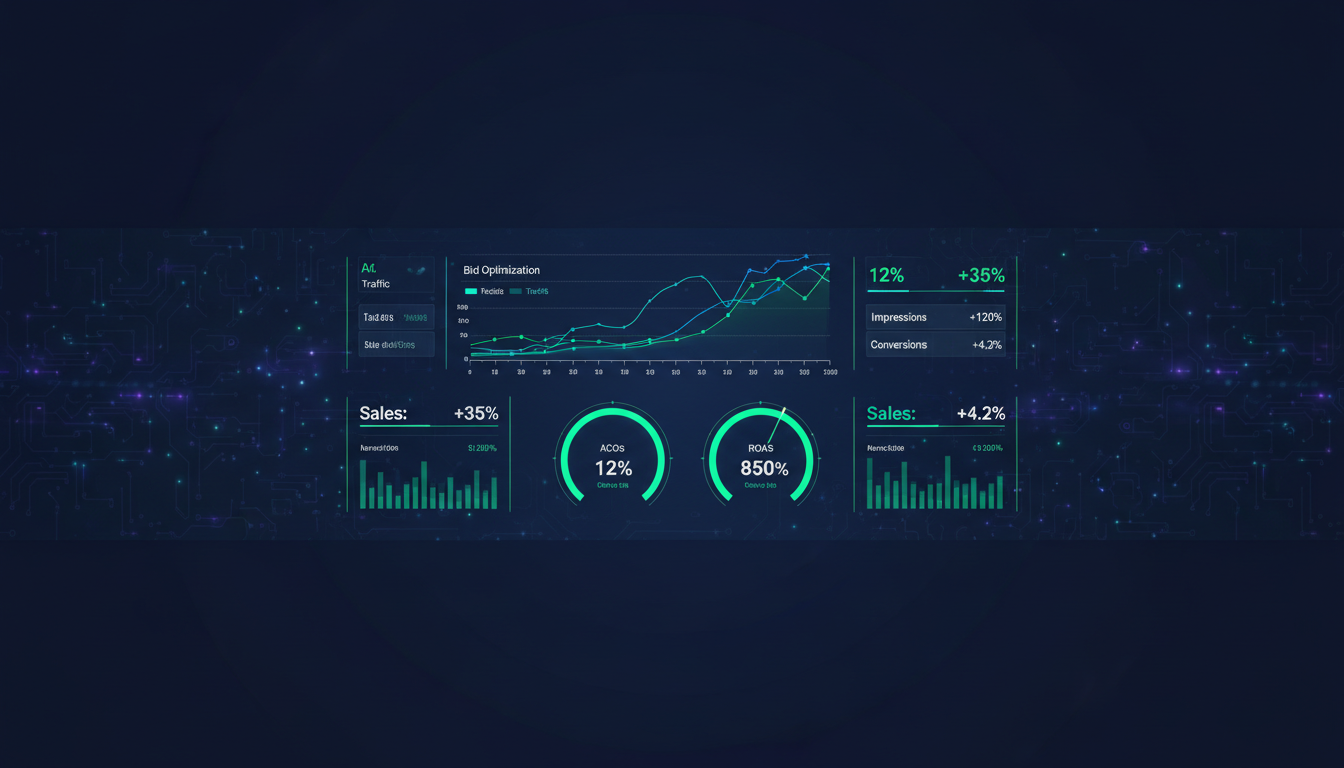
Over 30% of Amazon ad spend is wasted on non-converting keywords — every single day.
If you're managing Amazon PPC manually, you already know the drill: bids that spiral out of control overnight, campaigns bleeding budget on searches that will never convert, and hours of reporting that still leave you guessing. You're not alone — and the problem isn't your products. It's the absence of a systematic, intelligent Amazon advertising strategy.
The good news? With the right Amazon PPC optimization framework — one powered by real-time data and AI automation — you can cut wasted spend dramatically, lower your ACoS to competitive benchmarks (the platform average sits around 30–32% ACoS), and finally see the ROAS growth your catalog deserves.
This guide lays out 8 proven, step-by-step strategies that serious Amazon brands and agencies are using right now to dominate their categories — without drowning in manual tasks.
Stop burning ad budget. Let AI optimize every bid, keyword, and creative — 24/7.
Start Your Free Trial on AdAstraa →
Why Amazon PPC Optimization Is Non-Negotiable in 2025
Amazon advertising revenue surged to $47.4 billion in 2024 — a 24% year-over-year jump — and CPC costs are climbing at roughly 15% annually. The platform is more competitive than ever, which means the margin for sloppy campaign management has effectively vanished.
Brands that rely on "set and forget" tactics or manual weekly bid reviews are handing profitable placements to competitors who review performance data in real time. The sellers winning in 2025 aren't necessarily spending more — they're spending smarter.
Effective Amazon PPC campaign management today demands a combination of clean campaign architecture, intelligent keyword governance, and the kind of always-on bid responsiveness that only AI-powered advertising automation can deliver at scale.
The True Cost of Poor Campaign Management
A single misaligned broad-match keyword can drain hundreds of dollars per week without generating a single conversion. Multiply that across a catalog of 20, 50, or 200 ASINs — and the number becomes quietly devastating to your true profit margin.
Beyond raw spend, unoptimized campaigns distort your performance data, making it nearly impossible to identify which products are actually profitable at the ASIN level. Real-time visibility into True Profit per ASIN is the foundation of every efficient Amazon advertising strategy.
1. Build a Campaign Structure That Actually Scales
The most essential — yet most overlooked — element of Amazon PPC advertising is campaign architecture. A poorly structured account buries high-performing keywords inside bloated ad groups, mixes match types that dilute data, and makes precise bid control nearly impossible.
The proven baseline for most accounts is the Single Product Ad Group (SPAG) model: one product per ad group, with clearly separated campaigns for auto discovery, broad research, and exact-match harvesting. This structure gives you surgical visibility and control at the ASIN level.
Separate Match Types into Dedicated Campaigns
Running broad, phrase, and exact match keywords in the same campaign is a guaranteed path to inflated ACoS. Each match type serves a different purpose: broad and auto campaigns discover converting search terms; exact-match campaigns harvest and scale them.
Once a keyword in your auto or broad campaign meets your conversion threshold, migrate it to a dedicated exact-match campaign with a refined bid — and add it as a negative to the source campaign. This prevents internal budget cannibalization, a game-changing move that elite Amazon advertisers execute consistently.
2. Eliminate Wasted Spend with a Ruthless Negative Keyword Strategy
If there's one strategy that delivers immediate, measurable results in Amazon PPC optimization, it's aggressive negative keyword management. Every irrelevant search term your ad triggers on is money that could have gone toward a proven converting keyword.
Audit your Search Term Reports weekly — or, better yet, automate the process with an AI-powered advertising strategy platform that flags non-converting terms in real time. Add irrelevant, high-spend, zero-conversion terms as negative exact or negative phrase matches at both the ad group and campaign level.
Negative Keyword Tiers That Protect Your Budget
- Permanent negatives: Competitor brand names (unless running conquest campaigns), unrelated categories, and irrelevant descriptors that will never convert for your product.
- ACoS-based negatives: Keywords spending above your break-even ACoS threshold with zero attributed sales over a statistically significant window (typically 2–3x your average CPC in spend).
- Isolation negatives: Terms migrated to dedicated exact campaigns, added as negatives in the source campaign to prevent traffic splitting.
Brands using AdAstraa's Autopilot feature report that automated negative keyword harvesting alone accounts for a significant portion of their ACoS reduction — because the system identifies waste at a speed and scale no human team can match.
3. Replace Rule-Based Bids with AI-Powered Bid Optimization
Traditional rule-based bid automation is reactive: "If ACoS exceeds 30%, reduce bid by 10%." It sounds logical — until you realize that a keyword can be highly profitable at 35% ACoS for a high-margin product and disastrous at 20% ACoS for a low-margin one. Rules don't understand context. AI does.
Modern AI PPC management platforms analyze hundreds of signals simultaneously: historical conversion rates, time of day, day of week, competitor aggressiveness, inventory levels, and seasonal patterns. Instead of executing a predetermined threshold, AI forecasts the optimal bid to maximize profitable conversions over the next 24 hours.
Why 24/7 Bid Adjustments Are a Competitive Advantage
Amazon's auction runs around the clock, and purchase intent — and therefore conversion rates — fluctuates dramatically by hour. A competitor can increase their aggression on your core keywords at 2 AM on a Tuesday. By the time your team runs the weekly bid review, you've already lost hundreds of impressions and conversions to a faster bidder.
AdAstraa's Autopilot runs live bid adjustments across 9 Amazon marketplaces, 24 hours a day, 7 days a week — responding to competitive shifts and performance signals the moment they happen. It's the ultimate antidote to the perpetual lag of manual campaign management.
The results speak for themselves: brands running on Autopilot have seen an average +41.8% ROAS lift, with over ₹218 Crore in ad spend optimized in a single quarter.
4. Target High-Intent Shoppers with Buyer Intelligence Data
Not all clicks are equal. A shopper searching "best organic protein powder for weight loss" carries dramatically higher purchase intent than someone searching "protein powder" — yet without intent intelligence, both might receive the same bid and creative. That's an enormous, hidden source of wasted spend.
Effective Amazon advertising management requires understanding the why behind search behavior, not just the what. By layering buyer intent signals on top of keyword data, you can identify which search terms are in the purchase-ready stage of the funnel versus the research stage — and bid accordingly.
How Shopper OS Transforms Keyword Targeting
AdAstraa's Shopper OS goes beyond conventional keyword tools by mapping buyer intent patterns across product categories. It identifies which search terms signal imminent purchase decisions versus early-stage browsing — giving your campaigns the intelligence to invest budget where conversion probability is highest.
This means your Amazon advertising campaign isn't just chasing traffic — it's pursuing the right traffic. The result is a higher conversion rate from the same (or smaller) budget, which is the most direct path to a lower ACoS without sacrificing top-line sales velocity.
5. Use Advanced Segmentation to Scale Winners and Kill Losers Fast
One of the most powerful — yet underutilized — Amazon PPC advertising tactics is product-level segmentation. When high-performing and low-performing ASINs share the same campaigns and budgets, winners subsidize losers. Profits get muted; problems get masked.
Segmenting your campaigns by ASIN performance tier (top performers, growth stage, launch stage, and low performers) gives you precise budget allocation control. You can aggressively fund your proven winners, test strategically with growth-stage products, and make ruthless, data-driven decisions about where to pull spend.
Real-World Example: Segmentation in Action
An FMCG brand managing a 40-ASIN catalog came to AdAstraa with a blended ACoS of 49% and an advertising budget that couldn't stretch further. After migrating to ASIN-level segmentation and AI bid optimization, the team identified that just 8 top-performing SKUs were driving 73% of attributed revenue — but competing for budget against 32 underperforming ASINs. By isolating and defunding poor performers and aggressively scaling proven winners, blended ACoS dropped to 27% within 60 days — while total ad revenue increased by 34%.
This kind of granular visibility into True Profit per ASIN is what separates breakeven advertisers from genuinely profitable ones. Without it, you're navigating blind.
6. Supercharge CTR with AI-Generated Ad Creatives
Even the most perfectly structured campaign with the lowest bids will underperform if your creative doesn't convert browsers into buyers. In a results page crowded with competitor listings, your Sponsored Brand ad creative is often the first — and only — impression you get to make.
Most brands approach creative as an afterthought: a static banner image uploaded at campaign launch, never tested, never refreshed. This is a breakthrough opportunity hiding in plain sight for competitors willing to treat creative as a performance lever.
Generate, Test, and Iterate at Scale with AdCreative+
AdAstraa's AdCreative+ uses AI to generate high-converting ad creatives tailored to your product category, audience signals, and campaign goals — eliminating the days-long creative production cycle that slows most teams to a crawl.
More importantly, AdCreative+ enables rapid A/B testing across creative variants without manual oversight. The system automatically identifies which visuals, headlines, and CTAs drive the highest CTR and conversion rates — then prioritizes those variants for budget allocation. It's the most effortless way to turn creative testing from a quarterly project into a continuous performance engine.
Higher CTR directly improves your Quality Score signals on Amazon, which can lower your effective CPC over time — a compounding advantage that manual creative management simply cannot replicate.
7. Implement Smart Budget Pacing and Dayparting for Maximum Efficiency
Spending your full daily budget by 10 AM — on low-intent, early-morning browsing traffic — and going dark during peak evening purchase hours is one of the most guaranteed ways to inflate ACoS. Yet this is precisely what happens when campaigns run without intelligent budget pacing.
Dayparting — the practice of adjusting bids or pausing campaigns during periods of low conversion probability — is an essential component of a complete Amazon PPC management strategy. By analyzing your historical conversion data by hour and day of week, you can identify your peak performance windows and concentrate budget there.
Automate Budget Decisions to Stop Leaving Money on the Table
Manual dayparting is theoretically possible but practically exhausting — especially across multiple campaigns and marketplaces. AI-powered ad campaign automation platforms handle this dynamically, continuously redistributing budget toward high-conversion time windows without human intervention.
The right Amazon PPC campaign management tool should also flag budget exhaustion risk before it happens — not after your campaigns have gone dark during your category's peak traffic window. Proactive budget governance, not reactive adjustment, is the standard that AI-powered platforms set.
Ready to automate your Amazon ad budget, bids, and creatives under one intelligent platform?
Explore AdAstraa's Full Platform →8. Move Beyond ACoS — Measure True Profit per ASIN
ACoS is a useful efficiency metric, but it's an incomplete picture of profitability. A campaign with a 15% ACoS on a 10% margin product is actually losing money. A campaign with a 40% ACoS on a 70% margin product could be extraordinarily profitable. Optimizing purely to ACoS targets without understanding true unit economics is a silent margin killer.
The most sophisticated Amazon advertising strategy frameworks track TACoS (Total Advertising Cost of Sales — ad spend divided by total revenue, not just ad-attributed revenue) alongside ASIN-level profit calculations that factor in COGS, FBA fees, return rates, and promotional discounts.
Build the Profit Dashboard Your Brand Actually Needs
AdAstraa's platform surfaces real-time True Profit per ASIN — giving brand managers and agency teams a single source of truth that connects ad performance to actual bottom-line impact. No more toggling between Seller Central reports, spreadsheets, and your accountant's notes to understand whether a campaign is genuinely working.
Healthy TACoS benchmarks for established brands typically sit in the 8–15% range. If your TACoS is climbing above that threshold quarter over quarter, it's a clear signal that organic velocity is weakening — and that your ads are propping up sales that should be converting organically. Explore AI-driven advertising strategies designed to improve both paid and organic performance simultaneously.
Tie Ad Performance to Customer Lifetime Value
The most advanced Amazon brands don't just optimize for first-purchase profitability — they use AI to understand which ad-acquired customers are most likely to repurchase, subscribe, or leave high-value reviews. AdAstraa's EcomGPT automates customer operations post-purchase, helping brands maximize the lifetime value of every shopper their PPC campaigns acquire — turning a single ad-attributed sale into an ongoing revenue relationship.
Bringing It All Together: The AI-Powered Amazon PPC Framework
None of these 8 strategies work in isolation. The brands achieving breakthrough results on Amazon are executing all of them — simultaneously, continuously, and at a speed that only AI-powered automation makes possible.
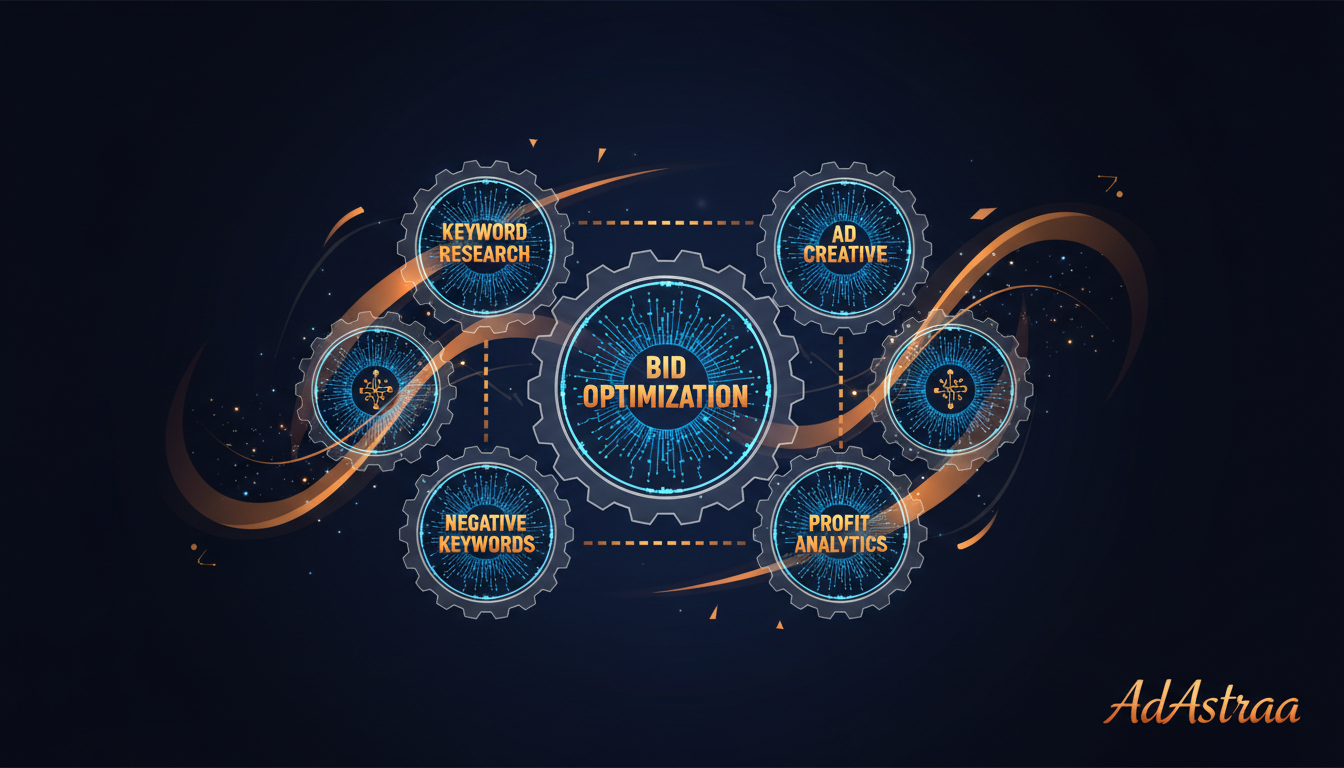
| Strategy | Primary Benefit | AdAstraa Tool |
|---|---|---|
| Campaign Structure (SPAG) | Granular budget and bid control | Autopilot |
| Negative Keyword Harvesting | Eliminate non-converting spend | Autopilot |
| AI Bid Optimization | 24/7 real-time bid precision | Autopilot |
| Buyer Intent Targeting | Higher conversion rates | Shopper OS |
| ASIN Segmentation | Scale winners, eliminate drag | Autopilot + Analytics |
| AI Ad Creative Generation | Higher CTR, lower CPC | AdCreative+ |
| Budget Pacing & Dayparting | Spend during peak conversion windows | Autopilot |
| True Profit Analytics (TACoS) | Real bottom-line visibility | Shopper OS + EcomGPT |
The right Amazon PPC software doesn't just automate what you're already doing — it elevates the entire standard of campaign management, executing strategies at a granularity and speed that creates a genuine, durable competitive advantage.
Additional Resources
Deepen your knowledge of Amazon PPC optimization and AI-powered advertising with these authoritative external references:
- 📖 Amazon Ads Official Learning Console & Guides — Amazon's first-party resource hub covering Sponsored Products, Sponsored Brands, campaign structure best practices, and bidding strategies directly from the source.
- 📊 FTC Digital Advertising Guidance — Essential regulatory context for digital ad compliance, disclosure requirements, and consumer protection standards every Amazon brand should understand.
- 🎓 Harvard Business Review: Building an AI-Driven Marketing Organization — A strategic framework from HBR on how brands structure marketing operations around AI capabilities for sustainable competitive advantage.
- 📈 McKinsey: The Value of Personalization in Marketing — McKinsey's research on how data-driven personalization — a core principle in AI advertising — directly impacts revenue and customer retention for consumer brands.
- 📰 eMarketer: Amazon Advertising Research & Benchmarks — Up-to-date industry data, spend forecasts, and category benchmarks for Amazon advertising — essential context for setting realistic ACoS and ROAS targets.
The Bottom Line: Optimization Is Not a One-Time Event
Amazon PPC optimization is not a checklist you complete once and archive. It's a continuous, dynamic discipline that demands constant attention to shifting keyword performance, competitive bid landscapes, buyer behavior patterns, and creative fatigue cycles.
The 8 strategies in this guide — from bulletproof campaign structure and aggressive negative keyword governance to AI-powered bid optimization and true profit analytics — form the foundation of every high-performing Amazon advertising strategy in 2025. The brands executing all of them, consistently, are the ones widening their competitive moat every single day.
The essential question is no longer whether to use AI in your Amazon advertising — it's how fast you can get there before your competitors do.
AdAstraa was built precisely for this moment: a purpose-built, all-in-one Amazon advertising platform that handles the complexity so your team can focus on strategy, brand-building, and growth. With Autopilot, Shopper OS, AdCreative+, and EcomGPT working in concert, you get the operational power of a full advertising team — running around the clock, at machine speed.
Your competitors are already running AI-powered PPC. Are you?
Join 1,500+ brands on AdAstraa and start cutting ACoS from day one.
Get Started Free on AdAstraa →