



Amazon's ad revenue crossed $56.2 billion in 2024. Most of that money didn't come from the biggest brands — it came from sellers who finally stopped guessing and started optimizing.
If you've ever watched your daily ad budget vanish by noon with nothing to show for it, you already know the gut-punch of wasted spend. You're bidding on keywords, your ads are running — but your ACoS is through the roof and ROAS is nowhere near where it needs to be. Sound familiar?
The truth is, pay-per-click advertising on Amazon is one of the most powerful revenue levers available to D2C brands — but only when it's treated as a precision instrument, not a spray-and-pray budget line. This guide breaks down 8 proven, essential strategies to transform your Amazon PPC into a consistent profit engine.
Stop burning ad spend on keywords that don't convert. Let AI do the heavy lifting — 24/7.
Start Your Free Trial with AdAstraa →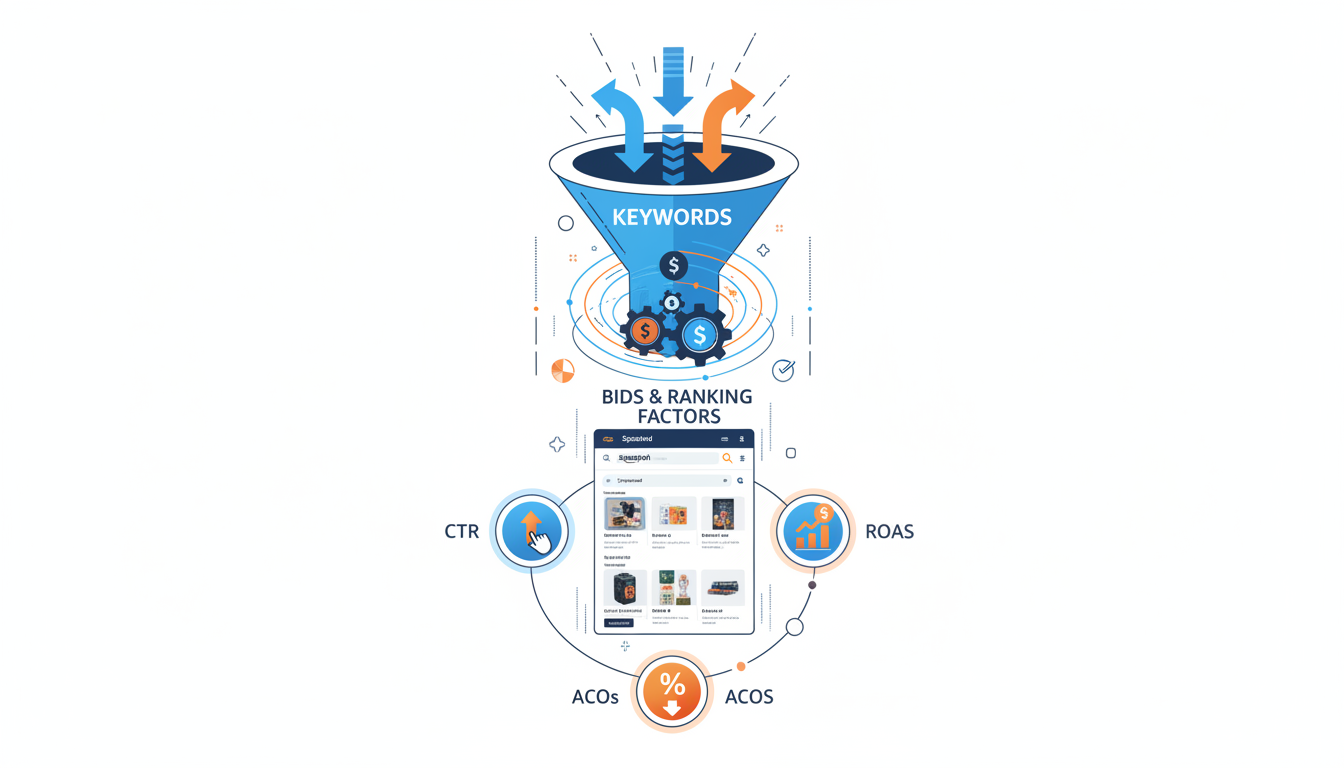
How Amazon Pay-Per-Click Advertising Actually Works
Before diving into strategies, you need a solid grip on the mechanics. Amazon's pay-per-click model is an auction-based system where sellers bid on keywords or product targets. When a shopper's search matches your target, your ad competes for placement. You only pay when someone actually clicks — hence, pay-per-click.
Amazon uses a second-price auction: the highest bidder wins the top placement but pays only $0.01 more than the second-highest bid. This means your maximum bid sets the ceiling, but your actual cost-per-click (CPC) is typically lower.
The Three Core Amazon Ad Types
- Sponsored Products — Drives direct sales on individual ASINs; responsible for ~65% of total Amazon ad spend.
- Sponsored Brands — Banner-style ads showcasing your logo, headline, and up to 3 products. Ideal for brand awareness and cross-selling.
- Sponsored Display — Retargeting ads that follow shoppers across Amazon and beyond, re-engaging high-intent buyers.
Each ad type serves a distinct ad objective: Sponsored Products are built for conversions, Sponsored Brands for awareness and consideration, and Sponsored Display for retargeting and audience-based reach. Aligning your ad objectives to your funnel stage is step one of every winning campaign structure.
Want to go deeper on campaign architecture? Explore AdAstraa's complete Amazon PPC guide for a step-by-step breakdown of campaign types, match types, and targeting structures.
The Click-Through Rate Equation (And Why It's a Make-or-Break Metric)
Your click-through rate (CTR) is the most immediate signal of how compelling your ad is. It tells Amazon — and you — whether shoppers find your listing worth investigating. The click-through rate formula is elegantly simple:
CTR = (Clicks ÷ Impressions) × 100
Example: 240 clicks from 40,000 impressions = 0.6% CTR
For Amazon Sponsored Products, a CTR of 0.3%–0.5% is considered average, while anything above 0.5%–1% signals a strong, resonant listing. Why does this matter beyond the obvious? Because Amazon's algorithm rewards high-CTR ads with better placement and lower effective CPCs — creating a virtuous cycle where good ads get cheaper over time.
What Silently Kills Your CTR
- Low-quality or generic main product images (Amazon's own data shows lifestyle images can lift CTR by up to 40% in mobile Sponsored Brands ads)
- Weak or keyword-stuffed product titles that don't read naturally
- Price mismatch versus competitors on the same search page
- Irrelevant keyword targeting sending your ad to the wrong audience
- Too few reviews or a low average star rating reducing shopper trust
The click-thru rate formula is just the start — the real power is in diagnosing why your rate is what it is and engineering a systematic fix. AdAstraa's Shopper OS uses buyer intent intelligence to identify exactly which search queries are driving impressions without clicks — so you can fix the disconnect at the root.
Strategy 1: Build a Keyword Architecture That Converts, Not Just Ranks
Most Amazon sellers treat keyword research as a one-time task. The smartest sellers treat it as a living system. Effective pay-per-click advertising begins with understanding that not all keywords are equal — and bundling them into one campaign is a guaranteed path to mediocre ACoS.
Structure your keyword strategy across three tiers:
- Broad/Auto Discovery Campaigns — Run automatic targeting to mine new, converting search terms you haven't considered.
- Phrase Match Campaigns — Bridge campaigns that capture mid-funnel shoppers using relevant keyword variations.
- Exact Match Campaigns — Your profit campaigns. High-intent, proven converters with aggressive, optimized bids.
Harvest winners from automatic campaigns and graduate them to exact match manually — or let AI do it automatically. The game-changing move is negative keyword harvesting: systematically eliminating search terms that drain your budget without producing orders. This single habit can reduce wasted spend by 20–35% within 30 days.
The Long-Tail Keyword Advantage
Broad, short-tail keywords like "coffee maker" carry massive competition and inflated CPCs. A laser-focused term like "pour-over glass coffee maker with timer" attracts buyers with specific intent — and at a fraction of the cost. Long-tail keywords consistently deliver lower CPCs and higher conversion rates, making them the secret weapon of profitable Amazon advertisers.
Strategy 2: Master Bid Optimization With Data-Driven Precision
Bidding on Amazon is no longer a set-it-and-forget-it activity. With CPC inflation hitting 15% year-over-year across most categories (average CPC now sits at ~$1.12), every cent of your bid needs to earn its place.
Amazon offers three core bidding strategies:
| Strategy | How It Works | Best For |
|---|---|---|
| Dynamic — Up & Down | Adjusts bids higher for likely conversions, lower for unlikely ones | Scaling proven campaigns |
| Dynamic — Down Only | Only reduces bids for low-conversion scenarios | Budget-conscious optimization |
| Fixed Bidding | Holds a constant bid regardless of conversion probability | Highly controlled testing scenarios |
The breakthrough that separates high performers from the rest is moving from manual bid adjustments to algorithmic optimization. AdAstraa's Autopilot monitors every keyword and placement 24/7 — adjusting bids in real time based on conversion probability, time-of-day trends, and competitive pressure signals. No more waking up to find your entire daily budget burned on one non-converting keyword overnight.
Strategy 3: Decode ACoS and ROAS to Set Targets That Actually Make Sense
The two metrics that define whether your pay-per-click advertising is profitable are ACoS (Advertising Cost of Sale) and ROAS (Return on Ad Spend). They measure the same performance from opposite angles:
ACoS = (Ad Spend ÷ Ad Revenue) × 100 | Lower is better
ROAS = Ad Revenue ÷ Ad Spend | Higher is better
Industry benchmarks put average ACoS between 25%–36%, with top performers achieving 22–25%. But here's the essential insight most sellers miss: your break-even ACoS equals your product margin. A 30% margin product should never sustain a 45% ACoS long-term — you're literally paying to lose money.
Set tiered ACoS targets by campaign type: exploration campaigns can run at higher ACoS while gathering data; performance campaigns should operate well below your break-even threshold. Track TACoS (Total Advertising Cost of Sale) as your north-star metric — it accounts for organic halo revenue that pure ACoS analysis ignores entirely.
Strategy 4: Optimize Your Product Listing to Supercharge Click-Through Rates
Here's a hard truth: the most expertly crafted PPC campaign cannot save a weak product listing. Your listing is the landing page for every ad click you pay for. If it doesn't convert, you're pouring money into a leaky bucket.
The elements that directly impact your click-through rate equation from the search results page are:
- Main Product Image — Must be high-resolution, white background, with the product filling 85%+ of the frame. Consider testing lifestyle images in Sponsored Brands ads (proven to lift CTR by up to 40%).
- Product Title — Lead with the primary keyword, include the key differentiator, and keep it readable. Keyword stuffing hurts CTR even if it helps impressions.
- Price & Ratings Signal — Shoppers see your price and star rating before they click. A competitive price and 4+ stars with meaningful review volume is a powerful conversion signal.
- A+ Content & Bullet Points — These don't affect CTR from search but powerfully impact conversion rate post-click — the second half of your profitability equation.
AdAstraa's AdCreative+ generates AI-powered ad creatives — including lifestyle imagery, headline copy, and banner variations — engineered specifically for Amazon's ad formats. Stop relying on static product shots when dynamic, intent-matched creatives can deliver measurable CTR lifts at scale.
Discover how AdCreative+ builds scroll-stopping Amazon ad creatives — automatically.
Explore AI Creative Generation →Strategy 5: Configure Ad Settings and Campaign Structure for Maximum Visibility
Even experienced sellers underestimate how much their ad settings configuration impacts performance. Campaign structure is not just organizational hygiene — it's a fundamental performance lever. The essential rules:
One ASIN Per Campaign (Where Possible)
Grouping multiple ASINs in a single campaign dilutes your data. Amazon distributes budget across ad groups, making it impossible to know which product is consuming spend. Isolating ASINs gives you clean, actionable data — and true visibility into your profit per ASIN.
Placement Bid Adjustments Are Non-Negotiable
Amazon lets you increase bids by up to 900% for Top of Search placements. Top-of-Search ads consistently deliver higher CTR and conversion rates than detail page or rest-of-search placements. For your proven, exact-match campaigns, layering a 50–150% Top-of-Search bid adjustment is often the single fastest way to unlock scale without restructuring your entire account.
Budget Throttling Silently Kills Momentum
If your best campaigns routinely run out of budget before the day ends, you're leaving guaranteed revenue on the table. Monitor budget utilization rates daily and prioritize increasing budgets on sub-25% ACoS campaigns first — these are your proven profit machines that deserve fuel.
Strategy 6: Track True Amazon Revenue with Profit-First Analytics
Here's a question most sellers can't answer confidently: "What is your actual profit per ASIN after ad spend, fees, COGS, and returns?" If you're tracking Amazon revenue only at the account level, you're flying blind.
The breakthrough shift is from revenue tracking to True Profit tracking. This means accounting for:
- Amazon fulfillment and referral fees (FBA or FBM)
- Cost of Goods Sold (COGS) per unit
- Ad spend attributed at the ASIN level
- Return rate and refund costs by SKU
- Sponsored ads contribution to organic rank lift (TACoS view)
AdAstraa's platform delivers real-time True Profit per ASIN visibility — so you instantly know which products are your genuine stars and which are silently subsidized by your winners. This isn't just analytics; it's the operational intelligence that powers step-by-step budget reallocation decisions. Learn more about building a profit-first ad strategy through our AI advertising strategies hub.
Strategy 7: Use Real-World Campaign Data to Drive Continuous Improvement
Theory is valuable. Data-backed iteration is unstoppable.
Consider a mid-sized FMCG brand selling personal care products on Amazon. They were running 14 campaigns with a blended ACoS of 41% — well above their 28% product margin. Profitable on the surface, catastrophic underneath. Their core issues:
- Auto campaigns were generating 60% of spend but only 22% of conversions
- Three top-of-search exact match keywords were responsible for 71% of all ad revenue
- No negative keyword strategy — broad match was cannibalizing their budget on irrelevant searches
After restructuring campaigns around a three-tier keyword architecture, adding 180 negative keywords, and reallocating budget to the three proven exact-match terms, their blended ACoS dropped to 23% within 45 days — a 44% improvement — while total ad-attributed revenue grew 18%.
The lesson: most Amazon PPC accounts don't need more budget — they need better architecture. Explore proven AdAstraa case studies to see how brands across categories have engineered these same transformations.
Strategy 8: Automate and Scale Your PPC With Purpose-Built AI — Not Guesswork
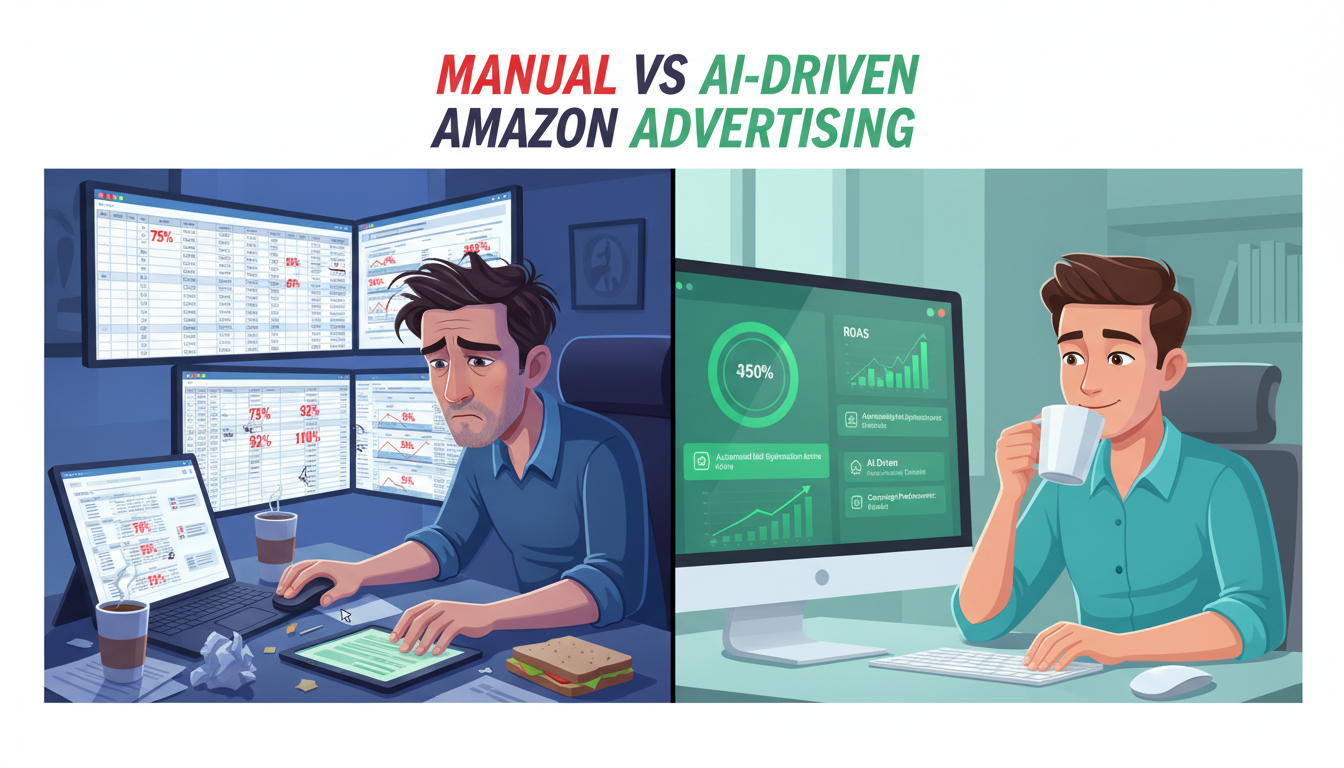
Here's the uncomfortable reality of manual Amazon PPC management: the platform moves faster than any human can. Keyword performance shifts hourly. Competitor bids change overnight. Seasonal demand spikes catch static bids off-guard. Managing this manually — even with a dedicated ads manager — means you're always reacting, never anticipating.
AI-powered automation is no longer optional for brands serious about scaling. It's the only way to achieve 24/7 optimization at the granularity level that actually moves the needle. The right automation platform should:
- Adjust bids in real time based on conversion signals — not just schedule-based rules
- Automatically harvest and promote converting search terms from auto to exact campaigns
- Pause or reduce bids on keywords draining budget without orders
- Flag anomalies (budget overruns, CTR drops, sudden CPC spikes) with actionable alerts
- Report True Profit in real time — not just ad metrics in isolation
AdAstraa's Autopilot does exactly this — operating as a 24/7 bid optimization engine that treats your ad account the way a world-class media buyer would, but at machine speed and scale. Combined with Shopper OS's buyer intent signals and EcomGPT for automated customer operations, it's the complete operating system Amazon-first brands need to compete and win. See the full AdAstraa platform overview to understand how all four tools work together.
Additional Resources
Deepen your understanding of Amazon pay-per-click advertising with these authoritative external resources:
-
Amazon Ads — Official Sponsored Products Guide
The definitive guide from Amazon on how Sponsored Products work, including campaign setup, targeting options, and performance measurement. -
FTC — Endorsement & Advertising Disclosure Guidelines
Essential compliance reading for any brand running paid advertising or sponsored content on digital platforms including Amazon. -
Harvard Business Review — Why Every Company Needs a Retail Media Strategy
A strategic framework from HBR on why retail media (including Amazon PPC) has become central to modern brand advertising strategy. -
Jungle Scout — Amazon PPC Ultimate Guide (2024)
A comprehensive, data-rich guide covering campaign types, bidding strategies, and benchmark CTR and ROAS data across major Amazon categories. -
Amazon Ads — Sponsored Brands Goal-Based Campaigns
Official Amazon resource explaining how to align Sponsored Brands campaign objectives (awareness, consideration, conversion) with your brand's ad goals.
The Bottom Line: Profitable Pay-Per-Click Advertising Is a System, Not a Campaign
The 8 strategies above aren't independent tips — they're an integrated, step-by-step system. Keyword architecture feeds bid optimization. CTR improvements fuel better Quality Scores and cheaper clicks. Profit-first analytics direct budget reallocation. And AI automation ensures the entire machine runs continuously, without the manual overhead that drains your team.
Amazon's advertising landscape in 2025 rewards sellers who operate with precision, speed, and data intelligence. With $56 billion in annual ad revenue flowing through the platform and CPC costs rising every quarter, the window for undisciplined spending is closing fast.
The brands winning today aren't necessarily spending more. They're spending smarter — with powerful tools that eliminate waste, surface opportunity, and compound performance over time. That's exactly what AdAstraa was built to deliver.
Ready to stop guessing and start winning?
Join Amazon-first brands using AdAstraa's Autopilot, Shopper OS, EcomGPT, and AdCreative+ to scale profitably — without the manual management hours.
Get Started Free with AdAstraa Today →