
Did you know Amazon sellers who actively optimize their pay per click campaigns reduce ACoS by up to 30% within 90 days — while their competitors keep burning budget on keywords that never convert?
Amazon's advertising ecosystem crossed $47.4 billion in revenue in 2024, growing 24% year over year. With the average cost per click now sitting at $1.12 and climbing, running a pay per click campaign without a disciplined strategy is no longer just inefficient — it's existential for your margins.
Whether you're new to Amazon PPC advertising or a seasoned seller trying to squeeze more out of every dollar, this guide delivers eight battle-tested, data-backed strategies to transform your campaigns into a genuine growth engine.
Stop letting non-converting keywords drain your ad budget every single day.
Start Your Free AdAstraa Trial Today →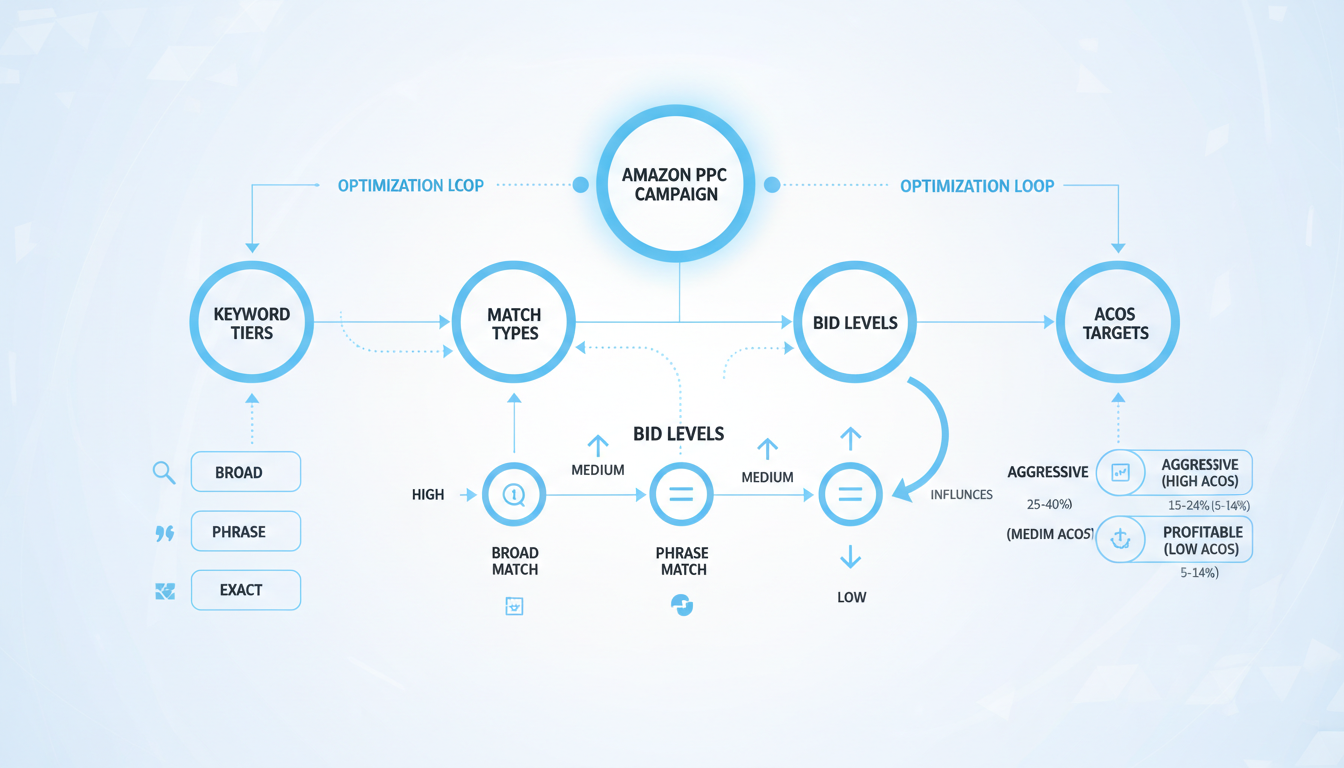
What Is a Pay Per Click Campaign on Amazon (And Why It Matters More in 2025)
Amazon's pay per click model is an auction-based advertising system. Sellers bid on keywords, and when a shopper searches for a matching term, Amazon displays the highest-bidding relevant ad. You only pay when a shopper clicks — hence, pay per click.
It sounds simple. The reality is far more nuanced.
With CPCs rising 15.5% year over year and top-of-search click-through rates reaching 4.11% compared to just 0.73% for mid-page placements, where your ad appears matters as much as what your ad says. That placement advantage is directly tied to bid strategy, relevance score, and campaign structure — all of which this guide will walk you through.
The Three Core Amazon PPC Campaign Types
- Sponsored Products — The workhorse of Amazon PPC. Drives 65% of total ad spend across the platform. Ideal for product-level visibility.
- Sponsored Brands — Showcases your brand logo, headline, and multiple products. Essential for brand recall and new-to-brand customer acquisition.
- Sponsored Display — Reaches shoppers both on and off Amazon. The only format that supports retargeting within the last 30 days of browsing behavior.
Understanding which campaign type serves your goal — visibility, conversion, or retargeting — is the essential foundation everything else is built upon.
Strategy 1: Build a Bulletproof Campaign Structure from the Start
The single most overlooked factor in pay per click campaign performance is architecture. Sellers who dump all their products into one catch-all campaign, or who fail to segment by product type, spend level, or match type, are setting themselves up for a painful audit later.
A proven structure follows a deliberate hierarchy: campaigns at the top (budget and targeting type), ad groups in the middle (product clusters), and individual product ads at the base. Each ad group should target a tight cluster of closely related products and keywords.
Campaign Naming Conventions That Save You Hours
Use a naming system that immediately tells you what a campaign is about without logging into Amazon Seller Central. A reliable format: [Brand] | [Product Category] | [Campaign Type] | [Match Type]. When you're managing dozens of active campaigns, this structure is a game-changing time saver.
Pair this with a strict "one objective per campaign" rule — don't mix brand awareness Sponsored Brands campaigns with conversion-focused Sponsored Products campaigns in the same reporting bucket. Clean separation creates clean data, and clean data creates powerful decisions.
Strategy 2: Master Keyword Research with Match Types
Keyword research isn't a one-time task — it's a living process. The most successful Amazon sellers run a three-layer keyword strategy that balances reach, intent, and efficiency.
- Broad Match — Maximum reach, maximum discovery. Use for auto campaigns during product launch phases to surface new keyword opportunities.
- Phrase Match — Balanced reach with some control. Target shoppers who use your keyword within a longer query.
- Exact Match — Maximum control, highest intent. Reserve your top bids for keywords that have proven they convert.
The breakthrough tactic here is what top sellers call the "auto-to-manual pipeline": start with an automatic campaign to harvest converting search terms, then graduate the winners into a manual exact-match campaign with optimized bids. This is the step-by-step flywheel that separates scaling brands from stalling ones.
Use AdAstraa's Shopper OS buyer intent intelligence to identify high-intent keywords your competitors haven't claimed yet — before CPC inflation makes them unaffordable.
Strategy 3: Eliminate Waste with an Aggressive Negative Keyword Strategy
If there's one lever that produces the most instant impact on ACoS, it's negative keywords. These are the search terms you're telling Amazon: do not show my ad for this query.
Most sellers set up their campaigns, run them for weeks, and never audit their Search Term Reports. Meanwhile, their ads are showing for wildly irrelevant queries — draining budget on clicks that have zero purchase intent.
How to Run a Weekly Search Term Audit
- Download the Search Term Report from your Amazon Seller Central login every 7 days.
- Filter for terms with more than 5 clicks and zero conversions.
- Add the worst offenders as exact-match negatives at the campaign level.
- For systematic issues (e.g., brand-name competitor searches), add phrase-match negatives.
- Review and iterate weekly — negative keyword lists are never finished.
A household goods brand using this approach alongside AI automation slashed their ACoS from 38% to 21% in under 60 days — simply by eliminating the traffic they were paying for but never converting. The must-know insight? Negative keywords are not restrictions — they're budget redirectors.
Strategy 4: Use Data-Driven Bid Optimization to Maximize Every Dollar
Bidding on Amazon is not a "set it and forget it" exercise. With average CPCs fluctuating by category, time of day, device type, and competitive pressure, manual bid management is genuinely untenable at scale.
The proven formula for a target bid is:
Optimal Bid = Target ACoS × Product Price × Conversion Rate
Example: 0.25 × $40 × 0.10 = $1.00 per click at 25% target ACoS
But real-world bidding is more dynamic. Top-of-search placements command premium bids because CTR there is 5× higher than rest-of-search positions. Amazon's Placement Modifiers allow you to set a percentage multiplier for top-of-search bids — a critical lever most sellers leave untouched.
Dynamic Bidding Modes: Which One Should You Use?
| Mode | Best Use Case | Risk Level |
|---|---|---|
| Down Only | Mature campaigns with stable CVR | Low |
| Up and Down | Product launch and scaling phases | Medium |
| Fixed | Testing and baseline benchmarking | Medium-High |
AdAstraa's Autopilot engine handles bid adjustments 24/7 — analyzing conversion signals, placement performance, and dayparting data in real time, so your bids are always working at peak efficiency without you logging in at midnight.

Strategy 5: Allocate Budgets Strategically Across Your Campaign Portfolio
Budget misallocation is a quiet killer. Many sellers over-fund broad discovery campaigns and starve their highest-converting exact-match campaigns of the budget they need to scale.
A guaranteed framework that works: allocate budgets proportional to proven conversion data, not assumptions. Start new automatic campaigns at $30–$50 per day during the data-gathering phase. Once you identify your top 20% of converting keywords, shift the majority of spend behind them in dedicated manual campaigns.
A Simple Budget Allocation Model by Objective
- 60% — Conversion Campaigns: Proven exact-match keywords driving profitable sales.
- 25% — Discovery Campaigns: Auto and broad campaigns mining new keyword opportunities.
- 15% — Brand Campaigns: Sponsored Brands and Sponsored Display for retargeting and new-to-brand acquisition.
This structure keeps the profitable core of your pay per click campaign well-funded, while giving your discovery layer enough runway to surface tomorrow's winners. Revisit the allocation monthly — or more frequently during peak seasons like Prime Day.
Ready to see exactly where your ad budget is going — and where it should be going instead?
Get Your Free PPC Audit with AdAstraa →Strategy 6: Optimize Listings to Convert the Traffic You're Paying For
Here's a truth most digital marketing ad agencies won't tell you: a great pay per click campaign can't save a bad product listing. If your click-through rate is acceptable but your conversion rate is poor, you're wasting every dollar you're spending on ads.
Amazon's average conversion rate sits at 10–12%, but top performers exceed 15%. The gap between average and excellent is almost always a listing problem, not an advertising problem.
The Essential Listing Elements That Drive Conversion
- Main Image: White background, product filling 85%+ of frame. This is the most impactful single element on CTR.
- Title: Lead with your primary keyword. Include key benefits, size/quantity, and brand name in the first 80 characters.
- Bullet Points: Address the top five objections a buyer has. Lead with benefits, follow with features.
- A+ Content: Brands enrolled in Amazon Brand Registry should use A+ Content with comparison charts, lifestyle imagery, and brand story modules.
- Reviews: Social proof is a conversion amplifier. Prioritize review acquisition through follow-up programs and the Vine program.
Use AdAstraa's AdCreative+ tool to generate high-converting ad creatives and listing assets at scale — without the lag time and cost of commissioning a design agency every time you need a new creative variation.
Strategy 7: Track the Right Metrics — ACoS, TACoS, and True Profit per ASIN
Most sellers obsess over ACoS. That's understandable — it's Amazon's native profitability metric. But ACoS tells only part of the story. Sophisticated sellers track a constellation of KPIs to get the full picture.
The Metrics That Actually Drive Decisions
- ACoS (Advertising Cost of Sale): Ad spend ÷ ad-attributed revenue. Industry average is 29.6%; strong performers sit at 18–22%.
- TACoS (Total Advertising Cost of Sale): Ad spend ÷ total revenue. The ultimate health indicator of your brand's advertising dependency.
- ROAS (Return on Ad Spend): Ad revenue ÷ ad spend. In 2024, top sellers achieved ROAS of 5.3×, up from 5.0× the prior year.
- True Profit per ASIN: Revenue minus COGS, FBA fees, ad spend, returns, and storage. This is the ultimate number — and the one most sellers never actually calculate.
- New-to-Brand %: Available via Brand Registry. Shows what percentage of conversions are from first-time brand buyers — a key indicator of growth quality.
AdAstraa's real-time dashboard surfaces True Profit per ASIN at the product level, so you always know which ASINs are building your business and which ones are quietly subsidized by your winners. Explore the full AdAstraa platform overview to see how every metric connects.
Strategy 8: Scale Effortlessly with AI-Powered Campaign Automation
Manual optimization worked when you had 10 SKUs and two campaigns. In 2025, the fastest-growing Amazon brands manage hundreds of ad groups, thousands of keywords, and millions of bid-decision points every month. That is not a human-scale problem anymore — it requires machine-scale intelligence.
This is exactly the gap AI-powered platforms were built to close. AdAstraa's Autopilot engine monitors every keyword, bid, and placement in your pay per click campaign 24 hours a day, 7 days a week — making micro-adjustments that no manual process can replicate.
What AI Campaign Automation Actually Handles
- Bid optimization based on real-time conversion data, competitive auction pressure, and placement performance.
- Negative keyword automation — systematically pausing search terms that cross your ACoS threshold without converting.
- Budget pacing — preventing campaigns from going dark mid-day while avoiding end-of-day over-spending.
- Dayparting — adjusting bids based on hour-by-hour conversion rate patterns specific to your category.
- New keyword discovery — surfacing high-intent search terms from auto campaign data and injecting them into manual campaigns automatically.
One FMCG brand using AdAstraa's full automation suite reduced manual management time by 18 hours per week, lowered ACoS from 34% to 19%, and achieved a ROAS of 5.8× — all within their first quarter on the platform. That kind of effortless, compounding improvement is what separates brands that scale from brands that stagnate.
Whether you're a solo seller or a digital marketing ads agency managing multiple Amazon accounts, intelligent automation is the breakthrough that makes sustainable scale possible.
Real-World Snapshot: How a D2C Brand Reclaimed $14,000 in Monthly Ad Waste
A mid-size D2C kitchenware brand had been running Amazon pay per click campaigns for two years. Their Sponsored Products budget was $22,000 per month, their ACoS was hovering at 36%, and their team was spending nearly 20 hours a week manually managing bids across 340 active keywords.
After implementing the eight strategies outlined in this guide — and plugging into AdAstraa's Autopilot and Shopper OS tools — here is what changed over 90 days:
- ACoS dropped from 36% to 21%
- Ad-attributed ROAS improved from 2.8× to 4.7×
- Monthly ad waste eliminated: $14,200
- Weekly management hours reclaimed: 17 hours
- New-to-brand customer acquisition rate: up 31%
The key drivers? Aggressive negative keyword pruning in week one, migrating proven broad-match winners into exact-match campaigns in week two, and allowing Autopilot to handle bid adjustments around the clock from day one. No magic. Just step-by-step process applied consistently.
Browse the full collection of AdAstraa case studies to see how brands across categories have achieved similar breakthroughs.
Additional Resources
- Amazon Advertising: Official Sponsored Products Guide — Amazon's authoritative documentation on Sponsored Products campaign setup, targeting, and bidding.
- Amazon Seller Central: Advertising Policies & Overview — Official policy reference and campaign structure guidelines direct from Amazon.
- Harvard Business Review: How Retail Media Is Transforming Marketing — Strategic analysis of how retail media networks like Amazon Ads are reshaping digital marketing investment.
- FTC: Endorsement Guides for Digital Advertising — Essential compliance reading for brands running sponsored content and advertising on digital platforms.
- eMarketer: Amazon Advertising Forecast & Benchmarks — Industry-leading data on Amazon advertising market share, spend growth, and category benchmarks.
The Bottom Line: Your Pay Per Click Campaign Is Either Working For You or Against You
Amazon's pay per click advertising landscape in 2025 is more competitive, more expensive, and more data-rich than ever before. The brands that thrive aren't necessarily those with the biggest budgets — they're the ones with the most disciplined strategy and the most intelligent automation working behind the scenes.
Every dollar you spend on an Amazon pay per click campaign is a vote of confidence in your strategy. The eight proven approaches in this guide — from bulletproof campaign structure and negative keyword mastery, to AI-powered bid automation and True Profit tracking — give you the complete toolkit to make every vote count.
The brands winning on Amazon right now aren't managing campaigns manually at scale. They've built systems — and for the most ambitious ones, those systems run on AdAstraa.
Stop guessing. Start growing.
Join hundreds of Amazon sellers who've reclaimed their ad spend, lowered their ACoS, and built campaigns that compound — powered by AdAstraa's AI operating system.
Launch Your First Optimized Campaign Free →