Here's a number that should make every Amazon seller stop and think:
Amazon's advertising revenue crossed $56.2 billion in 2024 — an 18% year-over-year surge. Yet industry data consistently shows that the average seller wastes 30–40% of their entire ad budget on keywords that will never convert a single buyer.
That's not a rounding error. That's real profit hemorrhaging from your account every single day — while your competitors quietly sharpen their edge with smarter Amazon PPC optimization techniques.
If you've been manually adjusting bids, guessing at match types, and hoping your campaigns eventually find their footing, this guide is your essential reset. Below, you'll find 9 proven, battle-tested Amazon PPC optimization strategies that top-performing brands use to slash ACoS, protect margins, and scale with confidence — not chaos.
🚀 Stop burning your ad budget. Let AI handle bid optimization 24/7.
AdAstraa's Autopilot engine analyzes thousands of signals in real-time so you don't have to.
Start Your Free Trial Today →
Why Amazon PPC Optimization Is Non-Negotiable in 2025
Amazon's ad ecosystem has grown dramatically more complex. Cost-per-click (CPC) is rising roughly 15% year-over-year across competitive categories. New sellers flood the marketplace daily. And Amazon's own auction mechanics are designed to maximize Amazon's revenue — not your margin.
The brands winning today are the ones who treat Amazon PPC as a living system — one that demands continuous iteration, data-driven decisions, and intelligent automation. Passive campaign management simply cannot keep pace.
Understanding key metrics like ACoS (Advertising Cost of Sale), ROAS (Return on Ad Spend), and TACoS (Total Advertising Cost of Sale) isn't optional — it's the foundation of every profitable campaign. If you want a deep breakdown of how these numbers interact, explore our comprehensive Amazon PPC guide.
Quick Benchmark Reality Check
According to current industry data, ACoS typically ranges from 20–40% depending on category, and a solid ROAS benchmark sits between 2.5x–5.0x. If you're operating outside these ranges without a strategic reason, you almost certainly have optimization gaps to close.
1. Build a Bulletproof Campaign Structure from Day One
The most powerful thing you can do before touching a single bid is architect your campaigns intelligently. Sloppy campaign structures are the silent killers of Amazon ad performance — they cause internal keyword competition, murky data, and impossible-to-interpret reports.
Separate Auto and Manual Campaigns
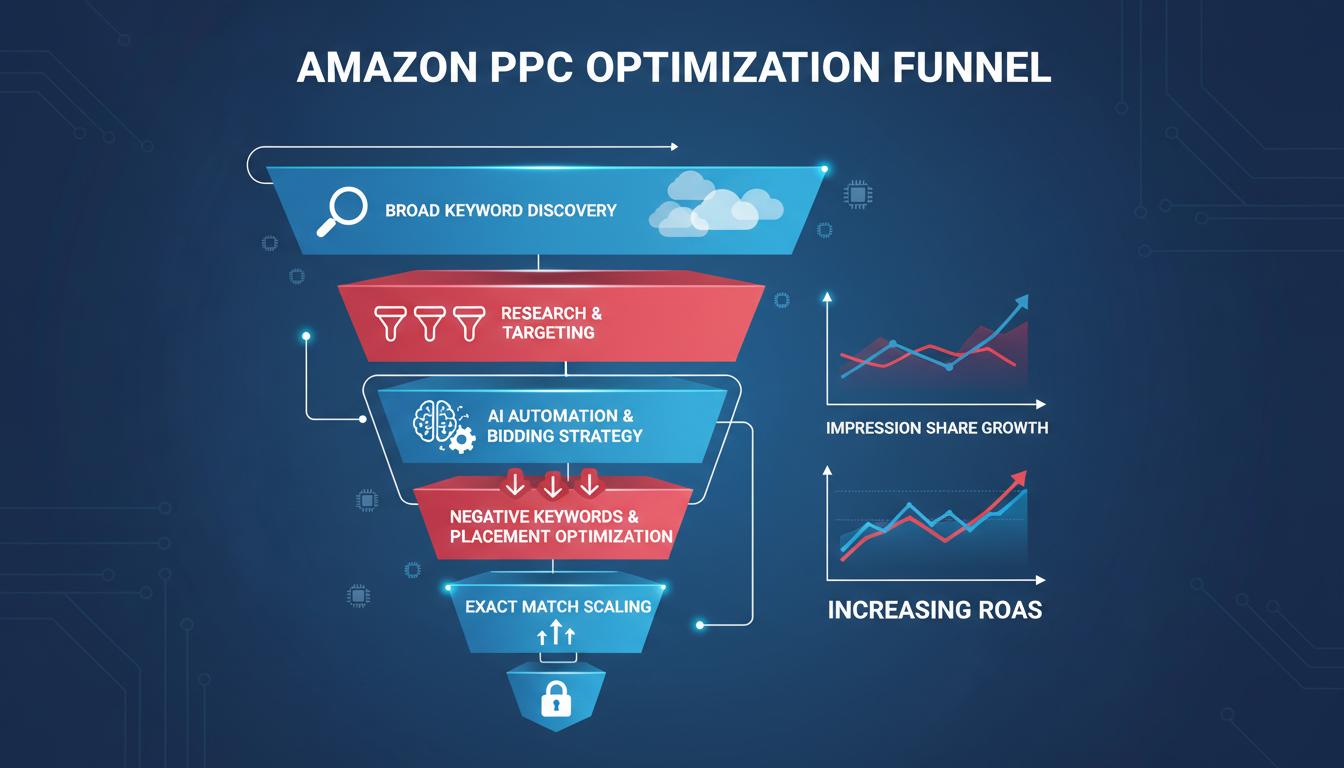
Use automatic targeting campaigns as discovery engines — let Amazon surface new search terms you haven't thought of yet. Then harvest those winners and move them into manual exact-match campaigns with controlled, deliberate bids. This creates a self-reinforcing funnel: auto finds opportunities, manual scales them profitably.
Use Single-ASIN Ad Groups
Grouping multiple ASINs into one ad group makes it nearly impossible to accurately measure per-product profitability. Break out each ASIN into its own ad group so your True Profit per ASIN data stays clean, actionable, and meaningful. AdAstraa's Shopper OS intelligence engine is specifically built to surface this level of buyer-intent data at the ASIN level.
2. Master Match Types — Don't Let Them Master You
One of the most common and costly mistakes Amazon sellers make is running the same keyword across Broad, Phrase, and Exact match simultaneously without segmentation. This creates internal bidding competition where your own campaigns fight each other for the same placement — driving up your own costs.
The Step-by-Step Match Type Funnel
- Broad Match: Use for initial discovery with conservative bids. Monitor search term reports weekly.
- Phrase Match: Promote high-performing broad search terms here. Refine reach while maintaining intent alignment.
- Exact Match: Reserve for proven, high-converting keywords. Bid aggressively here — every click has demonstrated buyer intent.
When a keyword proves itself in Broad, add it as Phrase or Exact and add it as a negative in Broad to stop overlap cold. This disciplined funnel approach is one of the essential cornerstones of elite-level Amazon PPC campaign management.
3. Aggressively Harvest and Deploy Negative Keywords
Negative keyword management is one of the most underutilized and highest-ROI activities in Amazon PPC optimization. Every irrelevant click is money that could have gone toward a conversion — and those costs compound silently across thousands of search terms over time.
Build a Data-Driven Negation Framework
Rather than applying arbitrary rules like "negate after 25 clicks," build product-level benchmarks. Calculate your break-even clicks-to-conversion ratio based on your actual margin, then negate any term exceeding that threshold with zero conversions. Pull your Search Term Report weekly and analyze n-gram patterns (common word combinations appearing in non-converting queries).
Add negatives at both the campaign level (for broad exclusions) and ad group level (for granular control). Use negative exact to block specific wasteful terms and negative phrase to exclude entire intent categories.
Brands using AI-powered negative keyword harvesting — like the automation built into AdAstraa's AI advertising platform — can reclaim 15–25% of wasted spend within the first 60 days.
4. Stop Trusting Amazon's Suggested Bids — Set Yours Strategically
This is a hard truth most beginners learn the expensive way: Amazon's suggested bids are optimized for Amazon's revenue, not your profitability. They consistently push you toward the higher end of competitive ranges, even when lower bids would achieve equal or better results.
The Target ACoS Bid Formula
Start with your Target ACoS — the maximum percentage of a sale's revenue you're willing to spend on advertising. From there, use this formula:
Max Bid = (Target ACoS × Product Sale Price × Conversion Rate)
Example: 25% ACoS × $30 price × 10% CVR = $0.75 max bid
This ensures every single bid you place is anchored to profitability — not Amazon's revenue targets or gut instinct. Adjust bids weekly based on actual performance data and conversion rate changes. For scaling brands managing hundreds of ASINs, manual bid management becomes impossible — which is exactly where AI-powered bid automation becomes a game-changing advantage.
5. Use Placement Bid Adjustments to Win Premium Positions
Amazon allows you to set bid multipliers of 0% to 900% for different placement positions: Top of Search, Rest of Search, and Product Pages. These aren't just cosmetic options — they're one of the most powerful levers for controlling where your budget flows and which shoppers you reach.
Let the Data Tell You Where to Push
Pull your placement performance report and compare conversion rate and ACoS by placement type. If Top of Search converts at 12% versus 4% on Product Pages, it warrants a bid adjustment to capture more of that high-intent real estate. Conversely, reduce adjustments on placements that drain spend without converting.
Re-evaluate placement multipliers at least bi-weekly, especially after seasonal demand shifts, product launches, or competitor activity. This level of precision placement management is a must-know tactic for any brand serious about Amazon advertising campaign profitability.
6. Implement Dayparting to Align Spend with Peak Buying Hours
Your Amazon campaigns run 24 hours a day — but your customers don't buy 24 hours a day. Dayparting is the breakthrough practice of adjusting bids based on hour-of-day and day-of-week performance data, ensuring your budget concentrates on windows when purchase intent is highest.
Pull your hourly impression and conversion data, identify your peak conversion windows, and apply bid increase modifiers during those periods. During low-conversion hours (typically late night or early morning), reduce bids or pause spend entirely to protect your daily budget for high-value moments.
Done manually, dayparting is extremely time-intensive. AI-powered campaign management tools can automate this entirely — adjusting bids in real-time based on live performance patterns across your entire campaign portfolio.
💡 Real-World Example
A home goods brand running AdAstraa's Autopilot engine discovered through hourly data that 67% of their conversions occurred between 7–11 PM. After implementing time-based bid scaling and pulling spend from 2–6 AM, their ACoS dropped 22% within 45 days — without reducing total sales volume. That's not luck. That's intelligent, automated campaign management acting on data humans can't process at scale.
7. Track TACoS — Not Just ACoS — to Measure True Brand Health
ACoS tells you how efficiently your ads generate ad-attributed sales. But TACoS (Total Advertising Cost of Sale) tells you something far more important: what percentage of your total revenue is being consumed by advertising. It's the ultimate measure of your brand's sustainable profitability on Amazon.
A dropping TACoS over time signals organic growth — your products are gaining rank, earning reviews, and converting without ad dependency. A rising TACoS without corresponding revenue growth is a red flag that your paid strategy is subsidizing stagnant organic performance.
Smart Amazon brands monitor TACoS at the ASIN level, setting category-specific targets aligned to their growth stage. New product launches may tolerate a TACoS of 20–30% as they build rank, while mature, well-ranked products should target sub-10%. For full visibility into per-ASIN True Profit and TACoS, explore how AdAstraa's advertising operating system gives you this intelligence in real time.
8. Leverage Sponsored Brand Video and AI-Generated Creatives
In a marketplace where every sponsored placement looks nearly identical, creative differentiation is your ultimate conversion weapon. Sponsored Brand Video ads have consistently demonstrated click-through rates 2–5x higher than standard Sponsored Products placements — and they command premium above-the-fold real estate on mobile search results.
Use AI to Scale Your Creative Production
Creating high-quality video and display ad creatives used to require significant time, budget, and creative resources. AI-powered ad creation tools have fundamentally changed that equation. Platforms like AdAstraa's AdCreative+ engine generate conversion-optimized ad creatives at scale — aligned to your brand, your product benefits, and your target shopper's intent — in minutes, not weeks.
Test multiple creative variants simultaneously using Amazon's built-in A/B testing tools. Let click-through rate and conversion data determine your winners, then reallocate budget toward proven performers. Creative optimization is no longer optional — it's a core pillar of Amazon advertising strategy in 2025.
9. Deploy AI-Powered PPC Automation — The Ultimate Scaling Multiplier
Manual Amazon PPC management has a ceiling. When you're running campaigns across 50+ ASINs, dozens of ad groups, and hundreds of keywords across multiple match types, the sheer volume of optimization decisions exceeds what any human team can handle at the required frequency and precision.
This is where AI-powered PPC automation becomes not just helpful — but essential. Machine learning algorithms can analyze thousands of performance signals simultaneously, adjust bids every hour, identify wasted spend patterns before they appear in weekly reports, and scale proven winners with speed that manual management cannot match.
What the Best Amazon PPC Automation Delivers
- 24/7 bid adjustments based on real-time performance data across all keywords and placements
- Automated negative keyword harvesting that eliminates waste before it accumulates
- Dayparting automation that shifts spend to peak conversion windows without manual scheduling
- Cross-campaign budget rebalancing that moves money toward your highest-ROAS opportunities in real time
- True Profit per ASIN tracking so you optimize for actual margin — not just ad efficiency metrics
Brands using AdAstraa's Autopilot engine report an average ROAS lift of +41.8%, with over ₹218 Crore in ad spend optimized last quarter alone across 1,523 brands. That's the power of purpose-built AI at work — not generic automation, but a system designed specifically for the complexity of Amazon's advertising ecosystem.
Explore the full suite of AI advertising strategies that top Amazon brands are using right now to compound their competitive advantage.
⚡ Your competition is already automating.
See exactly how AdAstraa's Autopilot, Shopper OS, and AdCreative+ can transform your Amazon ad performance — no fluff, just results.
Explore AdAstraa Free →Putting It All Together: Your Amazon PPC Optimization Framework
Each of these 9 strategies is powerful in isolation. But the brands achieving truly breakthrough results implement them as an integrated, interconnected system — where campaign structure feeds match type decisions, which feeds negative keyword workflows, which feeds bid optimization, which feeds placement data, all overseen by AI automation that never sleeps.
| Strategy | Primary Benefit | Time to Impact |
|---|---|---|
| Campaign Structure | Cleaner data, zero overlap | Immediate |
| Match Type Mastery | Lower ACoS, better relevance | 2–4 weeks |
| Negative Keywords | Eliminate wasted spend fast | 1–2 weeks |
| Strategic Bid Setting | Protect margins proactively | Immediate |
| Placement Adjustments | Higher-intent placements | 2–3 weeks |
| Dayparting | Budget focused on peak hours | 4–6 weeks |
| TACoS Tracking | True profitability visibility | Ongoing |
| Video & AI Creatives | Higher CTR, lower CPCs | 3–6 weeks |
| AI PPC Automation | Scale without manual limits | Immediate & compounding |
Additional Resources
Deepen your Amazon PPC knowledge and stay ahead of the curve with these authoritative external sources:
- Amazon Ads Official Learning Console — Amazon's own library of campaign setup guides, best practices, and ad type walkthroughs directly from the source.
- FTC Advertising Disclosure Guidelines — Essential compliance reading for any brand running sponsored content and influencer-driven ad campaigns.
- Harvard Business Review: How AI Is Making Advertising More Effective — A research-backed look at how machine learning is reshaping the performance advertising landscape.
- Jungle Scout 2024 Amazon Advertising Report — Comprehensive benchmark data across ad types, ROAS trends, and category-level insights from millions of Amazon campaigns.
- eMarketer: Amazon Advertising Forecast & Analysis — Independent analyst projections on Amazon ad spend growth, category trends, and competitive dynamics through 2025 and beyond.
The Bottom Line: Optimization Is a Competitive Advantage, Not a Checkbox
Amazon's advertising platform is simultaneously the most powerful and most punishing paid channel in e-commerce. Every optimization gap you leave open is a gap your competitor is actively filling. Every dollar wasted on irrelevant clicks is a dollar that could have built brand equity, funded inventory, or scaled a winning product.
The 9 proven strategies in this guide — from bulletproof campaign architecture and match type mastery, to dayparting precision and AI-powered automation — aren't just tactics. They're a compounding advantage. Each one builds on the next, creating a self-improving advertising system that gets smarter, leaner, and more profitable over time.
The brands dominating Amazon in 2025 aren't just spending more. They're spending smarter — with AI that never sleeps, data that informs every decision, and an operating system built for the unique complexity of the world's largest e-commerce marketplace.
🎯 Ready to build your own intelligent Amazon PPC system?
Join 1,500+ Amazon-first brands already scaling profitably with AdAstraa. Start with a free account — no credit card required.
Get Started with AdAstraa Free →