


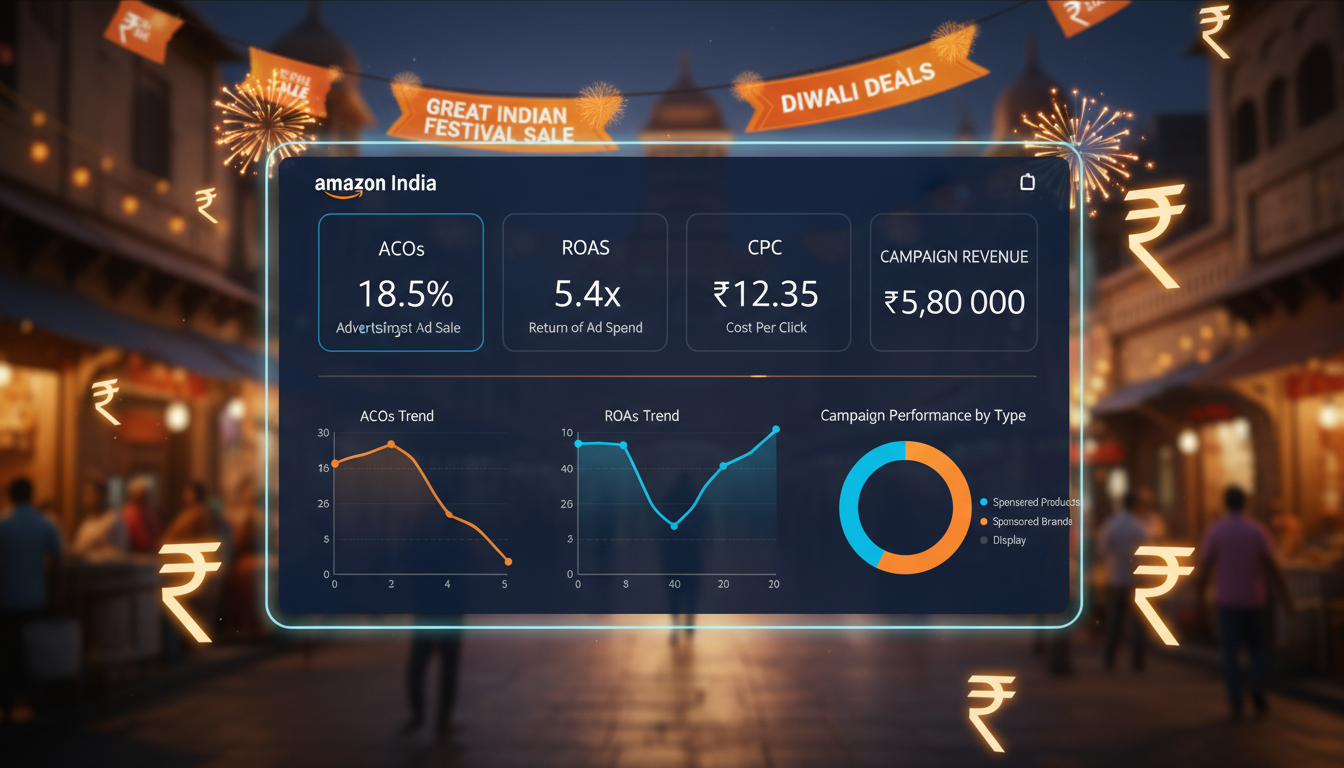
Indian brands on Amazon are leaving crores on the table — and most don't even know it.
Here's a number that should make every Amazon seller in India sit up: Amazon's global advertising revenue crossed $68.63 billion in 2025 — up 22% year-on-year. And India, with Amazon holding a 30–35% e-retail market share and over 100 million active customers, is one of the fastest-growing arenas in this ecosystem.
Yet most Indian D2C brands and FMCG sellers run their Amazon pay-per-click advertising on gut feel, outdated keyword lists, and a prayer. The result? Ballooning ACoS, invisible ROAS, and campaigns that chew through budgets without generating meaningful profit.
If you've ever wondered why your Amazon India advertisement costs keep climbing while sales stay flat, you're in the right place. This guide gives you 7 proven, step-by-step strategies to transform your Amazon ads India game — from smarter ad testing to AI-powered bid management — so you stop burning money and start building a scalable, profitable presence on the world's most powerful retail media platform.
Stop guessing. Start optimising. AdAstraa's AI runs 24/7 bid optimization so your Amazon ads India campaigns never waste another rupee.
Start Your Free Trial Today →
Why Amazon Advertising in India Is No Longer Optional
Let's be blunt: organic reach on Amazon India is dying. With millions of SKUs competing for the same search real estate, a listing without paid advertising is essentially invisible.
The numbers back this up. Average cost-per-click (CPC) on Amazon globally rose 15.5% year-over-year to $1.12 in 2025. In India, competitive categories like consumer electronics, beauty, and health supplements are seeing even steeper bid inflation as more brands pile into the auction. The window to build dominant ad presence at a low cost is closing — fast.
But here's the essential truth that separates winning brands from the rest: Amazon advertising PPC is not just about visibility — it's a profit lever. When structured correctly, Sponsored Products campaigns produce a 3x–5x ROAS. When managed poorly, they crater your margins and train Amazon's algorithm to show your listing to the wrong buyers.
The great news? The vast majority of Indian brands are still making elementary mistakes — which means a game-changing opportunity exists for those willing to be more strategic.
Strategy 1: Build a Campaign Structure That Separates Discovery from Profit
The single most powerful thing any Amazon India seller can do is stop running everything in one campaign. Blending auto-targeting with manual exact-match keywords in the same campaign is like mixing your testing budget with your profits — you can't see what's working.
The Auto-to-Manual Keyword Funnel
Start with automatic campaigns to let Amazon's algorithm discover which search terms your buyers actually use. Review your Search Term Report every 7 days. Any term generating a click-through rate above 0.35% and a conversion rate above 8% gets graduated into a manual exact-match campaign with an optimised bid.
This creates a self-reinforcing system: your auto campaigns keep feeding you fresh, high-intent keywords while your manual campaigns lock in profitability on proven winners. Brands using this architecture consistently achieve ACoS in the 22–28% range, well below the category average of 30.2%.
The Breakthrough Power of Negative Keywords
In the India market specifically, search behaviour is highly varied — buyers search in English, Hindi, and transliterated regional terms. This means your auto campaigns will attract a flood of irrelevant, non-converting clicks unless you're ruthless about negative keyword hygiene.
Block generic informational queries ("what is," "how to use," "review of"), competitor brand terms you don't want to pay for, and category-level broad terms that attract browsers rather than buyers. Every irrelevant click you eliminate is direct margin you reclaim. Learn more about structuring intelligent campaigns through our in-depth Amazon PPC guide.
Strategy 2: Use Systematic Ad Testing to Find Your Highest-Converting Creatives
Advertising testing isn't optional — it's the engine of every high-performing account. Yet most Indian sellers launch a single Sponsored Brands creative and leave it running for months, wondering why CTR is declining.
Amazon's own data shows AI-assisted creative testing produces up to 40% CTR improvement in controlled tests. The principle is straightforward: run at least two creative variants simultaneously, let the data run for a minimum of 14 days (or 1,000 impressions), then kill the underperformer and create a new challenger against the winner.
What to Test in Your Amazon India Advertisements
- Main product image — lifestyle vs. white-background vs. infographic-style
- Sponsored Brands headline copy — benefit-led vs. feature-led vs. social-proof-led
- Video ad thumbnails — human faces outperform product-only frames in most Indian categories
- Landing page destination — Store homepage vs. individual product page vs. custom landing page
- Bid placement modifiers — Top of Search vs. Rest of Search vs. Product Pages
For Indian brands launching during high-competition windows like the Great Indian Festival or Republic Day sales, having pre-tested creatives is not a nice-to-have — it is the difference between a profitable festive season and a cash-flow crisis. Explore how AI-generated creatives can accelerate this process with AdCreative+ by AdAstraa.
Strategy 3: Graduate Beyond Manual Bids with AI-Powered Automation
Here is the uncomfortable truth about manual bid management for Amazon ads India: you are always behind. Amazon's auction clears hundreds of times per second. Competitor bids shift by the hour. Manual adjustments made on Monday may be completely irrelevant by Thursday.
The brands dominating India's most competitive categories — beauty, FMCG, consumer electronics, and health supplements — are not winning because they have more time. They're winning because their bids adjust in real time, 24 hours a day, 7 days a week.
A Real-World Example: How Automated Bidding Changes the Game
Consider a mid-sized Indian FMCG brand selling protein supplements on Amazon India. They were manually managing bids across 12 campaigns — spending approximately 15 hours per week on adjustments. Their average ACoS was stuck at 38%, well above their 28% target.
After implementing 24/7 AI bid automation (the kind powered by AdAstraa's Autopilot engine), the system began suppressing bids during low-conversion hours (late night and early morning), scaling aggressively during peak purchase windows (7 PM–11 PM IST), and eliminating bids on non-converting keyword patterns entirely. Within 60 days, their ACoS dropped to 24% and their ROAS climbed to 4.2x — without any increase in total ad spend.
That's not an anomaly. It's what happens when machine-speed decision-making replaces human-speed adjustments in a real-time auction environment.

Ready to see what 24/7 AI bid optimization looks like for your Amazon India campaigns? Get real-time visibility into your True Profit per ASIN — starting today.
Book a Strategy Call with AdAstraa →Strategy 4: Target Buyer Intent — Not Just Search Volume — in Your PPC Campaigns
In Indian e-commerce, high search volume does not equal high purchase intent. A keyword like "protein powder" may attract millions of monthly searches — but a significant fraction of those searchers are researching, comparing, or simply browsing. The keyword "buy whey protein 1kg under 1500" signals unmistakable purchase intent.
The most sophisticated Amazon India advertisers segment their keyword strategy by intent tier:
| Intent Tier | Example Keyword | Recommended Match Type | Bid Strategy |
|---|---|---|---|
| High Intent (Buy-ready) | "buy whey protein 1kg" | Exact Match | Aggressive — top of search |
| Medium Intent (Comparison) | "best protein powder India" | Phrase Match | Moderate — rest of search |
| Low Intent (Research) | "what is whey protein" | Negative — exclude entirely | Zero spend |
This is exactly what AdAstraa's Shopper OS does at scale — mapping buyer intent signals across thousands of search terms to ensure your per-click advertising budget is concentrated exclusively on the moments most likely to convert into verified purchases.
Strategy 5: Set ACoS Targets by Product Lifecycle — Not One Number for Everything
One of the most essential mistakes we see Indian brands make is applying a single ACoS target across their entire catalogue. A new product launch needs a different ACoS tolerance than a mature, review-rich hero SKU. Conflating the two leads to either under-investment in launches (starving new products of visibility) or over-investment in mature products (eroding margin on your highest-volume ASINs).
Here is the proven framework:
- Launch Phase (0–90 days): Accept ACoS up to 50–60%. You are buying data, reviews, and rank — not immediate profit. Think of it as a guaranteed investment in long-term organic visibility.
- Growth Phase (90–180 days): Compress ACoS to 30–40% as you identify top-converting keywords and prune weak performers aggressively.
- Mature Phase (180+ days): Target 20–28% ACoS. At this stage, campaigns should be highly efficient, with the majority of spend locked into exact-match, high-converting keywords.
To see your True Profit per ASIN in real time — factoring in ad spend, FBA fees, returns, and COGS — you need more than Amazon's native reporting. AdAstraa's AI advertising platform delivers this level of profit-layer visibility as a standard feature, not an add-on.
Strategy 6: Build a Festive Season Advertising Playbook That Actually Works
Amazon India's Great Indian Festival — aligned with the Diwali season — is the single most important 10-day window of the year for most sellers. Customer intent is at its absolute peak. Traffic volumes explode. And so does CPC.
Most brands make the fatal error of waiting until 48 hours before the sale begins to ramp up campaigns. By then, CPCs have already spiked, campaign learning periods haven't completed, and competitor creatives are already dominating the most valuable ad placements.
The 30-Day Festive Advertising Countdown
- Day –30: Refresh listings, upload festival-specific main images and A+ content, confirm FBA inventory levels.
- Day –21: Launch new auto-targeting campaigns to harvest fresh festive search terms before auction competition peaks.
- Day –14: Begin A/B testing two creative variants for Sponsored Brands. Let data determine the winner before the sale begins.
- Day –7: Set budget caps at 2x–3x daily averages. Activate Top of Search bid multipliers (20–50%) on your highest-converting exact-match campaigns.
- Sale Days: Monitor hourly. Use dynamic bid automation to capture conversion surges — especially during the critical 7 PM–11 PM IST window when Indian shoppers are most active.
- Day +3: Run retargeting Sponsored Display campaigns to recapture high-intent browsers who viewed but didn't purchase during the peak window.
Brands that execute this 30-day playbook consistently outperform reactive competitors by 2x–3x on ROAS during India's festive season — turning the period of highest CPC into their most profitable quarter of the year.
Strategy 7: Measure True Profit, Not Just ROAS — The Must-Know Shift for Indian Brands
ROAS is a seductive but dangerously incomplete metric. A 4x ROAS looks impressive — until you account for FBA fees, return rates, GST, and the actual landed cost of your product. Many Indian brands with "strong" ROAS figures are, in reality, running at near-zero or negative net margin.
The most breakthrough shift you can make in your Amazon India advertising strategy is moving from ROAS-first to True Profit per ASIN as your north-star metric. This means:
- Factoring ad spend, FBA fees, referral fees, return rates, COGS, and storage costs into every campaign performance review.
- Pausing or restructuring any ASIN where ad-attributed revenue is positive but net contribution margin is negative.
- Reallocating budget from low-margin products to high-margin SKUs — even if absolute ROAS appears similar on the surface.
- Using TACoS (Total Advertising Cost of Sale, measuring ad spend against total brand sales) to understand the true halo effect of your advertising on organic performance.
"The brands that win on Amazon India long-term are not the ones with the highest ROAS. They're the ones who know their True Profit per ASIN and ruthlessly allocate capital to protect it."
AdAstraa's AI advertising strategies are built around this exact profit-first philosophy — giving Amazon India sellers an effortless, unified view of every rupee earned and every rupee spent across their entire catalogue.
Your Immediate Action Plan for Amazon Ads India
You now have the full picture. Let's make it instantly actionable. Here's where to start in the next 7 days:
- Audit your current campaigns — identify how many campaigns are blending auto and manual targeting, and separate them immediately.
- Pull your Search Term Report — find the top 10 non-converting terms eating your budget and add them as negatives today.
- Map your top 5 ASINs by lifecycle stage — launch, growth, or mature — and set a distinct ACoS target for each.
- Launch one creative A/B test on your highest-volume Sponsored Brands campaign.
- Calculate your True Profit per ASIN by pulling FBA fees and COGS against ad-attributed revenue for last 30 days.
These five actions alone will give you cleaner data, lower wasted spend, and a sharper picture of where your real profit is hiding — within a single week.
And once you're ready to scale beyond what manual management can achieve, AdAstraa's full-stack Amazon operating system handles the rest — automatically, intelligently, and relentlessly.
Additional Resources
Deepen your Amazon advertising knowledge with these authoritative external sources:
- Amazon Ads Official Marketing Optimization Guide — Amazon's own resource on A/B testing, audience optimization, and campaign efficiency best practices.
- Jungle Scout: The Ultimate Amazon Advertising Guide for Sellers — A comprehensive reference covering ad types, bidding strategies, and keyword management.
- Sequence Commerce: Amazon Advertising Statistics 2025 — Benchmark data on CPC, CTR, ACoS, and ROAS across categories for data-driven target-setting.
- SalesDuo: Amazon Advertising Benchmarks 2026 — Category-level CPC, ACoS, and ROAS benchmarks to pressure-test your campaign performance.
- MerchantSpring: India E-Commerce Marketplaces 2025 Report — Market share, GMV, and growth trend data for Amazon India and the broader Indian e-commerce ecosystem.
The Bottom Line on Amazon Ads India in 2025
Amazon advertising in India is simultaneously the most powerful growth engine and the most dangerous budget drain available to D2C brands and FMCG sellers today. The difference between these two outcomes comes down to one thing: intelligent, data-driven execution.
The brands winning on Amazon India right now are not spending more. They're spending smarter — with structured campaigns, systematic ad testing, AI-powered bid management, buyer intent intelligence, and a relentless focus on True Profit per ASIN rather than vanity metrics.
You now have the proven, step-by-step blueprint to join them. The strategies above are not theoretical — they are the exact operating principles embedded in the way AdAstraa was built, for Indian brands that refuse to let another rupee go to waste.
Ready to make every rupee of ad spend count?
Join hundreds of Amazon India brands using AdAstraa to lower ACoS, boost ROAS, and reclaim 15+ hours of manual management time every week.
Get Started with AdAstraa Free →