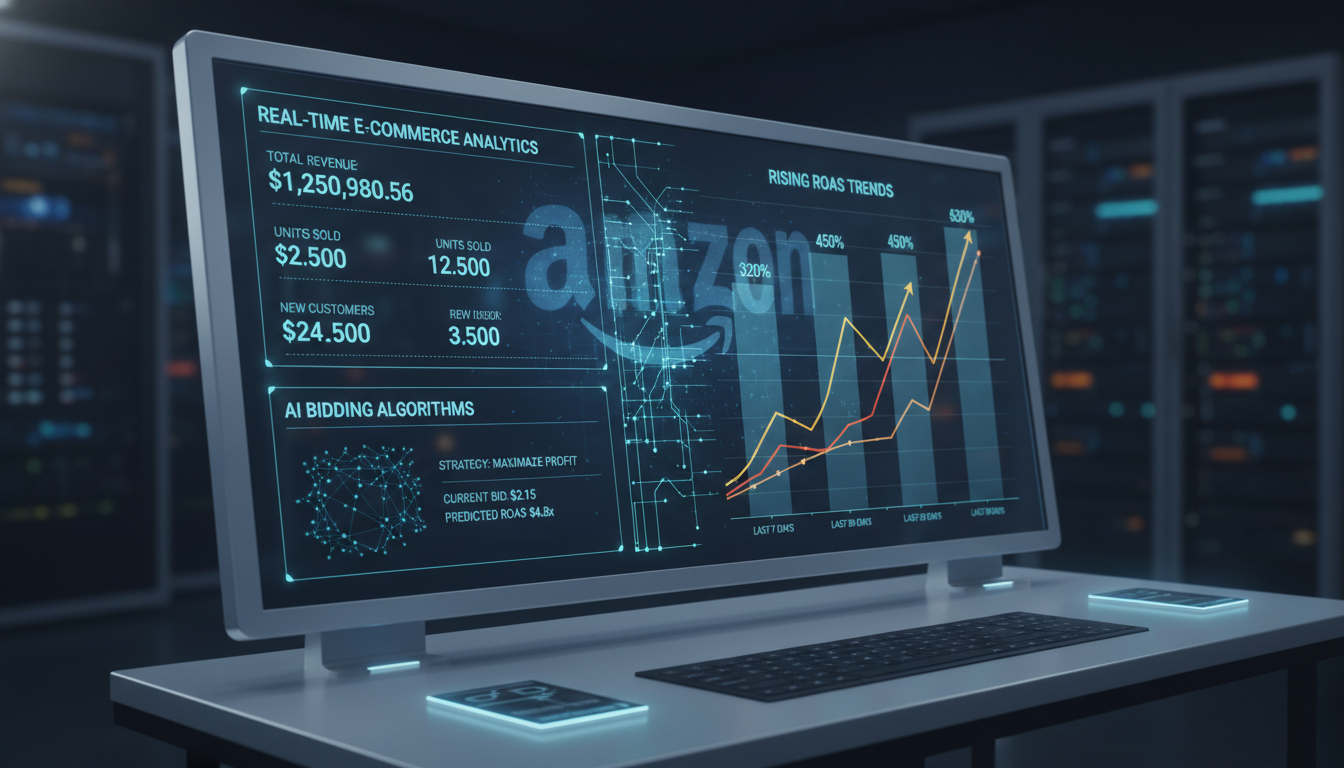
The New Era of Amazon Advertising: Navigating the Algorithmic Marketplace
The Amazon e-commerce landscape is undergoing a monumental paradigm shift. For years, digital storefronts could achieve sustainable growth through basic keyword targeting, manual bidding strategies, and routine product page adjustments. Today, however, the sheer volume of competitors, rising cost-per-click (CPC) rates, and increasingly complex customer journeys have made manual campaign management a bottleneck to growth. Modern e-commerce is highly saturated, and brands that rely solely on human-paced execution are quickly falling behind. Real-time marketplace fluctuations require real-time decisions, a feat that is humanly impossible without leveraging advanced ai advertising and marketing automation tools.
Amazon remains a premier hub for conversion-focused marketing. According to the Sequence Commerce e-commerce performance research, Amazon's average advertising conversion rate of approximately 9.96% is roughly seven to eight times higher than the typical e-commerce conversion rate of 1.33% found on standard external platforms. This hyper-focused purchase intent represents a massive opportunity, but it also triggers relentless competition. To capture this intent efficiently without bleeding capital, professional sellers are turning to sophisticated ai advertising tools, ppc software, and comprehensive ad automation platforms. Using artificial intelligence ads and algorithmic campaign structures is no longer an optional strategy for luxury brands—it is an absolute operational necessity for any merchant aiming to scale.
By transitioning to an integrated approach with AdAstraa's AI-driven operating system, Amazon-first brands, FMCG conglomerates, and marketing agencies can streamline their workflows, lower Advertising Cost of Sales (ACoS), and dramatically elevate Return on Ad Spend (ROAS). In this definitive guide, we will unpack the strategic blueprint of marketing with ai, showing you exactly how to structure campaigns, automate bid changes, design compelling ad creatives, and analyze performance to secure your market share.

Why Manual Amazon PPC Management is Failing Modern Brands
To fully appreciate the impact of ai in ads, one must first understand the structural shortcomings of the traditional manual amazon ppc advertising framework. Historically, a brand manager or digital agency representative would log into Seller Central or an outdated ad software dashboard several times a week to review keyword performances. Based on static reports, they would make broad adjustments: increasing the bids on high-performing terms, decreasing the bids on poor-performing ones, and manually harvesting search terms to add to exact match ad campaigns. This human-led cycle introduces severe systemic flaws:
- The Speed Bottleneck: Amazon’s ad auction operates continuously. Bid requirements fluctuate hourly based on search density, inventory availability, competitor stockouts, and regional buyer activity. Manual adjustments happen on a weekly or daily schedule, meaning your campaigns are bidding sub-optimally for the vast majority of the day.
- Data Siloing and Human Bias: Human operators struggle to process multi-variable datasets simultaneously. They might lower a bid on a keyword with a temporarily high ACoS, failing to recognize that this specific keyword acts as an essential first-touch discovery point in the consumer journey that eventually drives highly profitable organic and brand-affinity conversions.
- Wasted Ad Spend (Bleeding Budgets): Identifying non-converting keywords manually is a slow process. A bad-fit search term can easily accumulate dozens of clicks and drain hundreds of dollars before an operator notices and marks it as negative. This delayed action dramatically inflates your blended ACoS.
- Bid Fatigue and Scale Caps: Managing an amazon ads campaign with hundreds or thousands of ASINs requires monitoring tens of thousands of active keywords. This leads to operational paralysis, where teams only optimize the top 20% of high-volume keywords and completely ignore the long-tail terms that hold massive potential for high conversion rates.
To overcome these systemic issues, brands must move away from archaic ppc campaign management software that merely displays data, and instead adopt a fully automated ads ecosystem. An intelligent amazon ppc tool does not sleep. It constantly monitors and updates bids every hour of the day, using predictive statistical models to calculate the probability of conversion for every individual impression opportunity.
The Core Pillars of a Modern AI Advertising Architecture
To build a high-performing e-commerce marketing engine, you need more than just a single-point software. True success is realized through an all in one advertising platform that integrates and orchestrates four vital pillars: bidding intelligence, buyer intent parsing, creative generation, and backend business analytics. Let us explore each of these pillars in depth.
1. Dynamic 24/7 Bid Optimization (The Autopilot Engine)
The foundation of any superior amazon ads automation strategy is a real-time, algorithmic bid engine. Rather than relying on rigid if-this-then-that rule sets, which often break when market trends shift, a modern amazon ppc ai uses machine learning models to analyze multi-dimensional historical data. The software evaluates keyword relevance, dynamic conversion trends, historical conversion rates by hour of day, and current inventory levels. This enables the amazon ppc software to dynamically adjust your bids on the fly. If a product's stock drops, or if conversion rates decrease during specific low-intent hours, the algorithm instantly dials back bids to protect your margin. Conversely, during high-intent peaks, it aggressively adjusts bids to capture top of search visibility and win market share.
2. Buyer Intent Intelligence (Understanding the Shopper Journey)
Successful amazon advertising management requires an intimate understanding of the shopper's mindset. Modern marketing automation using ai allows brands to unlock granular audience intelligence that goes far beyond standard search volume. Intelligent platforms utilize buyer intent frameworks, like Shopper OS, to analyze the precise digital breadcrumbs that customers leave behind. By mapping user behavior, repeating purchase patterns, and cross-channel searches, the platform groups target audiences into precise categories. It identifies exactly when a buyer transitions from browsing to actively comparing products, allowing you to serve the perfect ad format—such as Sponsored Products, Sponsored Brands, or Sponsored Display—with absolute precision.
3. AI-Generated Ad Creatives (The Design Revolution)
Historically, the biggest bottleneck in executing high-frequency ai marketing strategies was the creative team. Producing rich lifestyle images, custom product variations, and engaging video ads for dozens of ASINs required massive budgets and long turnaround times. Modern ai powered ad creative has completely transformed this workflow. By utilizing an advanced ai ad generator or an ai advertisement generator like AdCreative+, brands can automatically transform flat product listings into jaw-dropping, high-converting promotional banners and video creatives. These ai tools for advertising generate dozens of creative variants optimized for CTR, enabling continuous A/B testing without requiring a dedicated graphic design team. This rapid cycle of testing and iteration ensures your amazon advertising strategy remains visually compelling and fresh.
4. True Profit Visibility & Deep Analytics
A major pitfall discussed in contemporary e-commerce circles is the dangerous reliance on vanity metrics. In the industry podcast "The PPC Den" hosted by Ad Badger, experts stress that high ROAS and low ACoS are completely meaningless if they do not result in real, bottom-line business profitability. A keyword might look highly profitable on paper, but when you factor in Amazon's FBA fees, return rates, referral cuts, and storage overhead, the actual product margin might be razor-thin or negative. An advanced marketing analytics ai integrates directly with your financial ledger to calculate "True Profit per ASIN." This ensures that your campaign management tools optimize your bids not just to drive more revenue, but to maximize your actual cash-in-hand profit margins.
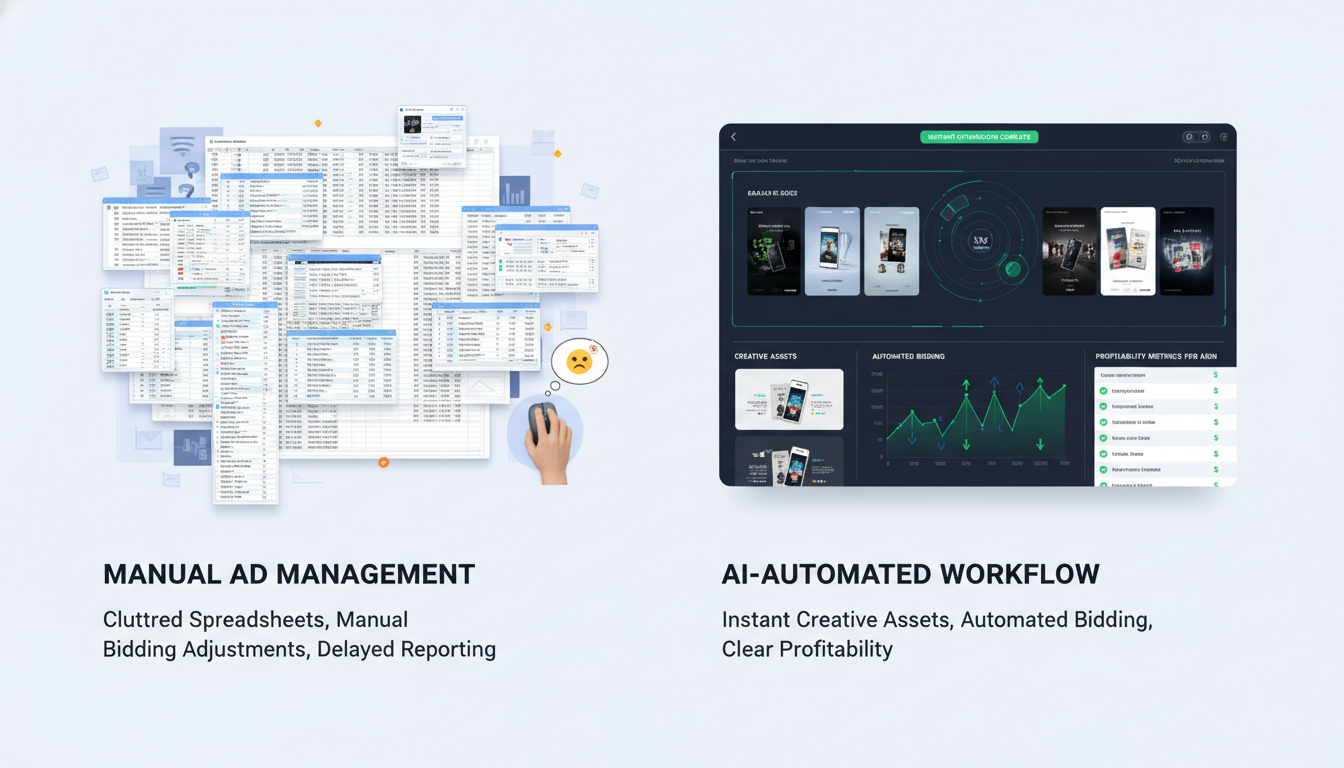
Comparing Traditional Manual Management vs. Modern AI-Driven Automation
To help visualize the tangible differences between these two methodologies, let us evaluate the key administrative and operational metrics that define e-commerce advertising success:
Step-by-Step Strategic Blueprint for Implementing AI Ads
Transitioning from a legacy setup to an automated marketing management platform might seem daunting, but following a structured roadmap guarantees a seamless onboarding experience with immediate optimization results. Here is the operational blueprint utilized by elite Amazon-first brands:
Phase 1: Deep Diagnostic Audit & Baseline Definition
Before launching any new amazon advertising campaign, you must establish an accurate baseline. Connect your Seller Central account to your chosen amazon ppc automation software. Let the analytical algorithms scan your trailing 60-day history. This diagnostic audit will instantly uncover hidden issues: finding long-tail keywords that have spent hundreds of dollars without a sale, detecting bidding conflicts where your own campaigns are bidding against each other, and mapping your current conversion rates across different times of day. This creates a data-grounded benchmark for conversion rate (CVR), click-through rate (CTR), and true profitability per product line.
Phase 2: Establishing Smart Guardrails and Bid Bounds
One of the biggest misconceptions about the decision to automate amazon advertising is that you must hand over absolute control and let the algorithms run completely unmonitored. On the contrary, the best ppc software tools provide users with the flexibility to set smart parameters. Brands can establish boundaries to protect their bottom lines:
- Target ACoS and ROAS Constraints: Specify the exact performance boundaries for each product tier. For high-margin, newly launched items, you can allow a higher target ACoS to aggressively gain organic keyword ranking. For mature, steady-state items, you can set a highly conservative, profit-maximizing ACoS target.
- Daily and Portfolio Budgets: Establish hard-capped boundaries to prevent sudden spending spikes during seasonal shopping events or holiday rushes.
- Key-Value Bid Limits: Set maximum cost-per-click thresholds for highly competitive terms, ensuring you never pay more than a sensible amount per click.
Phase 3: Automated Ad Creation and Continuous Asset Optimization
Once your bidding structures and guardrails are firmly in place, it is time to upgrade your creative strategy. Deploy an intelligent ad creator ai or ai ads creator to build highly compelling Sponsored Brands and Sponsored Display banners. Feeding these generators with high-quality source product photos allows them to automatically output multiple visual asset variants. The system can run these design variations through live creative testing, automatically allocating dynamic ad budgets to the specific visual combinations that produce the highest engagement and purchase intent. This is the cornerstone of ai based advertising—using continuous performance feedback to shape both target placement and creative delivery simultaneously.
Phase 4: Algorithmic Search Term Harvesting and Negating
With campaign architectures live, the amazon ppc automation tool begins its ongoing, systematic maintenance cycles. The AI system runs a perpetual research-peel-and-stick loop: it monitors broad and auto campaigns for high-intent, converting search queries, harvests them, and escalates them to exact match keyword campaigns with optimized custom bids. Concurrently, it tracks poorly performing queries and instantly flags them as negative matches. This ongoing loop reduces waste, boosts keyword relevance scores, and allows your marketing optimization tools to reinvest freed-up capital into highly profitable, converting sales avenues.
Advanced AI Marketing Strategies to Maximize Profitability
When executing an advanced amazon advertising strategy, simply automating bid changes is not enough to maintain a competitive advantage. Elite sellers utilize sophisticated, high-level marketing strategies to squeeze every drop of margin from their ad spend. Let us review three advanced frameworks:
1. Dynamic Dayparting & Hourly Bidding
Consumer behavior on Amazon fluctuates wildly throughout the course of a day. Conversion rates are typically highest during midday and early evening hours, while late-night and early-morning clicks are often low-intent browsing sessions that result in high ad spend with minimal sales. Traditional campaign tools only allow you to set daily budgets, which are frequently depleted by midday by low-value clicks. In contrast, an advanced ai ppc management engine executes dynamic dayparting. The algorithm automatically increases bids during your product's historically high-converting hours and lowers bids during low-converting hours, ensuring your capital is focused where it delivers the highest return.
2. Cross-Channel Audience Mapping & DSP Sync
An elite ai advertising platform does not operate in an Amazon-only silo. It syncs with external search platforms and social channels to execute highly advanced retargeting strategies. For example, if a potential buyer browses your product on Amazon but leaves without purchasing, your ai software for marketing can pass this intent data directly to the Amazon Demand-Side Platform (DSP) or external channels. This allows you to serve highly dynamic retargeting ads to that exact buyer as they browse external websites, seamlessly guiding them back to complete their purchase on Amazon. This omnichannel orchestration delivers a massive boost to customer lifetime value (LTV).
3. Aligning Ad Automation with Inventory Diagnostics
One of the most painful experiences for an Amazon seller is running out of stock on a top-performing ASIN. A stockout instantly ruins your search rankings, degrades your organic keyword performance, and costs thousands of dollars in lost momentum. Manual management teams rarely sync their ad campaigns with real-time warehouse data, meaning ads continue to run at full speed until the moment stock hits zero. An integrated ppc optimization software connects directly to your inventory management system. If stock levels drop below a critical threshold and logistics shipments are delayed, the AI-driven system automatically tempers your ad velocity. By scaling back bids and pulling back aggressive placements, the software stretches your remaining stock to avoid a total stockout while preserving your valuable organic rankings.
The Measurable Impact of AI Advertising
Implementing ai marketing strategies and automated tools is not just about adopting modern trends; it is about driving concrete, measurable results that directly impact your company’s financial bottom line. This is especially true given the current performance benchmarks across the broader e-commerce landscape.
Recent platform data highlights how crucial automated optimization is for scaling profitably. In Triple Whale’s latest Amazon Ads benchmarks, modern performance data reveals that the average ecommerce ROAS climbed +10.16% to 3.14, and CVR improved +9.97% to 11.02%, reflecting a convergence of declining acquisition costs and improving returns for brands that optimize their funnels effectively. This illustrates that brands using intelligent optimization tools can easily outpace industry averages by aligning their ad spend with real-time intent data.
When brands adopt dedicated amazon ppc automation software, they consistently experience significant, quantifiable improvements across their entire business operations:
- Reduced Operational Overhead: E-commerce brands and agencies save an average of 15 to 25 hours per week of tedious spreadsheet work. This allows team members to pivot their focus from manual data entry to higher-level creative strategy, product development, and marketplace expansion.
- Drastic ACoS Reductions: By instantly identifying and eliminating non-converting search terms, brands typically see a 15% to 30% reduction in ad spend waste within the first 30 days of implementing automation. This immediately lowers their blended ACoS.
- Increased Organic Ranking and Market Share: Winning the Amazon buy box is heavily dependent on maintaining high conversion rates. Because AI systems continuously optimize bidding to target only high-converting traffic, your listing's conversion rate increases. Amazon’s organic algorithm rewards this positive feedback loop by elevating your organic product rankings, driving "free" traffic and sales.
Strategic Case Insight: Reclaiming Manual Management Hours
"Moving our catalog of over 250 SKUs to an automated advertising platform saved our team over 22 hours of tedious spreadsheet work every single week. Instead of constantly guessing bid changes, we now let the AI handle dynamic bidding, while our team focuses on design, brand storytelling, and launching new product lines. Our sales grew by 35% in three months, and our actual ACoS decreased by 6 percentage points." — Amazon FMCG Brand Director
Selecting the Best Amazon PPC Automation Software
With a wide variety of amazon ppc management tools and SaaS platforms on the market, choosing the right solution requires careful evaluation of your specific catalog size, management structure, and operational requirements. When researching potential partners, look for these critical differentiators:
- True Multi-Variable Machine Learning: Avoid platforms that rely on simple, basic rule builders. Ensure the software utilizes advanced machine learning algorithms capable of processing multi-variable inputs, such as inventory levels, time-of-day trends, and competitor pricing, to calculate optimal bids.
- All-In-One Unified Ecosystem: A fragmented tech stack is a recipe for operational inefficiency. Look for a comprehensive, all in one advertising platform that integrates bid optimization, intent mapping, creative asset creation, and financial ledger data.
- Deep Ledger Financial Integration: Ensure the software integrates directly with your Amazon financial ledger. To truly optimize your business, your automation tools must have access to real product costs, storage fees, and overhead, allowing them to optimize for true net profitability per ASIN.
- User-Friendly Controls: The ideal software should be incredibly easy to navigate. It should offer clean dashboards, fast set-up paths, and transparent reporting interfaces that keep your team fully informed without overwhelming them.
Conclusion: Unlock Your Brand's Full Growth Potential
The days of manually managing Amazon campaigns with clunky spreadsheets and static rule-sets are gone. To scale effectively in today's ultra-competitive e-commerce landscape, brands must adopt an agile, algorithmic approach. Implementing advanced ai marketing software and dynamic ad creators enables you to continuously optimize your bidding, maximize your conversion rates, and build beautiful, high-converting ad assets in seconds.
By shifting from manual oversight to automated workflows, you do not just lower your ACoS and boost your ROAS—you reclaim valuable hours of strategic focus. This allows your team to stop worrying about day-to-day bids and start focusing on what truly matters: growing your brand, launching new products, and building deep customer relationships.
Are you ready to stop wasting ad spend and reclaim your manual management hours? Explore AdAstraa’s AI-powered operating system to find out how our purpose-built suite of tools—including Autopilot bid optimization, Shopper OS intent mapping, and AdCreative+ asset generation—can help your business scale profitably on Amazon today.