
The New Era of E-Commerce Advertising: Overcoming the Amazon Complexity Wall
For high-volume Amazon sellers, brand managers, and digital agencies, executing a profitable amazon advertising campaign has transformed from a straightforward keyword bid game into a highly volatile, multi-variable challenge. Daily ad budgets evaporate on non-converting terms, aggressive competitor bidding drives cost-per-click (CPC) rates to unsustainable heights, and keeping up with the structural intricacies of Sponsored Products, Sponsored Brands, and Sponsored Display requires dozens of manual management hours every single week.
Relying on traditional manual workflows or simple, rule-based campaign management tools is no longer viable. To scale profitably in a crowded market, modern brand builders must transition to high-performance ai advertising. By incorporating artificial intelligence ads into their overall e-commerce playbook, brands can automate complex decision-making, optimize placements 24/7, and protect their margins from rising ad costs. This comprehensive guide outlines how next-generation ai and advertising strategies empower brands to reclaim control of their ad spend, lower their Advertising Cost of Sales (ACoS), and drive sustainable growth.
Why Legacy Amazon PPC Management Tools Fall Short in Modern E-Commerce
Historically, brands utilized basic ppc software and rule-based ad software to scale their advertising efforts. These systems rely on strict, pre-programmed "if-then" logic. For example, a user might write a rule stating: "If a keyword's ACoS exceeds 35% over a 14-day window, reduce the bid by 10%." While this rule-based approach was a step up from manual spreadsheet uploads, it has severe limitations when faced with the modern dynamics of amazon ppc advertising.
The Structural Limitations of Rule-Based Automation
Rule-based advertising software suffers from several fatal flaws in today’s hyper-competitive marketplace:
- Reactive, Not Proactive: Rules only execute after waste has already occurred. They look backward at historical data rather than predicting conversion probability in real time.
- Inability to Handle Seasonality: During critical traffic spikes like Prime Day, Black Friday, or category-specific seasonal surges, legacy rules can prematurely throttle bids, causing brands to lose massive search placement advantages to more agile competitors.
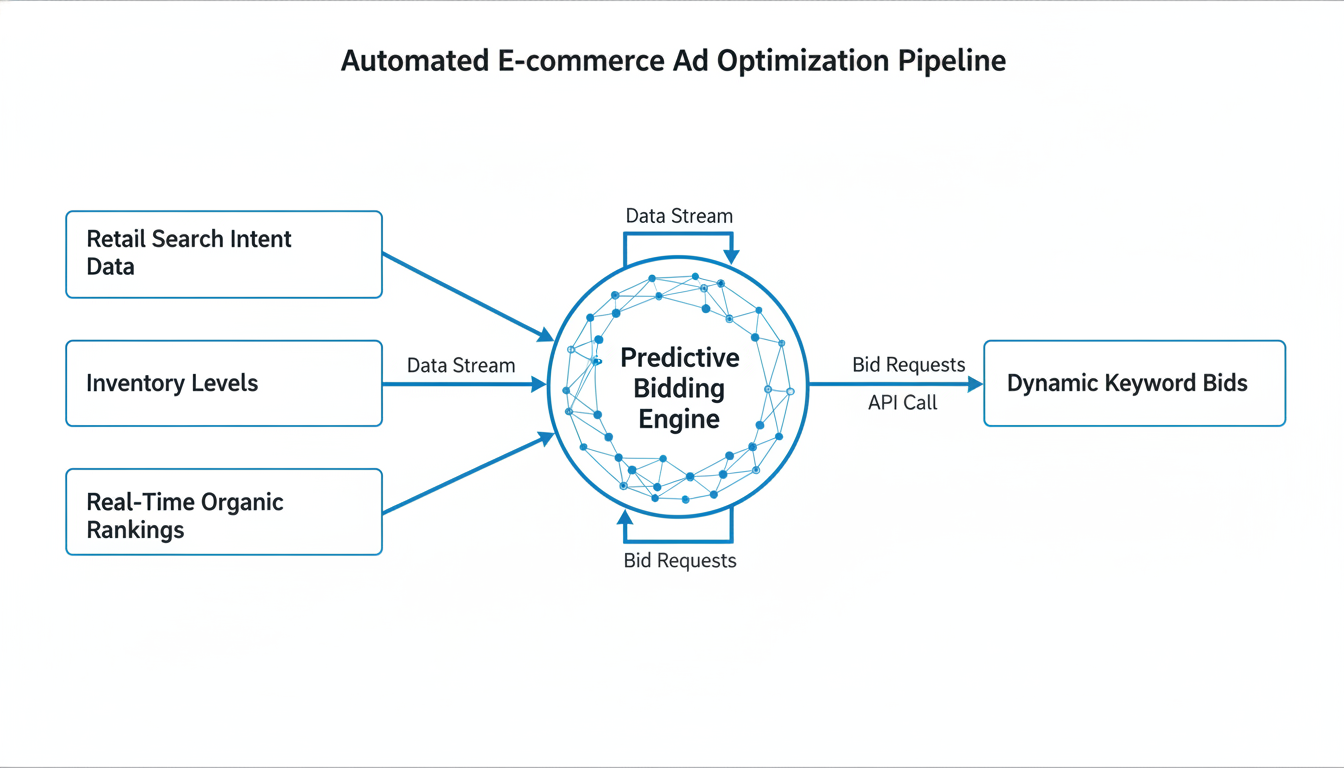
- Lack of Cross-Channel Context: Traditional rule-based software operates in a silo. It cannot connect changes in ad performance to real-time inventory levels, buy box suppression, or organic search rankings.
The Shift to AI-Powered Predictive Machine Learning
In contrast to static rules, an advanced ai advertising platform leverages deep learning models to predict bid outcomes before they occur. By continuously analyzing millions of data points—including historical click-through rates (CTR), conversion rates (CVR) by the hour, historical seasonal surges, and real-time competitor density—amazon ppc ai systems adjust bids dynamically.
Instead of waiting for a 14-day cycle to complete, ai ppc management tools anticipate performance dips, automatically allocating your budget toward the highest-converting hours of the day while scaling back during low-intent periods. This approach, known as algorithmic dayparting, transforms passive campaign tracking into active, profit-focused asset optimization.
Harnessing Amazon PPC AI for Predictive Bidding & Workflow Automation
To scale an amazon advertising strategy across hundreds or thousands of ASINs, brands must deploy automation that handles both tactical micro-adjustments and macro-level budget allocation. Transitioning from legacy rule systems to a modern, AI-powered Amazon advertising operating system unlocks three foundational pillars of automation:
1. 24/7 Algorithmic Bid Optimization
In the Amazon auction, keyword value fluctuates constantly. Factors such as consumer browsing habits, competitor budget exhaustion, and time-of-day dynamics mean that a $1.50 bid might be highly profitable at 2:00 PM but completely wasteful at 2:00 AM. A specialized amazon ppc automation tool monitors these hourly trends, implementing high-frequency bidding updates that humans cannot replicate. By executing continuous bid adjustments, the ppc ai platform keeps your listings in the top-of-search placements when conversion probability peaks, and automatically dials down spend during off-peak hours.
2. Dynamic Search Term Harvesting and Isolation
One of the most tedious tasks in amazon advertising management is keyword research and negative targeting. A sophisticated amazon ppc automation software platform automates this entire pipeline. It continuously scans your automatic, broad, and phrase-match campaigns to isolate top-performing search terms. Once identified, these high-converting terms are immediately promoted to exact match targets in your scaling campaigns. Concurrently, the amazon ppc tool adds them as negative matches in the origin campaign to eliminate duplicate bidding and budget cannibalization. This systematic isolation ensures that every dollar spent is directed toward highly precise search queries.
3. Multi-Touch Budget Allocation and Portfolio Management
Managing budgets across Sponsored Products, Sponsored Brands, and Sponsored Display requires balanced coordination. Too often, high-performing exact match campaigns run out of budget by midday, while lower-funnel discovery campaigns slowly drain resources. An all in one advertising platform solves this by dynamically shifting funds across your portfolio based on real-time ROAS. If a primary Sponsored Product campaign is converting rapidly, the system instantly reallocates unused funds from secondary campaigns, ensuring your top-converting products remain active and visible throughout the day.
Technical Comparison: Rule-Based Systems vs. AI Predictive Bidding
To understand why leading FMCG brands and D2C sellers are migrating away from legacy tools, it is helpful to look at how different architectures handle common advertising challenges:
| Optimization Vector | Traditional Rule-Based Software | AI-Powered Predictive Platform |
|---|---|---|
| Bidding Adjustments | Executes once daily or weekly based on basic retrospective rule blocks. | Calculates real-time conversion probability and adjusts bids 24/7. |
| Keyword Harvesting | Manual search term report downloads and spreadsheet uploads. | Automated real-time search term isolation and negative placement. |
| Dayparting (Hourly Bid Shifts) | Static pre-scheduled bid multipliers that do not adjust for live trends. | Dynamic hourly optimization aligned with consumer purchase intent. |
| Inventory Integration | Unlinked; ads keep running even if inventory is depleted, risking buy-box loss. | Monitors stock status and automatically pauses ads before stockouts occur. |
| Creative Asset Management | Requires manual uploads, static graphic designs, and manual A/B testing. | Algorithmic creative testing with automated variant generation. |

The Creative Frontier: Leveraging AI for High-Converting Ad Visuals
While bidding algorithms and keyword placement are critical components of a successful amazon advertising strategy, creative assets have increasingly become the deciding factor in ad relevance and click-through rates. In the past, creating lifestyle images, custom headlines, and engaging video assets required extensive graphic design support, resulting in slow production times and high operational costs. This creative bottleneck often led to "creative fatigue," where ad performance deteriorated because shoppers grew accustomed to seeing the same static banners.
Scaling Asset Production with an AI Ad Generator
Using a specialized ai ad generator or ai ads creator, brands can now generate hundreds of high-quality, conversion-focused creative variants in minutes. These advanced systems study your core product images, strip away basic studio backgrounds, and generate hyper-realistic lifestyle settings that appeal directly to target demographics. Whether you need an outdoor theme for a sports drink or a warm, clean kitchen setting for a culinary tool, an ai advertisement generator produces tailored backgrounds that seamlessly match your branding guidelines.
This rapid production process is particularly critical for Sponsored Brands and Sponsored Display placements, where visual distinction is paramount. Utilizing an AI-powered creative optimization engine allows marketing teams to rapidly test multiple combinations of custom copy, product angles, and background imagery. The platform automatically tracks which variations yield the highest click-through and conversion rates, shifting ad delivery toward top-performing combinations in real time.
Enhancing Creative Relevance with Intent-Driven Copy
Beyond visual imagery, an ai ad creator helps write optimized headlines and calls-to-action. By analyzing top customer reviews, question-and-answer sections, and trending search terms, the system writes ad copy that addresses consumer concerns, highlights core selling points, and complies with Amazon’s advertising policies. Combining high-performance visual generation with targeted copy creates highly relevant, ai powered ad creative assets that stand out in crowded search engine results pages (SERPs).
Deploying a High-ROAS Amazon Advertising Strategy: A Step-by-Step Playbook
To successfully transition your brand to automated advertising, it is helpful to structure campaigns around a multi-funnel framework. According to recent data on Amazon Advertising Benchmarks, typical conversion rates and target ACoS vary dramatically by category and stage of product maturity. This underscores why a dynamic, automated approach is vital for achieving sustainable ROI.
A balanced, automated campaign structure involves several key stages:
Stage 1: Launch and Discovery (Awareness)
When launching a new ASIN, your initial objective is keyword discovery and rapid indexing. Deploy automated auto and broad-match campaigns with moderately aggressive bidding to gather indexing data. During this stage, your automated ppc software tools gather search term volume and consumer response trends. The AI system rapidly compiles keyword performance data to identify high-potential terms while negative-targeting non-converting terms to prevent wasted spend.
Stage 2: Mid-Funnel Scaling and Consolidation (Consideration)
Once your initial data is established, the AI transitions your top search terms into phrase and exact match campaigns. This phase relies on a specialized buyer intent intelligence platform to segment shoppers based on high-intent search velocity and cross-channel purchasing signals. By targeting consumers who have previously viewed your category but have not yet purchased, you capture high-converting, mid-funnel traffic, helping you steal market share from slower competitors.
Stage 3: Defensive Brand Protection and Category Dominance (Purchase)
Do not let competitors hijack your product detail pages. Allocate a portion of your automated budget to branded keyword defense and product targeting campaigns on your own ASINs. This ensures your detail pages are protected by your own complementary products, maximizing average order value (AOV) and preventing customer leakage to competing listings. At the same time, the AI system dynamically cross-references your current inventory levels, instantly pausing aggressive bidding on low-stock items to prevent buy-box suppression.
Maximizing True Profitability with Advanced Marketing Analytics
Too many brands fall into the trap of analyzing ad performance in a vacuum. A campaign might boast an impressive 4x ROAS on paper, but if high return rates, steep Amazon fulfillment fees, and coupon deductions are eroding your margins, those ad sales may actually be unprofitable. This is where marketing analytics ai and automated profit tracking become indispensable.
An intelligent marketing management platform integrates advertising metrics directly with retail performance data, evaluating "True Profit per ASIN." This advanced analysis takes into account:
- FBA and Referral Fees: Factoring in weight-based fulfillment fees and Amazon referral percentages.
- Organic vs. Paid Share of Voice (SoV): Understanding how ad spend influences your organic search rankings.
- Total Advertising Cost of Sales (TACoS): Monitoring how your overall ad spend impacts total revenue (both paid and organic) to ensure long-term, organic growth.
- Promotional and Coupon Reductions: Tracking how discounts and coupons interact with ad conversion rates.
By connecting these metrics, the automated system ensures you do not waste money promoting products with tight margins. If profit margins drop on a specific ASIN due to a supply chain spike or a retail price change, the ai ppc management engine automatically scales back ad spend on that product, reallocating the budget to your most profitable catalog items.
Future-Proofing Your Brand with AI Advertising Platform Integration
The Amazon ecosystem is evolving rapidly. With Amazon's own rollout of Amazon generative AI ad solutions, the barriers to basic automation are disappearing. In this environment, generic bidding strategies and basic software tools are no longer enough to win top-of-search placements. The brands that dominate the market will be those that integrate specialized, high-performance systems capable of linking real-time bidding, deep buyer intent intelligence, and dynamic creative generation into a unified workflow.
By deploying a comprehensive, ai based marketing automation platform, you free up valuable marketing hours and make objective, data-driven decisions that protect your bottom line. Transitioning to smart ad management allows you to stop worrying about manual bid adjustments and focus on what really matters: developing great products, optimizing your supply chain, and growing your business.